A newly documented hoard of Roman Republican silver denarii found near Halle, Saxony-Anhalt, offers rare evidence for early contact and exchange between the Roman Republic and communities beyond its northern frontier
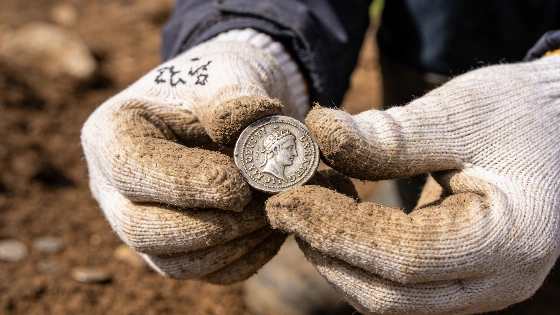
Archaeologists in Saxony-Anhalt have identified the region's first securely documented hoard of Roman Republican silver denarii, providing new material evidence for early interactions between the Roman Republic and societies north of its borders. The coins, discovered in 2025 near Halle (Saale) by a volunteer archaeologist, were recovered under the supervision of the State Office for Heritage Management and Archaeology Saxony-Anhalt. This find adds to a growing body of evidence for long-distance connections in Central Europe during the late first millennium BCE.
The Hoard and Its Context
The hoard consists of five silver denarii, with one coin minted in 148 BCE and the remaining four struck between 82 and 79 BCE. The coins were likely deposited together, possibly in a small purse or container, before being dispersed by later agricultural activity or natural processes. Prior to this discovery, only 19 Republican coins had been recorded in Saxony-Anhalt, almost all as isolated finds or from historical collections, making this the first confirmed hoard of its kind in the region.
All five coins show significant wear, indicating they circulated for decades before arriving in what is now eastern Germany. Four of the coins were produced within a narrow time frame, and three are serrati-denarii with distinctive serrated edges. The function of this serration remains debated, with hypotheses ranging from anti-counterfeiting measures to decorative intent. Two of the serrati also bear ancient graffiti, a rare feature that adds to the hoard's archaeological value.
Regional Patterns and Exchange Networks
Republican silver coins are more commonly found in neighboring Thuringia and Lower Saxony, but become increasingly rare further northeast. Only a handful of comparable hoards have been documented in Brandenburg and Mecklenburg-Western Pomerania. The Halle hoard's composition and wear suggest it reached the region around the beginning of the first century CE, before Imperial coinage became widespread. The absence of later coins supports this interpretation, though researchers caution that the evidence remains circumstantial.
During this period, there was no established monetary economy in Saxony-Anhalt. Instead, silver denarii likely functioned as objects of material value and social prestige rather than as circulating currency. The coins may have arrived through trade, diplomatic gifts, military payments, or exchanges among Germanic communities. Roman military campaigns led by Drusus, Ahenobarbus, and Tiberius in the late first century BCE and early first century CE have left a trail of coin finds across Central Germany, with intervals corresponding to a day's march for Roman armies. Recent discoveries of Roman marching camps in Saxony-Anhalt further highlight the region's role in cross-border interactions, though these sites are generally associated with later campaigns.
Interpreting the Evidence
The five-coin hoard provides a rare opportunity to examine the movement of Roman silver beyond the Empire's frontiers. The presence of ancient graffiti on two coins is particularly notable, as it may reflect individual or group practices related to ownership or value. While Roman historian Tacitus claimed that Germanic peoples favored serrated denarii, archaeological evidence for this preference remains limited. The coins' extensive wear and lack of later Imperial issues suggest they entered the region before Roman coinage became a regular feature of local exchange.
Researchers emphasize that the coins' archaeological context is critical for interpretation. Unlike isolated finds or objects from old collections, a securely documented hoard allows for more precise analysis of deposition, movement, and post-depositional processes. The discovery also contributes to broader debates about the nature of contact between the Roman world and communities beyond its borders, complementing evidence from other regions such as the early Roman-linked burials in Britain described in recent research on Iron Age cemeteries.
Material Evidence and Uncertainty
The small size of the hoard-just five coins-limits the scope of interpretation, but its secure recovery and detailed documentation make it a valuable addition to the archaeological record. The coins' wear, graffiti, and chronological clustering provide multiple lines of evidence for their movement and use. However, the precise mechanisms by which Roman silver reached Saxony-Anhalt remain uncertain, and the absence of associated settlement or burial features at the findspot constrains further analysis. Ongoing research may clarify whether such hoards represent isolated events or part of broader patterns of exchange and contact.
Numismatic evidence, such as the Halle hoard, is a key resource for reconstructing ancient exchange networks, but its interpretive value depends on secure archaeological context. Coins found in situ, with clear documentation of their recovery and association, allow researchers to distinguish between primary deposition and later disturbance. In contrast, coins from old collections or the antiquities market often lack the contextual information needed for robust historical analysis. The careful recovery and reporting of the Saxony-Anhalt hoard set a standard for future discoveries in the region and beyond.
Understanding the significance of coin hoards in archaeology requires attention to both their material properties and their depositional context. Coins can be dated precisely through inscriptions and typology, but their archaeological value is greatest when their find circumstances are well documented. Securely provenanced hoards provide insight into patterns of movement, exchange, and cultural contact that isolated finds cannot match. The Halle discovery demonstrates how even a small group of coins, when properly contextualized, can illuminate the complex dynamics of ancient cross-border interaction.