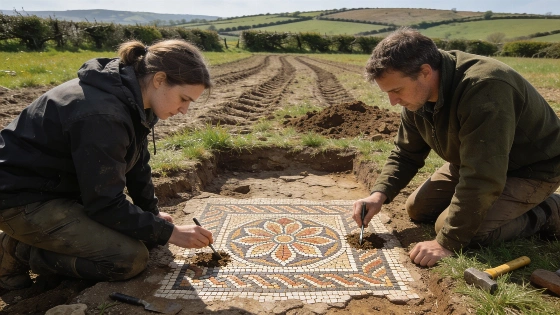
Archaeologists have excavated a Roman mosaic beneath farmland in Devon, England, revealing a rare decorated floor from a villa complex. The find offers new evidence for Roman presence in a region where such sites are uncommon.
A Roman mosaic floor has been excavated from beneath a ploughed field near Sampford Peverell in Devon, England, following more than a decade of investigation. The discovery, part of a larger Roman villa complex, provides rare evidence for high-status Roman occupation in a region where such sites are infrequently documented.
Excavation and Context
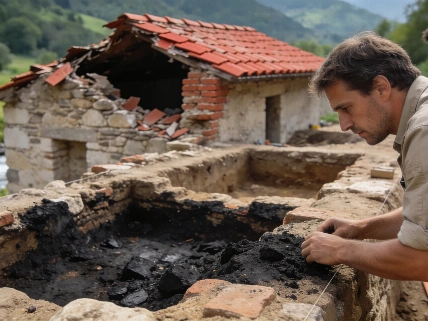
The villa complex was first identified 16 years ago when a local metal detectorist recovered a Roman coin and fragments of mosaic tesserae scattered across the field. Subsequent research by archaeologists from the University of Exeter, in collaboration with Cotswold Archaeology and local volunteers, confirmed the presence of substantial Roman remains. The site, which had been subject to regular agricultural ploughing, preserved only portions of the original mosaic floor, but enough survived to allow for careful excavation and recovery.
The mosaic, composed of patterned tesserae, was found within the footprint of a villa structure that also included evidence for agricultural buildings and a bath house. The surviving section features a central floral motif, consistent with decorative traditions seen in other Roman villas in Britain, though such finds are notably rare in Devon. The mosaic and associated artifacts are now undergoing conservation and will be displayed at the Tiverton Museum of Mid Devon Life.
Material Evidence and Preservation
Archaeologists documented the disturbed context resulting from decades of ploughing, which had fragmented the mosaic and dispersed tesserae across the field. Despite this, the team was able to recover a significant portion of the decorated floor, along with coins and other material culture linked to the villa's occupation. The precise dating of the mosaic relies on associated finds and stratigraphic relationships, as no direct radiocarbon or dendrochronological samples were available from the floor itself.
Roman villas are uncommon in Devon, and those with preserved mosaics are even more exceptional. The evidence suggests the villa was a high-status rural residence, likely occupied by a family with access to considerable resources. Researchers are now investigating whether the estate had connections to the Roman legionary city of Exeter or to military installations at Tiverton and Cullompton.
Research Program and Regional Significance
The excavation forms part of the ongoing five-year Saving Halberton's Ancient Roman Environment project, now in its second year. The project aims to document and interpret the extent of Roman settlement and land use in the region, which lies at the western edge of the Roman Empire's reach in Britain. The villa complex adds to a growing body of evidence for Roman influence in the area, complementing discoveries elsewhere in England such as the recently reported carved stone relief from Vindolanda, which was found beneath a Roman barracks floor and is discussed in detail in this related report.
While the Devon mosaic is not the first Roman artifact recovered by the lead metal detectorist-who previously contributed to the discovery of an Iron Age burial site in Dorchester-it represents a significant addition to the archaeological record of Roman Britain's southwestern frontier. The ongoing research will focus on further excavation, analysis of recovered materials, and the potential for uncovering additional structures or features associated with the villa estate.
Limitations and Future Directions
The interpretation of the site is constrained by the disturbed context and the incomplete preservation of the mosaic. Agricultural activity has removed or damaged much of the original floor, and the absence of direct dating samples limits chronological precision. Nevertheless, the combination of architectural remains, decorative flooring, and associated artifacts supports the identification of the site as a Roman villa of considerable status. Further excavation and analysis may clarify the villa's relationship to regional Roman infrastructure and settlement patterns.
Researchers emphasize the importance of integrating material evidence from Devon with broader patterns observed across Roman Britain. Comparative analysis with other villa sites, as well as with military and urban centers, will help refine understanding of the social and economic dynamics at the edge of the Roman world.
Mosaic floors in Roman Britain were typically constructed from small cubes of stone or ceramic known as tesserae, arranged in geometric or figurative patterns. The preservation of such floors depends on burial conditions, subsequent disturbance, and conservation efforts. In cases where agricultural ploughing has occurred, mosaics are often fragmented or dispersed, complicating reconstruction and interpretation. Archaeologists rely on careful excavation, documentation, and sometimes digital reconstruction to recover as much information as possible from these vulnerable remains.