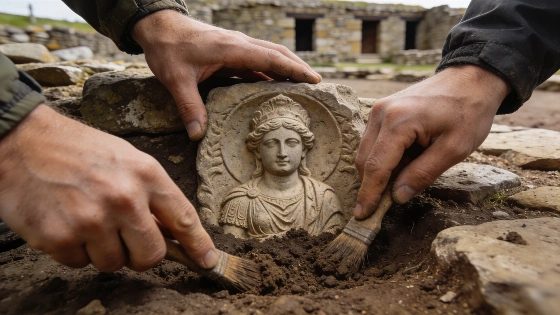
Archaeologists at Vindolanda, a Roman fort near Hadrian's Wall, have uncovered a carved stone relief depicting a protective deity. The artifact was found beneath a fourth-century barracks floor, offering insight into ritual practices at the site.
A carved stone relief representing a Roman protective deity has been recovered during recent excavations at Vindolanda, a Roman fort located just south of Hadrian's Wall in northern England. According to reporting from La Brújula Verde, the artifact was discovered beneath the floor of a barracks structure dating to the fourth century CE. The context suggests the relief was intentionally buried during the construction of the building, likely as part of a foundation ritual intended to safeguard the occupants and ensure the prosperity of the garrison.
Protective Iconography
The relief depicts a figure identified as a Roman genius, a type of guardian spirit commonly invoked in both public and private spaces throughout the Roman Empire. The carving shows the figure holding a cornucopia-a symbol of abundance and fertility in one hand, and a patera, or shallow ritual dish, in the other. Both objects are standard attributes in Roman iconography associated with offerings and the invocation of divine protection. The style and workmanship of the relief indicate it was likely produced by local artisans rather than imported from elsewhere in the empire.
Excavation records indicate the relief was found in situ beneath the original barracks floor, providing secure archaeological context. The barracks itself is attributed to the fourth century CE based on stratigraphic relationships and associated material culture, including ceramics and small finds typical of late Roman military occupation in Britain. The deliberate placement of the relief beneath the floor aligns with documented Roman practices of depositing votive objects or dedicatory offerings during construction, though the specific ritual details remain uncertain in the absence of written records from the site.
Foundation Deposit
Vindolanda has yielded a wide range of material evidence for Roman military and civilian life, including well-preserved organic remains, writing tablets, and architectural features. The discovery of the genius relief adds to the corpus of ritual and religious artifacts from the site, highlighting the integration of protective beliefs into daily routines and built environments. While the precise identity of the deity is not inscribed, the iconography is consistent with generalized Roman protective spirits rather than a named god. The artifact's preservation is relatively good, with clear carving details and minimal post-depositional damage, allowing for confident identification of its symbolic elements.
Archaeologists emphasize that while the relief's context and iconography support its interpretation as a foundation deposit, alternative explanations—such as later reuse or secondary deposition—cannot be entirely excluded without further stratigraphic and microarchaeological analysis. The absence of associated inscriptions or datable organic material limits the precision of dating, though the stratigraphic association with the barracks floor provides a strong terminus post quem in the fourth century CE. No direct radiocarbon dating was reported for the relief itself, as is typical for stone artifacts.
Ritual at Vindolanda
Vindolanda is one of the most extensively excavated Roman military sites in Britain, with ongoing research contributing to understanding of frontier life, ritual practice, and cultural interaction in the late Roman period. The genius relief offers a material example of how Roman religious traditions were adapted and localized in provincial contexts, and how ritual acts were embedded in the construction and use of military architecture.
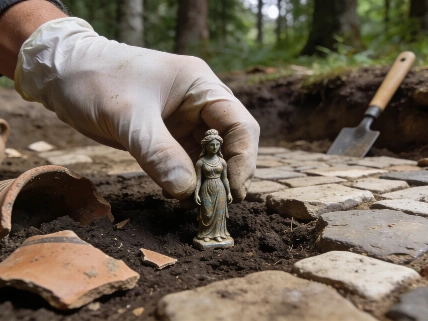
Foundation deposits are a recognized phenomenon in Roman and other ancient architectural traditions. These deposits, which may include objects such as coins, figurines, animal remains, or inscribed tablets, were placed beneath floors or within walls during construction. Their purpose was typically to invoke divine favor, protection, or good fortune for the building and its users. The archaeological identification of a foundation deposit relies on secure context, association with construction phases, and comparison with documented ritual practices. While the meaning of individual deposits can be difficult to reconstruct, their presence provides insight into the intersection of belief, daily life, and material culture in the ancient world.