Archaeologists at Vindolanda in northern England have uncovered a rare carved sandstone relief depicting a Roman Genius, preserved beneath a fourth-century barrack floor and offering new evidence for religious practices at the site
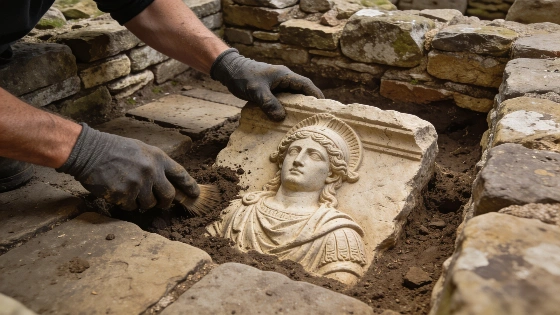
Archaeological excavations at Vindolanda, a Roman fort located just south of Hadrian's Wall in Northumberland, have revealed a carved sandstone relief depicting a Roman Genius, or protective guardian spirit. The artifact was recovered in 2026 from beneath the floor of a late Roman barrack building, where it had been reused as construction material during the site's final phases of occupation in the fourth century CE.
The relief was identified during the current excavation season by Dr Andrew Birley, Director of Excavations at the Vindolanda Trust, after the team investigated an unusually shaped flagstone within a barrack block. Careful removal of the stone exposed a finely carved figure, preserved in notably good condition due to its burial context. The relief measures 44 centimeters in height, 23 centimeters in width, and 8 centimeters in depth.
Context and Dating
The context of the find is significant for understanding both its original function and later reuse. The relief is believed to have originally formed part of a domestic shrine, known as a lararium, where it would have represented a Genius-the protective spirit associated with a household or place in Roman religion. Such figures were commonly venerated across the Roman Empire, but surviving carved stone examples are rare in Britain. The stratigraphic position beneath a barrack floor, combined with the architectural context, suggests the relief was deliberately buried or repurposed as building material during the late Roman period, likely after its original religious use had ended.
While the precise date of the relief's carving is not directly established, its deposition beneath a fourth-century barrack floor provides a terminus ante quem for its burial. The broader occupation of Vindolanda spans from the late first century CE to the early fifth century CE, with the fort yielding extensive evidence for military and civilian life along Rome's northern frontier.
Material Evidence and Interpretation
The relief depicts a standing figure holding a cornucopia in one hand-a symbol of abundance-and a patera, or shallow offering dish, in the other. These attributes are consistent with representations of the Genius in Roman iconography. The carving's style and execution suggest it was produced by a local mason, either at Vindolanda itself or in a nearby workshop, possibly associated with the Roman fort at Lanchester in County Durham. The artifact's preservation is notable, with minimal weathering or damage, likely due to its protected position beneath the barrack floor for over 1,600 years.
Specialists consulted following the discovery, including Lindsay Allason-Jones, Dr Fraser Hunter, and Alex Rome-Griffin, independently identified the figure as a previously undocumented example of a Roman Genius relief from Britain. While inscriptions dedicated to the Genius are relatively common in Roman Britain, carved stone reliefs of this type are considerably less frequent, making this find a valuable addition to the corpus of Roman religious material culture in the region.
Archaeological and Historical Significance
The recovery of the relief in a secure archaeological context provides direct evidence for the presence and later transformation of religious practices at Vindolanda. Its reuse as building material within a military barrack highlights the shifting meanings and functions of religious objects during periods of social and structural change in late Roman Britain. The find also contributes to ongoing research into the daily lives and beliefs of both soldiers and civilians at the site, complementing Vindolanda's extensive assemblage of writing tablets, footwear, textiles, and other artifacts.
The discovery is also notable for its connection to the Birley family, whose involvement with Vindolanda spans three generations of archaeological research. The artifact is currently undergoing conservation and further study before planned exhibition at the Vindolanda Museum.
Vindolanda remains one of the most important Roman archaeological sites in Europe, with its well-preserved material culture offering insights into the complexities of life along the Roman frontier. The Genius relief adds to the growing body of evidence for religious diversity and adaptation in the region during the closing centuries of Roman rule.
In archaeological research, the context in which an artifact is found is critical for interpretation. Stratigraphy-the study of soil and deposit layers-allows archaeologists to reconstruct the sequence of events at a site. When an object is recovered from a secure, undisturbed layer, its association with surrounding materials and structures can be established with greater confidence. However, when artifacts are reused or redeposited, as with the Vindolanda relief, careful analysis of the stratigraphic context and construction sequence is necessary to distinguish original use from later modification. This approach helps clarify both the chronology and the changing social or ritual significance of material culture over time.