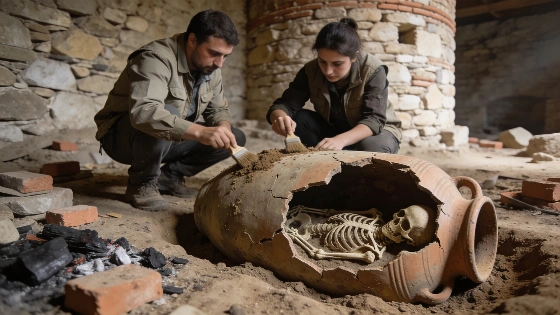
Archaeologists excavating the Late Roman fortress of Deultum in Bulgaria have uncovered a human skeleton inside a massive storage jar, offering rare evidence of a fatal episode during a violent attack over 1,600 years ago
When archaeologists opened a Late Roman turret at Deultum, Bulgaria, they did not expect to find a human skeleton curled inside a giant ceramic storage jar. Yet beneath layers of burned debris and collapsed masonry, the remains of a young individual-likely male-were discovered in a position suggesting desperate sheltering during a catastrophic fire. The find stands out not only for its rarity but for the stark evidence it provides of sudden, violent upheaval in the ancient city.
The Deultum Context
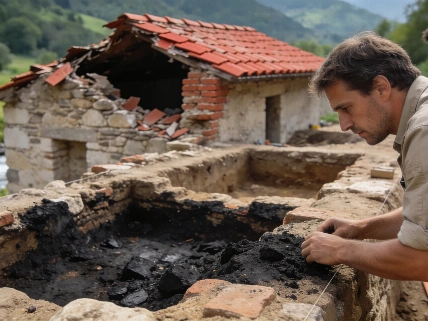
The Deultum site, located near the modern village of Debelt, preserves the remains of a Roman colony that faced repeated assaults from East Germanic groups and Huns during the fourth and fifth centuries CE. The skeleton was recovered from the northern turret of the city's western gate, a defensive structure that would have been a focal point during any attack. The context was sealed by a thick layer of burned material, including ash, charcoal, melted glass, and animal bones, indicating a rapid and intense conflagration.
Excavators identified the vessel as a dolium, the largest type of Roman storage jar, typically used for bulk goods such as olive oil or wine. The lower portion of this dolium, still in situ, measured about one meter in diameter-large enough to conceal a person in a crouched or fetal position. Associated finds included two iron knives and a belt, suggesting the individual entered the jar with personal belongings, possibly in an attempt to defend himself or simply to hide from attackers and fire.
Evidence and Interpretation
Material evidence points to a chaotic episode: numerous bronze coins scattered in the debris, animal remains likely brought inside the fortress for protection, and widespread destruction of architectural elements. The presence of ash beneath the skeleton indicates the individual entered the dolium after the fire had already begun, rather than being trapped by a sudden collapse. The body's position-resembling sleep rather than struggle-suggests no attempt was made to escape once inside.
Preliminary dating, based on stratigraphy and associated artifacts, places the event around 400 CE, though further analysis is underway. The skeleton was found with an iron knife between the legs and another in the belt, but there is no direct evidence of perimortem trauma or deliberate violence on the bones. The cause of death is most plausibly asphyxiation or thermal injury from the fire, rather than direct combat. After the destruction, the ruined turret was leveled and rebuilt, sealing the remains beneath a new floor and leaving the individual undiscovered until the present excavation.
Comparative Finds and Limitations
Human remains within settlement contexts are uncommon in Roman archaeology, as the dead were typically buried outside city walls except in cases of disaster. Comparable discoveries-such as those at Pompeii or in siege contexts-often reflect sudden, overwhelming events where normal mortuary practices were impossible. The Deultum skeleton adds to this rare category, providing a direct glimpse into the lived experience of ancient conflict. Earlier this year, the same team uncovered a Roman latrina (toilet) near the gate, further illustrating the complexity of the site's occupation layers and daily life.
While the evidence for a violent episode is strong, the precise circumstances remain uncertain. The identity, age-at-death, and biological sex of the individual will be further investigated through osteological and possibly genetic analysis in Sofia. The knives and belt may indicate personal defense, but cannot confirm the individual's social role or status. As with other disaster burials, the absence of deliberate interment complicates interpretation, and the possibility of alternative scenarios-such as accidental entrapment-cannot be entirely excluded.
Future Research at Deultum
The Deultum project plans to continue excavating the western gate complex in the coming season, aiming to clarify the architectural sequence and the chronology of destruction and rebuilding. The team's approach, integrating stratigraphic analysis with artifact study and bioarchaeological examination, reflects a broader trend in Roman archaeology toward reconstructing episodes of crisis and resilience. Comparable research at other Roman fortifications, such as the Tokod fortress, has highlighted the value of integrating architectural, artifact, and human remains evidence to understand the dynamics of ancient urban life and conflict.
Finds like the Deultum skeleton challenge archaeologists to balance dramatic context with careful interpretation. The evidence for a young person seeking shelter in a dolium during a fire is compelling, but the limits of preservation and context mean that the full story remains out of reach. As further analysis proceeds, the case will test the ability of archaeological science to extract meaning from rare, ambiguous, and emotionally charged discoveries. The ethical responsibility to treat such remains with respect and analytical rigor is paramount, especially when disaster and violence intersect with the ordinary lives of the past.
Osteological age estimation is a key method for reconstructing the life history of ancient individuals. In this approach, archaeologists assess skeletal features such as dental eruption, epiphyseal fusion, and degenerative changes to estimate age at death. Juvenile remains can often be aged with greater precision due to predictable developmental milestones, while adult age estimation is less exact and typically given as a range. Preservation quality, taphonomic alteration, and incomplete recovery can all affect the reliability of age estimates. In the case of the Deultum skeleton, further laboratory analysis will be required to refine the age and biological profile, contributing to a more nuanced understanding of the individual's experience and the circumstances of death.