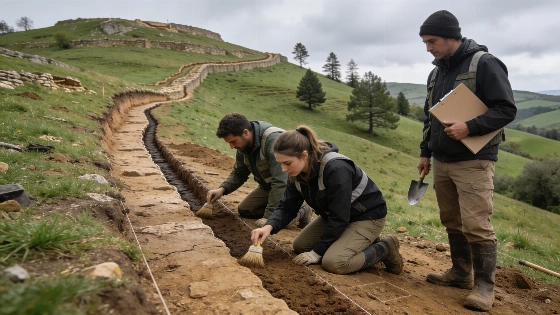
A 1.7-hectare enclosure about 500 metres from La Peña del Castro preserves Roman military footwear fittings and defensive remains. Excavations link it to the hillfort's siege, while its precise chronology remains unresolved
A fire at La Peña del Castro destroyed several structures, including two Iron Age temples, but the evidence has not established whether the destruction belongs to one assault or several phases. A newly excavated Roman enclosure nearby gives archaeologists a military context for the attack while leaving its exact chronology open.
Evidence at the camp
The enclosure lies about 500 metres from La Peña del Castro, an Iron Age settlement in La Ercina municipality in León province. On 15 October 2026, the University of León's Historia y Arqueología research group announced that excavations carried out in spring and summer 2026 had confirmed the structure's military character. Field surveys, aerial photography and LiDAR analysis had helped identify the site before excavation. Heraldo de León reported the team's association of the camp with the siege of the hillfort during the Cantabrian Wars, Rome's conquest of northern Iberia.
The camp covers approximately 1.7 hectares. Its quadrangular plan includes a clavicula-style entrance, a layout associated with Roman military installations. A perimeter wall built from local stone measures about 1.5 metres wide; the surviving section is less than half a metre high, although researchers suggest it may originally have stood roughly twice as high.
An earthen platform beside the wall is around 12 metres wide. Excavated material from the surrounding ground was used to build it, strengthening the defenses and providing a route along the perimeter. It may also have helped level the enclosure's sloping interior.
Fragments of weaponry, hobnails from Roman footwear known as caligae, fibulae and other military-associated objects support the military interpretation. Traces of structures made from perishable materials point to temporary accommodation or other facilities, but do not establish how many people occupied the camp or for how long. Archaeologist Eduardo González Gómez de Agüero described its position as well placed to control the hillfort and the approaches to it.
Reading the attack
At the hillfort, archaeologists place the assault on the northern slope, consistent with interpretations from earlier excavation campaigns. The extensive fire affected several buildings, including the two previously documented temples. Researchers are still assessing whether destruction occurred in a single engagement or across multiple periods of occupation and abandonment.
The deliberate destruction of the settlement may date to between 29 and 19 BCE, during the final phase of Rome's conquest of northern Spain. One proposal is that some buildings were deliberately demolished after the Roman conquest as part of an effort to weaken indigenous cultural and political identity. That remains a provisional interpretation. Researchers have also noted that a dating coin could help narrow the chronology. A watchtower at the hillfort's summit may help explain how Roman forces monitored the settlement and surrounding territory after its capture.
Carlos Fernández, head of the University of León research group, said the investigations had identified a phase of siege and destruction at the settlement. González Gómez de Agüero, co-director of the archaeological work, has emphasized the camp's position overlooking the hillfort and its approaches. The association is significant, but it does not by itself settle the sequence or duration of the attack.
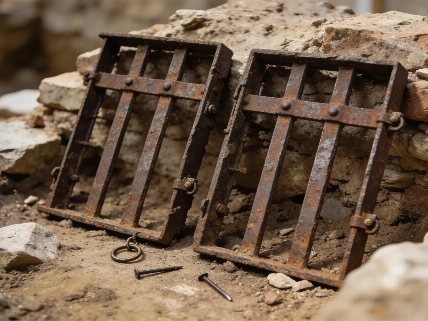
Roman archaeology can preserve very different kinds of evidence: an earlier Roman iron grille was recovered from a collapsed building at Augusta Raurica, while the León enclosure's defenses and military fittings relate to a conflict landscape.
Landscape and chronology
Archaeological work at La Peña del Castro began in 2013 and paused temporarily during the COVID-19 pandemic. After field investigations resumed, the team surveyed the surrounding landscape with aerial photography and remote-sensing methods including LiDAR. An unusual terrain formation led to preliminary investigations in spring 2026, followed by summer excavation that exposed the defensive architecture and military material. The camp is being studied as archaeological context for the hillfort's destruction, rather than as conclusive proof of a single assault.
The camp may help researchers trace Roman movement through mountain valleys between the Meseta Central and the Cantabrian coast. Roman installations linked to the Cantabrian Wars have been found in Asturias and Cantabria; others are known in Palencia. Establishing direct links between camps and indigenous settlements in mountainous León has been more difficult. The team is now examining connections with other sites in the Porma Valley.
Further excavation is intended to clarify whether the hillfort's destruction occurred in one episode or in several phases, and to investigate what happened to its inhabitants. González Gómez de Agüero said the team would process the information gathered and was already planning the next year's campaign. The excavation account is attributed to the University of León.
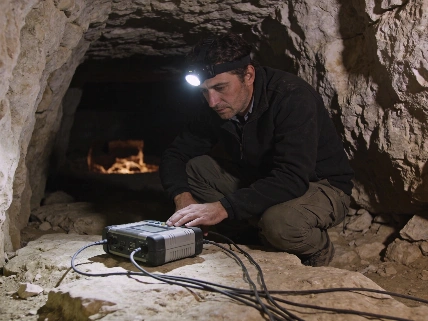
LiDAR records the shape of the ground using laser measurements, and processing can help reveal surface forms that vegetation obscures. Those forms are clues rather than identifications: a feature that looks artificial in a survey still needs archaeological assessment on the ground. Here, excavation supplied that check by exposing defensive structures and Roman military artefacts.
The camp's discovery adds a new point of comparison for research into Roman operations in León's eastern mountain region. Researchers are continuing to process the finds and plan further fieldwork to refine the chronology of both the military enclosure and the hillfort's destruction. La Nueva Crónica covered the research team's account of the dating questions and planned continuation of the excavation.