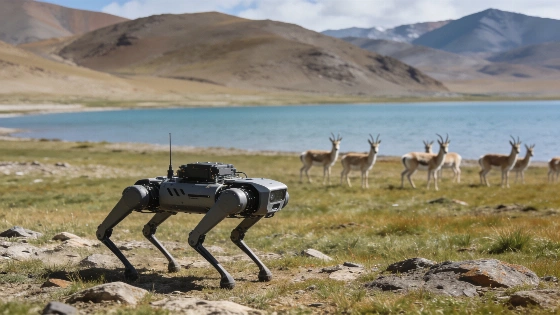
DEEP Robotics has deployed its Lynx M20 wheeled-legged robot in the Serling Tso Nature Reserve to collect visual data on Tibetan antelope migration, testing the system's ability to operate in extreme plateau conditions with minimal wildlife disturbance
DEEP Robotics has conducted a field deployment of its Lynx M20 wheeled-legged robot in the Serling Tso Nature Reserve, a high-altitude region in China averaging 4,700 meters above sea level. The deployment, which coincided with the annual migration of Tibetan antelopes between July and September, was designed to evaluate the robot's capacity to gather close-range visual data on wildlife behavior while minimizing human presence and disturbance. The Lynx M20 was tasked with traversing soft meadows, uneven permafrost, and gravel slopes around Cuo'e Lake, capturing video footage of antelopes migrating, nursing, and foraging. According to the company, the robot's relatively quiet operation allowed it to approach herds without triggering flight responses, enabling researchers to observe natural behaviors that are often disrupted by human observers.
The Lynx M20 is engineered for all-terrain mobility, combining wheeled speed with legged obstacle-crossing. It is equipped with LiDAR and depth cameras to perceive and adapt to changing ground conditions in real time. The robot's IP66 rating provides protection against dust and water, and its operating temperature range of -20°C to 55°C is intended to support reliable function in the unpredictable weather of the Tibetan plateau. During the field test, the robot was required to maintain stability across challenging surfaces and in cold, wet conditions that typically complicate the use of conventional camera equipment. The company reports that the system's sensor suite enabled it to adjust posture and movement dynamically, supporting continuous data collection in environments where human access is limited or potentially disruptive.
At Serling Tso, the migration season brings large herds of Tibetan antelopes returning with newborn calves, creating a critical window for behavioral research. The Lynx M20's low-interference approach is particularly relevant for this species, which is highly sensitive to unfamiliar sounds and movement. Researchers observed the robot approaching a herd near Cuo'e Lake without causing the animals to flee, suggesting that the system may offer a practical method for long-term population and behavioral monitoring in sensitive habitats. The deployment builds on previous high-altitude trials by DEEP Robotics, including the operation of its X30 quadruped robot in the Hoh Xil region at 4,800 meters, where a biomimetic design was used to further reduce animal disturbance.
While the Lynx M20's field performance demonstrates progress in rugged, low-impact scientific observation, the evidence remains limited to company-reported trials. The system's ability to operate autonomously is constrained by the need for remote supervision and pre-programmed navigation routines, and the long-term reliability of the hardware in extreme conditions has not been independently verified. The deployment did not include systematic measurement of failure rates, battery endurance, or the impact of environmental hazards such as snow and rain on sensor performance. As with other recent demonstrations of mobile robots in challenging environments-such as the use of humanoid systems for workplace ergonomics described in recent field trials in Europe-the transition from controlled demonstration to routine scientific use will require further validation, safety assessment, and integration with established research protocols.
According to DEEP Robotics, the Lynx M20 is designed to operate at elevations up to 4,800 meters, with an IP66 protection rating and a temperature tolerance from -20°C to 55°C. The robot's sensor suite includes LiDAR and depth cameras for terrain mapping and obstacle detection. During the Serling Tso deployment, the system was required to traverse soft meadows, permafrost, and gravel, conditions that often challenge conventional field equipment. The company has not disclosed detailed figures on battery life, intervention frequency, or the proportion of successful versus failed observation attempts. No independent evaluation of the system's impact on wildlife behavior or its long-term durability in high-altitude environments has yet been published.
Robotic field observation in sensitive ecological zones raises questions about the balance between data collection and wildlife disturbance. While mobile robots can reduce the need for direct human presence, their sensors, movement patterns, and noise profiles must be carefully evaluated to avoid unintended disruption. The Lynx M20's deployment at Serling Tso illustrates both the technical potential and the current limitations of robotic systems for ecological research in extreme environments. Further independent testing, transparent reporting of failure modes, and integration with established conservation protocols will be necessary to establish the reliability and safety of such systems for routine scientific use.
Understanding robot perception is essential for evaluating field deployments like the Lynx M20. Robot perception refers to the process by which a machine interprets sensor data-such as images, LiDAR, or depth measurements-to estimate its environment and guide movement. Unlike human perception, which integrates multiple senses and contextual knowledge, robot perception relies on algorithms that can be sensitive to noise, lighting, weather, and unexpected obstacles. In high-altitude or remote environments, sensor reliability and the ability to adapt to changing conditions are critical for both data quality and operational safety. Limitations in perception can lead to navigation errors, missed observations, or unintended disturbance of wildlife, underscoring the importance of robust sensor fusion and real-time adaptation in field robotics.