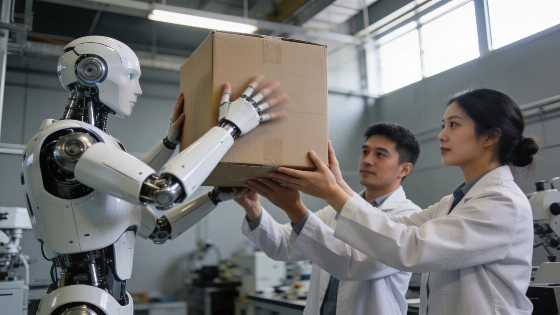
A research team in Italy and the UK has developed and tested ergoCub, a humanoid robot designed to adapt to human partners during shared lifting, aiming to reduce physical strain and improve workplace ergonomics in real time
Researchers from GenerativeBionics, the Italian Institute of Technology (IIT), and the University of Manchester have introduced a humanoid robot, ergoCub, designed to assist humans during physically demanding lifting and carrying tasks. The system was developed using a human-aware design framework that integrates hardware and control software, with the goal of reducing biomechanical strain and improving safety in collaborative work environments. The research, described in a recent technical paper, focuses on enabling robots to interpret human movement in real time and provide adaptive ergonomic support.
Unlike conventional humanoid robots, which are typically built with fixed hardware and later adapted through software, the ergoCub project optimizes both the robot's physical structure and its control algorithms in tandem. The design process includes adjusting limb lengths, joint placement, and weight distribution to maximize the combined performance of the human-robot team, rather than the robot alone. The system incorporates sensors and artificial intelligence to monitor human posture, predict movement, and adjust its own actions accordingly. This approach is intended to make the robot's assistance more natural and responsive to individual differences in body size and strength.
During laboratory experiments, the research team evaluated ergoCub's ability to assist with shared lifting tasks. The robot was able to synchronize its movements with a human partner, dynamically adjusting the force and trajectory of its assistance based on real-time sensor data. A key measurement was the estimated torque on the human partner's lumbosacral joint-a region of the lower back that is particularly vulnerable to injury during lifting. The experiments showed that, when working with ergoCub, the estimated biomechanical load on the human's lower back was significantly reduced compared to unaided lifting. The robot also demonstrated improved walking speed and energy efficiency relative to its predecessor, the iCub platform, as a result of the integrated hardware-software optimization.
The research team emphasizes that the system remains a laboratory prototype and has not yet been deployed in industrial settings. The experiments were conducted under controlled conditions, with the robot's performance evaluated in a series of collaborative lifting trials. The number of trials, specific task parameters, and failure rates were not disclosed in the available documentation. Human partners were required to work in close physical proximity to the robot, and the system's safety mechanisms-including collision detection and emergency stopping-were not described in detail. The robot's ability to generalize to new environments, object types, or untrained human partners remains untested outside the laboratory.
The design philosophy behind ergoCub has already influenced the development of Gene.01, a next-generation humanoid platform from GenerativeBionics. The team envisions modular robots that can be tailored for specific industries, such as manufacturing, logistics, and healthcare, by adapting sensors, AI models, and end effectors to the requirements of each application. This approach contrasts with one-size-fits-all humanoid designs and aims to address the diverse ergonomic and safety needs of different workplaces. Related research on full-body humanoid control, such as the Gemini Robotics 2 model, has also explored adaptive robot behavior in collaborative tasks, as discussed in recent coverage of multi-robot coordination systems.
While the results suggest that integrated hardware-software design can improve both robot and human outcomes in shared tasks, the evidence is limited to laboratory demonstrations. The system's safety, reliability, and effectiveness in real-world industrial environments have not been independently verified. Regulatory approval, workplace integration, and liability for potential failures remain open questions. The research highlights the importance of treating robot hardware as an active component of intelligence, but further testing and validation will be required before such systems can be considered for routine deployment alongside human workers.
Understanding shared control is essential for interpreting the significance of the ergoCub project. In robotics, shared control refers to systems where both the human and the robot contribute to task execution, with the robot adapting its behavior based on real-time feedback from the human partner. This approach aims to combine human judgment and adaptability with robotic strength and precision, but it also introduces new challenges in safety engineering, trust, and accountability. Effective shared control requires reliable sensing, robust prediction of human intent, and clear mechanisms for human override or intervention in case of unexpected behavior or failure.