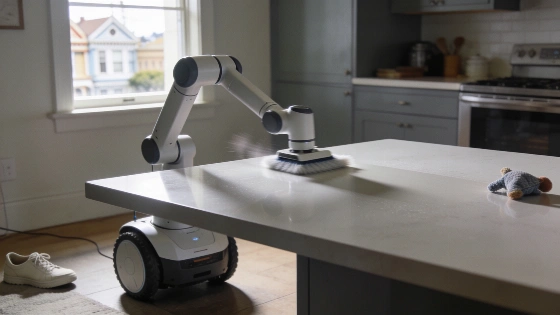
Flourish 1 is a compact household robot that owners teach by demonstration. Its low price, 3.3-pound lifting limit, and task-specific software reveal a deliberate tradeoff between broad capability and practical domestic automation.
A home robot priced at $3,555 is making a deliberate retreat from the idea that one machine must do everything. Flourish 1 is built for narrow household jobs such as collecting clothes and toys, wiping tables, fetching objects, and watering plants. Its central proposition is not exceptional strength but a lower hardware threshold for useful automation.
Flourish Robots introduced the machine on September 29, 2026, and opened pre-orders for the first 50 units. Deliveries are scheduled to begin in December 2026. The San Francisco startup says owners can teach tasks through a mobile app by physically demonstrating the desired action rather than writing code. The company describes the launch as a commercial product rather than a paid beta, while identifying component availability as a more immediate constraint than fundamental research and development.
The approach fits a long-standing principle in robotics: limiting the operating environment can reduce the sensing, planning, and mechanical performance required for a useful system. Research programs at MIT robotics laboratories and Stanford have likewise treated perception, manipulation, and learning as tightly coupled engineering problems rather than isolated software features. Flourish 1 applies that logic to a consumer product by narrowing the range of objects, spaces, and actions it is expected to handle.
Flourish 1 stands 110 centimeters tall and weighs 20 kilograms. It combines a wheeled base with two arms and a vertically moving body that raises the robot toward higher surfaces. Cameras and LiDAR provide environmental sensing while the arms are designed to stop when a person enters their reachable area.
The machine can operate for up to 12 hours on a charge but has a total lifting capacity of only 3.3 pounds. That is not an incidental weakness. In an interview with Forbes, founder and chief executive Antoine Marcel said the limit was chosen to simplify and reduce the cost of the construction. He also described the robot as intended for domestic use, not as an industrial platform adapted for the home.
Flourish 1 is not waterproof, an important qualification for a device intended to work around kitchens, plants, and household cleaning routines. Its mechanical envelope is therefore closer to a controlled indoor appliance than to a rugged service robot. The company is deliberately avoiding the industrial-grade hardware normally required for a general-purpose humanoid platform.
According to Forbes, the robot can reportedly be taught to load a dishwasher and perform other recurring domestic chores. The company also presents repeated household errands, including tasks involving objects in changing positions, as a target use case. These demonstrations show the intended operating range, but they do not establish performance across a statistically defined set of homes.
The robot is also slow. Marcel acknowledged that current versions perform household work relatively gradually. Flourish is therefore optimizing for whether a robot can complete recurring chores at all rather than whether it can match a person's speed or physical versatility. The design resembles an appliance strategy: reduce peak capability, constrain the job, and prioritize repeatability.
The company says a task can be learned in about 30 minutes through a mobile application without programming. That figure is a product claim rather than the result of a publicly described benchmark in the supplied material. No trial count, success rate, failure rate, confidence interval, or independent evaluation is reported, so the claim does not establish how consistently Flourish 1 performs across homes or how much correction users must provide.
Flourish's software approach is narrower than a universal household model. The company says it fine-tunes pretrained models around the individual home, its objects, and its tasks. Industry reporting also describes a system built around a Raspberry Pi, with cloud computing used for some artificial-intelligence functions. Those details imply a division between local sensing and control and remotely provided computation, although the available material does not specify latency, connectivity requirements, or what happens during an internet outage.
A chore such as moving a sock to a laundry basket can be decomposed into navigation to locate the item, physical manipulation to grasp it, and navigation again to carry it away. That decomposition reduces the amount of sophisticated physical AI required for any one activity. It also limits what the system must solve at once.
The tradeoff is generalization. A robot trained around one home may struggle when its environment changes substantially, even though Flourish says its models are designed to tolerate changes in object position, lighting, and clutter. In machine-learning terms, tolerance to variation within a familiar task is not the same as reliable transfer to a new task or recovery from an unrepresented failure. This distinction is central to the broader robotics literature discussed in Nature Machine Intelligence.
Teaching by demonstration is not the same as a robot teaching itself. People choose the task, provide the example, and remain responsible for deciding where the machine operates. Once training is complete, Flourish says the robot can repeat and schedule the task autonomously, but the available information does not describe how it handles unusual objects, failed grasps, blocked routes, ambiguous instructions, or recovery after a collision.
Flourish says Flourish 1 is intended to work without remote human operators after a task has been taught. That is task-level autonomy rather than broad independence. The robot is autonomous within the boundaries of learned routines and its sensing and control systems; the available material does not establish that it can reliably invent new chores or manage an open-ended household.
The distinction is similar to the one used in aerospace and laboratory automation, including systems developed for NASA: autonomy usually means that a machine can execute a defined sequence under specified conditions, not that it possesses general understanding. For a home robot, the difficult cases are often mundane rather than spectacular-a transparent object, a soft garment, a blocked route, a wet surface, or an item that has shifted since training.
The company has raised a pre-seed round led by Families Fund but has not disclosed its size. The first release is consequently a limited commercial product rather than evidence of a mature domestic robotics market. Pre-orders and a scheduled delivery date show an intended route to customers, not proven reliability in ordinary homes.
In a CNET interview, Marcel said the main current limitation was the supply chain and noted that some batteries have roughly a two-month manufacturing lead time. That constraint matters because consumer robotics depends not only on algorithms and prototypes but also on repeatable assembly, battery availability, repair logistics, and safe support for devices operating around people.
The price is far below the $20,000 listed for 1X's NEO or its stated $499-per-month option. That comparison matters because Flourish is competing through restriction. It is offering less lifting power and slower movement in exchange for a machine that the company says can be configured around a specific household.
The reported specifications provide a clear engineering profile but not a reliability assessment. Flourish 1 is 110 centimeters tall, weighs 20 kilograms, operates for up to 12 hours on a charge, and lifts no more than 3.3 pounds. The company has opened only the first 50 pre-orders at $3,555, with deliveries scheduled for December 2026. The supplied material gives no independent testing data and no measured comparison with human workers or competing robots.
The safety architecture described is also limited in the available evidence. Cameras and LiDAR can help the machine detect its surroundings, while stopping an arm when a person enters its reachable area addresses one specific physical risk. Those details do not show how the system behaves during sensor errors, communication problems, unexpected contact, falls, battery depletion, or a task it has learned incorrectly.
There is also no publicly reported study design establishing how the 30-minute learning claim was measured. A rigorous evaluation would normally define the number and diversity of homes, the number of demonstrations, the success threshold, the frequency of human interventions, and performance after changes in lighting, object placement, or furniture. Without those measurements, the claim should be read as an indication of intended usability rather than a validated performance guarantee.
Flourish 1 is best understood as an attempt to make household robotics practical by narrowing the problem. That is a more credible engineering strategy than promising a general-purpose machine on the basis of a polished demonstration, but it transfers responsibility to deployment: each home becomes part of the training environment and each owner becomes an informal tester.
Robot learning by demonstration works by using a human example to adapt software to a task rather than relying only on a fixed program. The resulting behavior still depends on perception, sensing, control, and the conditions represented during training. A change in clutter or lighting may be manageable, while a new object or an unfamiliar failure can expose a gap between repeating a routine and understanding a home. Flourish 1 therefore signals a sensible commercial direction for domestic robotics, but its real test will be repeatable performance and safe recovery in ordinary households rather than its low price alone.