Robbyant trained LingBot-Touch on nearly 5,000 hours of tactile data to translate signals from different sensors into a shared format; the company reports higher success across 26 real-world manipulation tests
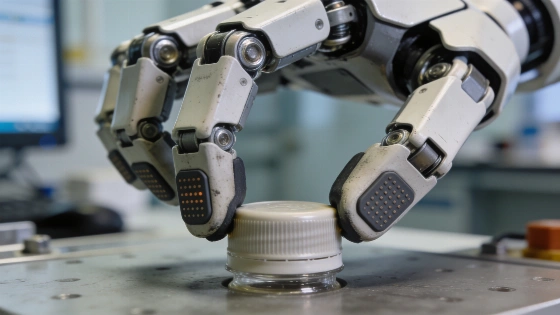
In a bottle-cap test, Sharpa Wave succeeded 90% of the time when the T-Rex action model used tactile signals processed by LingBot-Touch. Without tactile input, success was 56.25%; feeding raw sensor signals directly to the action model raised it to 62.5%. The comparison highlights the role of the model's learned tactile representation in this specific task.
Robbyant reports that LingBot-Touch improved average success by 13.9 to 24.8 percentage points across 26 real-robot manipulation tasks. The evaluations used two dexterous hands, Sharpa Wave and XHand, and four action models: LingBot-VLA, π0.5, Diffusion Policy and T-Rex. The tasks included force control, deformation, visual occlusion and bimanual coordination. The company's results are task-specific measures, not a general measure of robot reliability. A separate factory robot test reported a 96% result for automotive-part sorting, a different task that cannot be directly compared.
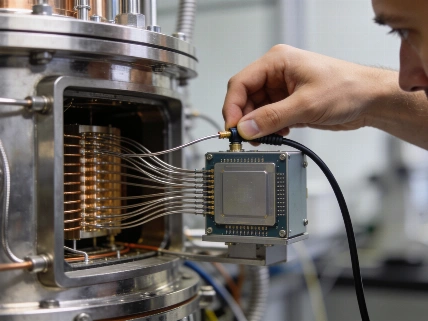
The model tackles a hardware problem: tactile sensors can register the same contact in incompatible ways. Its training data covers magnetic tactile sensing, visual tactile sensing and piezoresistive sensing. Pretrained on nearly 5,000 hours of real-world recordings, LingBot-Touch uses modality-specific tokenizers and a shared Transformer. It maps contact points from different sensor layouts into a common fingertip coordinate system, encoding contact location, force distribution and how those signals change over time. The JEPA-based model is designed to provide a shared tactile representation for existing action policies, including vision-language-action systems and diffusion policies.
Robbyant says the training combined data from people wearing tactile gloves with data from teleoperated robotic hands. That approach also supported a transfer test on XHand, whose magnetic sensors were absent from the model's pretraining data. Human-collected glove data supplied magnetic tactile examples; for the test, the foundation model's parameters remained unchanged while the action model was trained on XHand demonstrations.
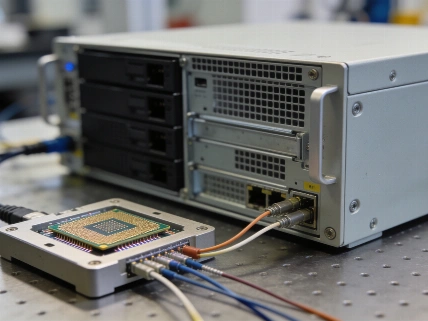
All 26 tests used LingBot-Touch-Tiny, which the article's technical account describes as having about 5.3 million parameters. Robbyant has made the technical report, code and model checkpoints publicly available in its LingBot-Touch repository, including an inference path for XHand data.