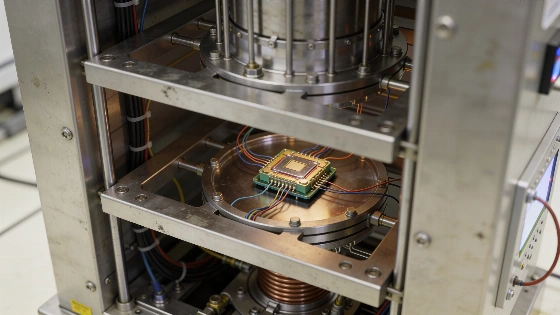
A hybrid quantum reservoir paired a graph-neural network autoencoder with a fixed 52-qubit register, lowering one-step forecast error on two PDE benchmarks while long circuits ran well beyond median coherence times
In a 128 × 128 Gray-Scott reaction-diffusion benchmark, the reported one-step normalized error fell 41.1% against a classical latent linear baseline. The 52-qubit run used IBM Quantum Heron r3 hardware identified as ibm_boston. The team describes its gradient-free forecasting method in an arXiv preprint.
The result came from a collaboration involving QodeX Quantum and the University of South Carolina, alongside the Naval Surface Warfare Center Panama City Division, NVIDIA and RTX BBN Technologies. It demonstrates forecasting on physical quantum hardware, not a general speedup for solving partial differential equations.
Reservoir architecture
The method separates mesh handling from the quantum circuit. A pretrained graph neural network autoencoder compresses the engineering data into latent variables, while a fixed, untrained quantum reservoir processes those variables. This arrangement lets the model work with an unstructured mesh without mapping its geometry directly onto the circuit topology.
At each step, data-reuploading rotations encode latent flow values in a memory register. Tunable partial-SWAP gates couple that register to readout qubits, which are measured and reset mid-circuit. The resulting controlled amplitude-damping channel gives the reservoir a fading memory while preserving the memory register for continued evolution. A post-hoc Pauli-weight truncation method limits readout-shot requirements.
Hardware benchmarks
For cylinder flow at Reynolds number 1000, the team used a 33,824-cell unstructured hex-dominant OpenFOAM mesh and 26 qubits split between 13 memory and 13 readout qubits. The compiled circuit reached 14,234 layers, with 38,670 CZ gates across 300 steps. One-step NRMSE was 0.081 against 0.121 for the latent linear baseline, a 33.2% reduction; the pressure observer showed a 21.2% reduction.
The Gray-Scott test used two interacting chemical species on a 128 × 128 grid. Its 52-qubit circuit reached 53,322 layers and 272,827 CZ gates across 1,001 steps. The reported one-step NRMSE was 0.133 against 0.225 for the baseline, a 41.1% reduction. The 26-qubit version also showed that reduction.
On the cylinder task, reported QPU sampling took 75 seconds, compared with 2.5 × 10⁵ seconds on an NVIDIA H100, a roughly 3,300-fold difference in sampling time. That comparison is specific to sampling and does not establish an end-to-end advantage for the forecasting workflow. For Gray-Scott, sampling on the 52-qubit IBM processor took 222 seconds, compared with approximately 2.5 × 10⁵ seconds for exact classical state-vector simulation on an H100, a reported ratio of about 1,100 to 1 under those sampling conditions. The comparison is not an end-to-end application speedup: it does not equate preprocessing, compilation, queueing, error mitigation or postprocessing costs. The 52-qubit run was beyond exact classical statevector simulation, which does not rule out other classical approaches. A separate account of cross-platform quantum workflows examined a different computational task.
Limits of the result
The long circuits ran beyond typical coherence windows. The paper reports continuous evolution up to 28 times the median qubit T1 and 24 times the median T2. Those figures describe the reservoir's operating duration relative to measured coherence times; they do not mean individual qubits remained coherent throughout the entire run.
In 10-step closed-loop autoregressive rollouts on cylinder flow, the hardware result had a test NRMSE of 0.257. The corresponding noiseless CUDA-Q simulation scored 0.707, while a classical persistence baseline scored 1.126. The authors interpret hardware noise as an effective regularizer in this test. That outcome is specific to the reported setup and comparison.
QodeX Quantum says the work also developed and validated modules of AlphaPsi, its agentic quantum workflow platform. The preprint reports a forecasting demonstration; it does not establish that the approach will outperform classical methods across other PDEs or engineering workloads.