A University of Illinois Urbana-Champaign team combined reinforcement learning with contraction theory and tested the controller in simulation and on three types of physical robots. Reported tracking gains reached 15 percent, though the available account gives few details about the comparisons
The Illinois researchers tested their controller in simulation before moving to physical machines, addressing a familiar robotics challenge: a robot model may not match the hardware operating in the real world.
The method, called Contraction-Aware Reinforcement Learning (CARL), combines reinforcement learning with contraction theory. The researchers report that it improved tracking performance by up to 15 percent compared with existing methods, including in physical robot tests.
Tracking means following a desired path while controlling how errors between the robot's actual movement and that path change. The reported improvement concerns this control task; it is not a guarantee of safety in every operating condition or protection against every possible failure.
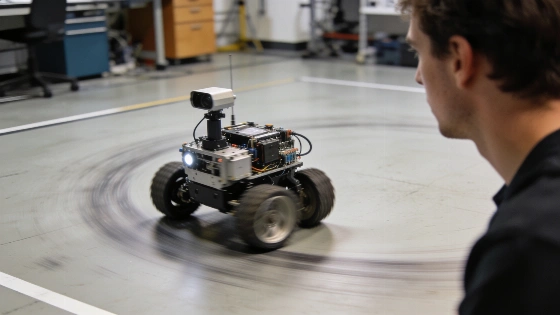
CARL was evaluated on different kinds of machines: a wheeled TurboBot 3 Burger, a flapping aerial drone and a six-legged Jethexa robot. Testing across these platforms allowed the team to examine the controller on machines with distinct forms of movement.
Reinforcement learning develops a control policy through repeated interaction with an environment. Feedback helps the system adjust its actions toward a target, but completing a task does not by itself guarantee stable behavior. A robot could make progress while veering away from its intended path or responding unpredictably.
CARL adds a mathematical constraint to that learning process. Contraction theory is used to bound how tracking errors can grow, while reinforcement learning remains the basic controller. Small errors can still occur; the approach bounds their magnitude rather than making movement error-free.
The sim-to-real gap makes those bounds relevant. A simulation may use physical properties that differ from those of the actual robot. The researchers illustrate the issue with a simulated mass of 1 kilogram (2.2 pounds) compared with a real machine weighing 1.2 kilograms (2.6 pounds); that mismatch can change how the robot responds to control commands. The team reports that CARL's tracking advantage persisted in physical tests as well as simulations.
This work addresses control reliability rather than coordinated construction tasks such as those described in robot teams for construction. The Illinois team identifies wildfire management as a possible application: robots might locate hotspots, provide information to first responders or deliver supplies. These are proposed uses, not deployments demonstrated in the reported tests.
The method's implementation code has been published on GitHub. The reported performance is a research result, while the proposed applications remain distinct from the robot tests described by the team.
Contraction theory is a mathematical structure for analyzing how differences between the states of a dynamic system change over time. Here, the relevant difference is between a robot's actual movement and its desired path. Bounding that error helps characterize controller behavior under specified conditions; it is not a blanket guarantee against hardware faults, unexpected surroundings or unsafe operation.