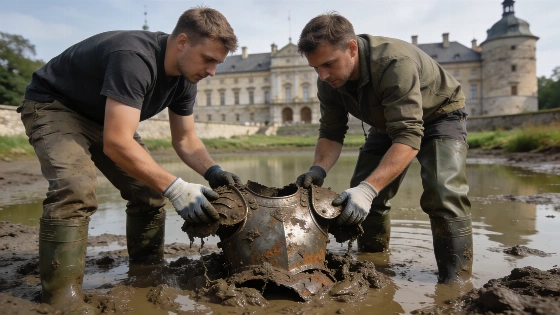
A fragment of 19th-century cuirassier armor was unexpectedly recovered from the moat of Pielaszkowice Palace in Lower Silesia, Poland, during a film-related exploration, offering new evidence of the site's turbulent Napoleonic and wartime history
When a group of young actors joined professional explorers at Pielaszkowice Palace, they expected a training exercise for a film adaptation. Instead, they found themselves handling a genuine artifact: a rare fragment of 19th-century cavalry armor, preserved in the mud of the palace moat. The discovery immediately shifted the focus from fiction to archaeological reality, raising new questions about the fate of military equipment and estate furnishings during periods of conflict.
Armor in the Moat
The most significant find was a metal fragment identified as part of a cuirassier's armor, likely dating to the early 19th century. Cuirassiers were heavy cavalry soldiers, equipped with metal breastplates and helmets, and played a prominent role in the Napoleonic Wars. The armor's survival in a waterlogged moat is notable, as such conditions can both preserve and corrode metal artifacts, depending on sediment chemistry and oxygen exposure.
The recovery took place at Pielaszkowice Palace, located near Kostomłoty, about 40 kilometers from Wrocław. The site is historically linked to the Napoleonic Wars: in June 1813, an armistice between Napoleon's forces and the allied armies of Russia and Prussia was negotiated at the residence. The palace's association with military history and subsequent wartime destruction makes it a plausible context for the deposition of military equipment.
Alongside the armor, searchers recovered fragments of carved park sculptures and original metal fittings from the palace, including door locks. These objects, like the armor, were found in the moat's mud, which had accumulated over decades of neglect and disturbance.
Context of Deposition
The moat's contents reflect multiple episodes of upheaval. During the final months of World War II, the palace was heavily looted by the Red Army. Contemporary accounts describe furnishings and valuables being thrown from windows into the moat, where they disappeared into a meter of mud and water. Local residents reportedly recovered Meissen porcelain from the moat shortly after the war, but no systematic archaeological investigation had been conducted until now.
The recent exploration was organized as part of preparations for a new adaptation of the Polish novel Satan from the Seventh Grade, which centers on a fictional treasure hunt linked to the Napoleonic era. The cast's participation was intended as immersive research, but the recovery of authentic artifacts transformed the exercise into a genuine archaeological intervention. The operation involved members of the DRACO History Explorers Association, the HUNTER Search Group, and geophysics specialists, who used systematic search methods to investigate the moat's deposits.
All recovered artifacts are to be donated to the Silesian House Museum in Ziębice, where they will be incorporated into a state museum collection rather than entering private hands. This approach aligns with current best practice in the stewardship of cultural heritage, especially for objects with insecure or disturbed provenance.
Preservation and Interpretation
The armor fragment's preservation is both unusual and informative. Waterlogged environments can slow corrosion by limiting oxygen, but fluctuating water levels and organic-rich mud can also accelerate decay. The armor's survival suggests that at least some metal objects deposited in the moat remained relatively undisturbed for decades, protected by sediment. However, the lack of controlled stratigraphic excavation limits the ability to reconstruct the precise sequence of deposition or to associate the armor directly with a specific historical event.
While the armor is consistent with equipment used by French or Prussian cavalry during the Napoleonic Wars, its exact origin and the circumstances of its deposition remain uncertain. It is possible that the armor was discarded or lost during the 1813 armistice period, but it could also have been part of the palace's collection or thrown into the moat during later looting. The presence of other architectural and decorative fragments in the same context supports the interpretation of the moat as a secondary deposit for displaced objects.
Comparable cases of disturbed or secondary deposition complicate archaeological interpretation. For example, as reported earlier, the recovery of a shield boss with cremated remains from a Polish scrap yard highlights the challenges of reconstructing original context when artifacts are removed from their primary archaeological setting.
Material Evidence and Uncertainty
The numerical context of the find is limited by the nature of the recovery. The armor fragment represents a single object, with additional finds including several carved stone fragments and metal fittings. The moat itself is estimated to contain up to a meter of accumulated mud, with unknown quantities of additional material potentially preserved below the waterline. No human remains or associated personal items were reported in this phase of investigation.
The absence of systematic excavation and the mixed context of the moat mean that the armor's association with the Napoleonic period is plausible but not confirmed. Without direct dating or secure stratigraphic association, the artifact's interpretive value is constrained. Further investigation, including controlled excavation and scientific analysis of corrosion products, could clarify the chronology and depositional history of the moat's contents.
The decision to transfer all finds to a public museum ensures that the artifacts will be available for future research and comparative study. This is particularly important for objects recovered from disturbed or secondary contexts, where documentation and conservation are essential for maintaining their evidentiary value.
The recovery of a rare cavalry armor fragment from the moat of Pielaszkowice Palace demonstrates both the potential and the limitations of archaeological discovery in disturbed contexts. While the find offers a tangible link to the site's military and wartime history, the absence of secure stratigraphic association and direct dating means that interpretation must remain cautious. The episode also underscores the importance of systematic recovery, documentation, and public stewardship of artifacts, especially when accidental discoveries intersect with popular media and public engagement. As with other recent finds from disturbed contexts, the armor's value lies not only in its material presence but in the questions it raises about preservation, context, and the complex afterlives of historical objects.
Understanding the significance of finds from waterlogged or disturbed contexts requires attention to taphonomy-the study of processes affecting remains after deposition. In moats, lakes, or wetlands, waterlogged conditions can preserve organic and metal materials by limiting oxygen and microbial activity, but fluctuating water levels, chemical changes, and later disturbance can also accelerate decay or mix deposits from different periods. Without controlled excavation and stratigraphic recording, it is difficult to reconstruct the original context or sequence of deposition, making interpretation more tentative. For this reason, systematic documentation and museum curation are essential for preserving the research value of such finds.