NASA's ESCAPADE mission has imaged Earth and the Moon in both visible and thermal infrared light, providing a rare calibration opportunity for its cameras as the spacecraft prepares for its journey to Mars
NASA's ESCAPADE mission, currently en route to Mars, has recorded new images of Earth and the Moon using its onboard cameras, capturing both bodies in visible and thermal infrared wavelengths. The images, taken from a vantage point hundreds of thousands of kilometers from Earth, offer a unique perspective on our planet and its satellite as seen from deep space.
Imaging Earth and Moon from Deep Space
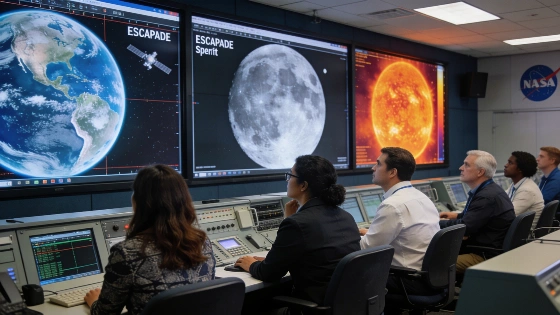
On July 3, one of the two ESCAPADE spacecraft used its Visible and Infrared Observation System, developed by Northern Arizona University, to observe Earth and the Moon while positioned approximately 584,600 kilometers from Earth and 186,100 kilometers from the Moon. At this distance, the Moon appeared unusually large relative to Earth in the field of view. The visible-light image shows both bodies as thin crescents, with only about 8% of their surfaces illuminated by sunlight due to the partial angle of illumination. In contrast, the thermal infrared image reveals the heat emitted by Earth's atmosphere and surface, even on the night side, while the Moon's far side remains much colder and less luminous in the infrared.
In the thermal data, Earth's shadowed hemisphere glows at temperatures between 250 and 280 kelvins (-10 to -44 degrees Fahrenheit), a result of retained heat in the atmosphere and oceans. The Moon, lacking such insulation, shows a much colder far side at around 100 kelvins (-280 degrees Fahrenheit). White rings were added to the thermal image to indicate the true sizes of Earth and the Moon, as the infrared glow can extend beyond their visible boundaries.
Instrument Calibration and Mission Status
Imaging well-characterized targets like Earth and the Moon serves as a critical calibration step for ESCAPADE's cameras before the mission's primary science phase at Mars. The spacecraft are currently in a "loiter" orbit near the Sun-Earth Lagrange point 2, roughly 1.5 million kilometers from Earth. This stable region allows for system checks and instrument validation ahead of the mission's planned Earth flyby in November 2026, which will use Earth's gravity to redirect the spacecraft toward Mars.
The ESCAPADE mission consists of two identical spacecraft built by Rocket Lab, each equipped to study the interaction between the solar wind-a stream of charged particles from the Sun traveling at about 1.6 million kilometers per hour-and the Martian atmosphere. Upon arrival at Mars in September 2027, the mission will investigate how these interactions drive atmospheric loss, a key process in the planet's climate evolution. ESCAPADE is funded by NASA's Heliophysics Division and led by the University of California, Berkeley's Space Sciences Laboratory, with contributions from Rocket Lab, NASA's Goddard Space Flight Center, Embry-Riddle Aeronautical University, Advanced Space, and Blue Origin.
Scientific Context and Calibration Value
Observing Earth and the Moon from deep space is not only a technical milestone but also provides a valuable reference for interpreting future Martian data. By comparing the known thermal and visible properties of Earth and the Moon, mission scientists can assess the accuracy and sensitivity of ESCAPADE's instruments. This calibration is essential for detecting subtle features in the Martian atmosphere and surface, such as aurorae or temperature variations, once the spacecraft reach their science orbits around Mars.
Such calibration efforts are standard practice for planetary missions, ensuring that instrument readings can be trusted when observing less familiar targets. The approach mirrors procedures used by other missions, such as the James Webb Space Telescope, which also relies on well-understood celestial objects for instrument validation. For context, NASA's ongoing work to improve astronaut health monitoring, as described in its recent development of a VTE risk algorithm for ISS missions, highlights the broader importance of calibration and validation across space science disciplines.
Next Steps for ESCAPADE
With calibration images now in hand, ESCAPADE's next major milestone will be its Earth flyby maneuver, scheduled for November 2026. This gravity assist will set the spacecraft on a trajectory to intercept Mars in September 2027. Once in Martian orbit, the twin spacecraft will operate in tandem to map the planet's magnetosphere and study how solar wind stripping contributes to atmospheric loss. The mission's dual-spacecraft approach is designed to provide simultaneous measurements from different locations, offering a more complete picture of the dynamic processes shaping Mars' upper atmosphere.
ESCAPADE's progress will be closely watched by the planetary science community, as its findings are expected to refine models of atmospheric escape and improve understanding of Mars' long-term climate evolution. The mission's success will depend on the continued performance of its instruments, now validated through these early observations of Earth and the Moon.
Calibration is a foundational process in space science, ensuring that instruments deliver reliable data when observing unknown environments. By imaging Earth and the Moon-objects with well-characterized physical and thermal properties-ESCAPADE's team can verify the accuracy of their detectors and correct for any systematic errors. This process is especially important for missions operating far from Earth, where in-flight recalibration opportunities are limited. Accurate calibration underpins the scientific credibility of all subsequent measurements, from planetary atmospheres to surface composition and beyond.