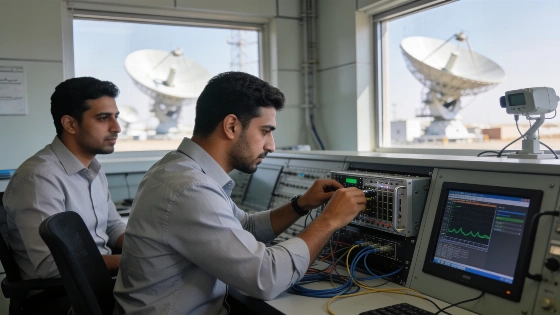
A live integration at Es'hailSat's Doha teleport tested Arqit's quantum-safe software on an active satellite link, showing post-quantum encryption can be deployed without hardware changes or service disruption
Arqit Quantum Inc., Es'hailSat, and Advanced International Electronic Equipment Company (AIEE) have jointly demonstrated the deployment of quantum-safe encryption over an operational satellite communications link. The test, conducted at Es'hailSat's Tier-4 certified teleport facility in Doha, integrated Arqit's software-based symmetric key agreement platform into the live Es'hail-1 satellite network. The experiment aimed to assess whether post-quantum cryptographic protections-designed to resist attacks from future quantum computers-could be implemented on existing satellite infrastructure without requiring hardware replacement or interrupting ongoing data transmission.
Integration With Live Satellite Systems
The demonstration used the Es'hail-1 satellite, positioned at the 25.5°/26° East orbital slot, to provide a real-world communications channel. AIEE managed the integration and interoperability testing, ensuring that Arqit's NetworkSecure and symmetric key agreement (SKA) software could operate within the established ground station and network environment. The system generated quantum-safe symmetric keys to secure data in transit, with the architecture designed to be compatible with standard satellite-connected networks used by government, enterprise, maritime, and energy sector clients. The trial was conducted on a live operational link, with no reported degradation in service quality or need for hardware modification.
Experimental Conditions and Measured Outcomes
During the trial, the quantum-safe encryption software was deployed directly onto the existing ground infrastructure, leveraging the active satellite link for key distribution and data protection. The test verified that post-quantum cryptographic protocols could be layered onto legacy satellite systems, providing resistance to "harvest now, decrypt later" attacks-where adversaries collect encrypted data today in hopes of decrypting it with future quantum computers. The demonstration did not require changes to the satellite payload or ground hardware, and operational performance metrics, such as data throughput and latency, remained within normal parameters throughout the test window. While the companies did not publish detailed cryptographic benchmarks or independent security audits, the integration was completed without observable service interruption.
Strategic Implications and Deployment Roadmap
The ability to retrofit quantum-resistant encryption onto existing satellite and ground assets is significant for operators managing long-lived orbital infrastructure. Many satellites are expected to remain in service for decades, making them vulnerable to advances in quantum computing that could compromise current public-key cryptography. By demonstrating a software-based upgrade path, the partners established a model for enhancing communications resilience across the Middle East and North Africa (MENA) region without the cost and risk of large-scale hardware replacement. This approach aligns with broader industry efforts to address quantum-era security risks, as seen in other initiatives to embed quantum-resistant cryptography in hardware platforms, such as the QASIC project detailed in recent coverage of post-quantum ASIC development.
Limitations and Open Questions
While the demonstration confirms that quantum-safe encryption can be integrated into operational satellite networks, several technical and engineering questions remain. The companies have not released peer-reviewed performance data, cryptographic protocol details, or independent security assessments. The effectiveness of the deployed software against advanced quantum attacks will depend on the specific algorithms and implementation standards adopted, as well as the broader migration of ground and user equipment to post-quantum cryptography. Additionally, the demonstration focused on symmetric key agreement and did not address the challenges of quantum key distribution (QKD) or the integration of quantum-secure authentication protocols. The long-term resilience of such retrofitted systems will require ongoing evaluation as quantum computing capabilities evolve.
Understanding the distinction between post-quantum cryptography and quantum key distribution is essential in evaluating satellite security upgrades. Post-quantum cryptography refers to algorithms designed to run on conventional computers but believed to be resistant to attacks from large-scale quantum computers. These algorithms can be deployed as software updates on existing infrastructure, as demonstrated in this trial. In contrast, quantum key distribution uses quantum states-typically photons-to establish cryptographic keys with security guaranteed by the laws of quantum mechanics, but requires specialized hardware and is not yet widely deployed in satellite systems. The choice between these approaches depends on operational requirements, cost, and the evolving threat landscape.