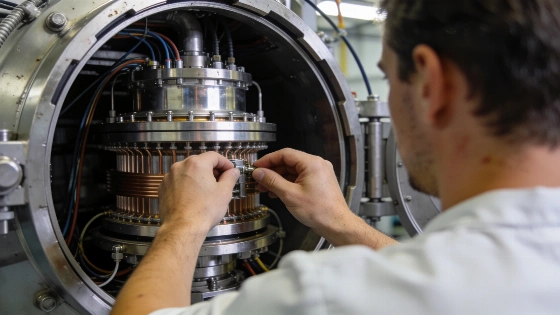
Quantum processors are no longer judged only as faster classical machines. Their value depends on whether real workloads can be mapped to quantum evolution and run reliably inside hybrid systems with effective error correction.
The decisive question for quantum computing is no longer whether a quantum processor can perform a calculation. It is whether the calculation has been redesigned so that quantum evolution does something classical search cannot do efficiently.
The Architectural Break
Classical machines have changed radically since Babbage's analytical engine, yet their computational model has remained recognizable. They evaluate states, sample possibilities, iterate through candidates, or approximate solutions using sequential steps and bounded parallelism. Modern GPUs and TPUs push those operations faster, but they do not replace the underlying logic of search.
Quantum algorithms begin elsewhere. A problem can be encoded into a quantum state whose amplitudes occupy a high-dimensional Hilbert space. Gates change those amplitudes, constructive interference increases the weight of useful outcomes, and destructive interference reduces others. The answer is not obtained by checking every candidate in sequence; it is extracted from the final measurement of a deliberately shaped evolution.
That mechanism is powerful only for problems with the right mathematical structure. Variational algorithms, quantum approximate optimization and selected simulation methods can exploit it, while workloads that do not map naturally into quantum states remain better suited to classical hardware. Calling a quantum processor a faster version of an existing accelerator therefore misstates the engineering task: the central work is problem reformulation.
The distinction is familiar from work at MIT and in the journal Nature, where experimental demonstrations are generally evaluated not only by qubit totals but also by fidelity, circuit depth, reproducibility and the degree to which classical control remains part of the experiment. Those criteria are increasingly important as commercial claims move from laboratory demonstrations toward deployable systems.
Utility Meets Hardware
The clean mathematics collides with difficult hardware. Decoherence, imperfect gates, limited connectivity and readout errors restrict circuit depth, while error correction adds a substantial layer of physical overhead. A useful system must also coordinate a quantum processing unit with classical processors that handle control, decoding and optimization.
Resource estimates in the briefing put the physical-to-logical qubit ratio in the hundreds to thousands, depending on the target logical error rate and code distance. That means a machine with several hundred physical qubits may support only a handful of logical qubits after protection is applied. The same overhead affects circuit depth because each additional logical operation creates another opportunity for failure.
Real-time syndrome decoding is part of the computation rather than a background service. Classical hardware must interpret error-correction data quickly enough to keep pace with the quantum cycle, and an inaccurate or delayed decoder can erase the benefit of improved physical qubits. Cryogenic electronics, room-temperature control, interconnects, dilution refrigerators and vibration isolation all become system-level constraints. Earlier laboratory work on experimental quantum error correction illustrates why encoded protection must be assessed through actual logical performance rather than through physical-qubit counts alone.
Recent industry results show why decoder latency has become a central systems metric. IonQ said it developed and tested an end-to-end real-time quantum-error-correction decoder running on a single standard CPU, describing it as an industry first. The company reported that its architecture can support hundreds of logical qubits and millions of operations without slowing execution. In its benchmark, a dual-decoder design reportedly added only 0.02% stretch time while scaling to as many as 408 logical qubits and more than 31.5 million quantum operations. These are company-reported engineering results, so independent replication and detailed methodological disclosure remain important, but the measurements target a genuine bottleneck: keeping classical decoding synchronized with quantum evolution.
Hardware topology matters just as much. Algorithms that assume all-to-all connectivity may require routing and gate decomposition on real devices, increasing circuit depth before the intended computation has even begun. The most credible near-term designs are therefore hardware-aware and hybrid, with shallow quantum circuits embedded in classical high-performance environments.
Where the Mapping Matters
Molecular simulation remains the clearest proposed near-term application in the briefing. Classical electronic-structure calculations become difficult when industrially relevant systems require high accuracy. Quantum algorithms can encode an electronic Hamiltonian directly, making the physical evolution of the quantum state part of the calculation. The claim is not that current machines can routinely design drugs or catalysts, but that fault-tolerant systems could reach identifiable crossover points for selected molecular problems.
Optimization under uncertainty offers a second target. Portfolio risk, logistics and combinatorial scheduling can be expressed through cost Hamiltonians whose low-energy states represent good solutions. In a practical hybrid loop, the quantum processor estimates expectation values or proposes candidate states while a classical optimizer adjusts parameters. Any advantage would depend on solution quality, total runtime and the strength of the classical baseline rather than on the presence of a quantum circuit alone.
This is why the distinction between a promising mapping and a useful application matters. As an earlier hardware report illustrates, logical-qubit demonstrations can provide valuable evidence about encoded operations without establishing a general-purpose fault-tolerant computer. Infleqtion has said it reached 30 entangled logical qubits, framing the milestone as progress toward larger fault-tolerant computations with fewer gates and fewer opportunities for error. The same discipline applies to application claims: a circuit that cannot be repeated with usable fidelity has not yet become an industrial workflow.
The Systems Test
By 2026, the field's meaningful benchmark is repeatable utility under realistic error rates and hybrid control conditions. Headline physical-qubit totals are less informative than usable logical capacity, decoder latency, connectivity, calibration stability and the number of industrially relevant circuits that can run reliably. The briefing describes a transition from laboratory proof-of-concept toward that systems test, not a completed arrival at general-purpose quantum computing.
That transition is also becoming geographically organized. Maryland is assembling a quantum cluster around academia, defense and industry. Reported milestones include an April 2025 DARPA-Maryland benchmarking agreement, Microsoft's September 2025 research-center announcement, and 2026 arrivals including IQM, Quantum Motion and Riverlane. Maryland's reported fiscal-year 2027 allocations include $20 million for IonQ's new global headquarters, $22 million for the University of Maryland's Quantum Startup Foundry and national testbeds, $20 million for a dedicated Deep Tech Facility, and $12 million for ARLIS and quantum faculty recruitment.
Microsoft has now announced a Maryland quantum research center with direct on-site DARPA access to its latest hardware. DARPA is expected to begin testing Microsoft's Majorana 2 chip there, while Microsoft has said it plans commercial quantum systems by 2029, as described in a Reuters technology report. The arrangement matters because it places hardware evaluation, defense-oriented benchmarking and industrial development in the same regional ecosystem, although a commercial timetable remains a company target rather than an independently demonstrated result.
Investor reaction shows how quickly technical claims can affect expectations. IonQ shares rose about 7% after hours following the error-correction announcement, and later reports put the pre-open move at 11.8%. Market response is not evidence of computational advantage, but it indicates that investors increasingly treat decoder performance and logical-qubit scaling as commercially meaningful milestones.
The economic consequences follow directly from the architecture. Teams that choose problems with a natural Hilbert-space formulation and shallow hardware-aware circuits can pursue narrowly defined value. Teams that force classical workloads onto unsuitable quantum hardware inherit error-correction costs without gaining a useful computational primitive. Capital and engineering effort should therefore track demonstrated workflows rather than undifferentiated claims of quantum advantage.
A physical qubit is an individual controllable quantum system, while a logical qubit stores information across multiple physical qubits so errors can be detected and corrected. Logical encoding does not remove noise; it spends hardware and classical processing to suppress its effect. That distinction is the dividing line between an impressive device specification and a credible route to useful computation. It also explains why quantum computing remains a specialized co-processor today rather than a replacement for classical machines, with standards familiar from CERN, NASA and other large-scale experimental programs: performance must be measured at the level of the complete instrument, not its most visible component.