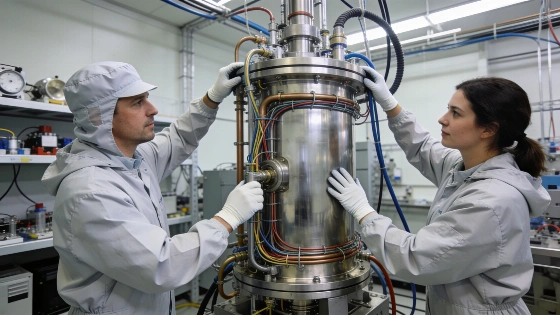
Recent months have seen a surge in quantum hardware deployments, new materials research, and major public investments. From room-temperature spin qubits to expanded quantum supply chains, the field is advancing but faces persistent engineering and scaling hurdles.
Quantum technology development in the first half of 2026 has been marked by a series of hardware deployments, materials discoveries, and policy initiatives, each addressing different bottlenecks on the path to practical quantum computing. While several companies and research groups have announced new devices and partnerships, the gap between laboratory demonstration and scalable, fault-tolerant quantum systems remains substantial.
Hardware Deployments and Supply Chain Initiatives
In the United States, the Illinois Quantum and Microelectronics Park (IQMP) FaQtory in Chicago has secured its first tenants, Zero Point Cryogenics and Ability Engineering Technology, aiming to localize quantum hardware manufacturing and reduce dependence on overseas components. Zero Point Cryogenics will establish its first U.S. innovation and service hub, while Ability Engineering Technology plans to modernize its plant and open an R&D satellite office. These moves are intended to accelerate hardware development and address persistent supply chain vulnerabilities that have slowed progress in scaling quantum processors.
Parallel efforts are underway in New Mexico, where the state awarded $1.2 million in grants to six quantum startups, contingent on maintaining operations locally. Maybell Quantum is deploying four dilution refrigerators at the Roadrunner Quantum Lab, providing shared cryogenic infrastructure for early-stage hardware companies. These investments reflect a broader trend toward building regional quantum clusters and supporting the infrastructure required for device testing and integration.
Materials and Device Research
On the materials front, researchers at Sungkyunkwan University, in collaboration with U.S. partners, have identified a molybdenum-oxygen-vacancy complex in zinc oxide (ZnO) semiconductors that functions as a room-temperature spin qubit. The defect, (MoZnvO)2+, exhibits millisecond spin coherence and high-fidelity single-shot readout, offering a potential alternative to diamond-based qubits. ZnO's compatibility with established semiconductor processes and its magnetic quietness make it a promising candidate for scalable quantum devices, though reproducibility and integration into large-scale architectures remain open questions.
Commercial device launches have also continued. SAXON Q introduced diamond-based room-temperature quantum computers with 128 and 512 qubits, using a proprietary sulfur co-implantation process to improve qubit yield and gate fidelity. While these systems are being deployed at research institutions, independent benchmarking and verification of their performance, especially for error rates and circuit depth, will be critical for assessing their practical utility.
Quantum Networking, Security, and Policy
Quantum networking and security have seen both technical and policy advances. QPerfect, a subsidiary of BTQ Technologies, is collaborating with the University of Strasbourg to create a hardware-accurate quantum digital twin for France's first public neutral-atom quantum computing platform. In parallel, Terra Quantum and Apex.AI have demonstrated the integration of post-quantum cryptography into edge-to-cloud systems, targeting long-lifecycle devices such as autonomous vehicles. These efforts reflect growing recognition of the need for quantum-safe security as quantum hardware matures.
Policy and funding initiatives are also shaping the landscape. The Hewlett Foundation has launched a $100 million, five-year program to address governance and security challenges in AI, biotechnology, and quantum computing. The Bloch Quantum Tech Hub, managed by the Chicago Quantum Exchange, secured $55 million in federal and matching grants to strengthen the U.S. quantum supply chain, focusing on manufacturing transition, supply chain integration, and infrastructure buildout. These investments are designed to bridge the gap between laboratory prototypes and industrial-scale manufacturing, but their impact will depend on sustained technical progress and workforce development.
Benchmarks, Error Correction, and Education
Benchmarking and error correction remain central challenges. WISER and E.ON have benchmarked hybrid quantum-classical machine learning models for smart grid energy forecasting using IBM Quantum hardware with over 100 qubits, reporting reduced forecasting errors even on noisy intermediate-scale devices. Rice University has joined the U.S. Department of Energy's Quantum Science Center to develop quantum error-correction decoding algorithms optimized for classical supercomputers, supporting the DOE's goal of a fault-tolerant ecosystem by 2028. IBM, for its part, has committed $50 million in quantum compute access to the DOE Genesis Mission, providing researchers with access to its 156-qubit Heron and 120-qubit Nighthawk processors.
Education and workforce development are also receiving attention. Bloq Quantum has partnered with institutions in India to establish undergraduate quantum computing labs and integrate quantum software into broader training programs. Tennessee's TN QuantumWorks initiative is piloting a K-12 quantum education framework, aiming to build digital literacy and connect students with hands-on quantum programming opportunities. These programs are intended to address the growing demand for technical skills across the quantum ecosystem.
Persistent Engineering and Scaling Barriers
Despite these advances, significant engineering challenges remain. Device yield, calibration stability, error rates, and integration with classical infrastructure continue to limit the scale and reliability of quantum processors. Many announced systems, including room-temperature and neutral-atom platforms, have yet to demonstrate reproducible performance at the scale required for practical applications. Error correction, while advancing, is still largely confined to laboratory experiments and small logical qubit demonstrations.
Security concerns are also driving investment in post-quantum cryptography and quantum-safe protocols, but the timeline for widespread adoption remains uncertain. As highlighted in Science Report's coverage of Bitcoin quantum security initiatives, the industry is preparing for future threats even as current quantum computers remain far from breaking widely used cryptographic standards.
Overall, the field is moving from isolated laboratory demonstrations toward more integrated, infrastructure-focused development. However, the transition to scalable, fault-tolerant, and commercially useful quantum systems will require continued progress in materials science, device engineering, error correction, and workforce training, as well as careful scrutiny of performance claims and reproducibility.
Understanding the distinction between physical and logical qubits is essential for interpreting progress in quantum computing. A physical qubit is a single controllable quantum system, such as a spin in a semiconductor or a trapped ion, that can be manipulated and measured. However, physical qubits are prone to errors from noise, decoherence, and imperfect control. Logical qubits encode information across multiple physical qubits using error-correcting codes, allowing errors to be detected and corrected if the physical error rate is below a certain threshold. Demonstrating that logical error rates decrease as more physical qubits are added is a key milestone on the path to fault-tolerant quantum computing. Most current systems remain at the stage of improving physical qubit quality and demonstrating small-scale logical encoding, with full fault-tolerant operation still out of reach.