JIJ uses classical and quantum-inspired solvers for most commercial optimization work while testing quantum photonics for better answers rather than faster runtimes
Quantum optimization is already being sold without waiting for a decisive quantum speedup. At Japan-based JIJ, about 80% of commercial optimization engagements use classical or quantum-inspired solvers, while only about 20% use quantum hardware. The ratio describes a practical deployment strategy: quantum processors are being evaluated as one resource within a broader computational system, not as an immediate replacement for established optimization methods.
That split is not a weakness in JIJ's approach. It is a direct acknowledgment that optimization is a systems problem rather than a contest between one processor and another. JIJ works across classical computing, quantum-inspired algorithms that run on classical infrastructure, and quantum hardware. Steve Gibson has described the company as operating across that full spectrum while leading its expansion from Japan into the United States, Europe, and wider global markets.
Gibson has linked JIJ's research foundations to Professor Hidetoshi Nishimori's laboratory and identified Yu Yamashiro and Kohji Nishimura as the company's founders. That history places JIJ within the Japanese research tradition surrounding Ising-based optimization, in which difficult combinatorial problems are represented through interacting variables and then searched for low-energy or low-cost configurations. The approach is relevant to scheduling, routing, allocation, manufacturing, and logistics because many of those tasks can be expressed as constrained optimization models.
Steve Gibson, who serves as JIJ's President of Americas, is tasked with extending that expertise into the United States and Europe. The company's public profile describes a startup focused on optimization calculation projects involving large-scale calculations, with its software and related platform activity reported across the UK, US, Germany, Singapore, and Japan. Those engagements place formulation, decomposition, constraints, and benchmarking alongside hardware selection rather than treating hardware as the sole measure of progress.
The practical question is not whether a quantum processor can replace a classical optimizer. It is whether a complex problem can be divided so that each part is handled by the tool best suited to it. That is the same logic behind hybrid architectures elsewhere in computing and it is more credible than treating quantum hardware as a universal replacement. The discipline resembles the benchmark culture expected in fields reported by Nature, where a new instrument or algorithm must be assessed against a defined baseline and a meaningful measurement.
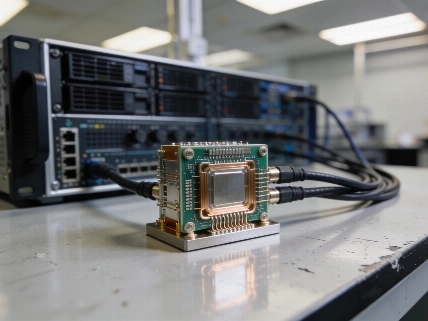
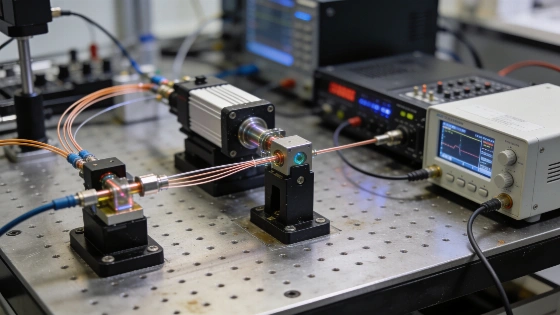
JIJ's clearest example comes from a UK national program test involving a quantum photonic system. The company decomposed the optimization problem so that part of the task ran on the quantum system. The quantum-assisted method did not finish faster than the strongest classical method, but it produced a slightly better answer.
That distinction matters. A better objective value and a shorter runtime are different forms of performance, and neither automatically establishes general quantum advantage. The reported test also compared a decomposed quantum-assisted workflow with a classical implementation that performed better when the problem was handled monolithically. The result therefore supports a limited claim about one formulation and one benchmark rather than a broad claim about quantum computing.
Research in photonic and quantum technology continues to examine the optimization of photonic circuits, optical architectures, and quantum communication systems. A current body of peer-reviewed work in EPJ Quantum Technology helps frame why photonic platforms remain scientifically important, but that literature does not by itself establish commercial quantum advantage for JIJ or any other vendor.
For readers tracking the field's harder benchmark questions an earlier analysis makes the same essential point from another angle: processor capability depends on architecture, error control, and the way a workload is mapped onto the machine. JIJ's example adds a commercial constraint. The answer must improve a customer's problem without making the overall workflow slower or harder to operate.
The distinction between a better answer and a faster answer is also important because optimization objectives can be multi-dimensional. A customer may value lower cost, fewer delays, reduced energy use, improved resource utilization, or greater robustness under changing conditions. A benchmark that reports only wall-clock time can therefore miss the metric that matters operationally, while a benchmark that reports only objective quality can ignore the cost of obtaining that result.
Gibson places quantum readiness on a longer timetable than a pilot project. He says providers are converging around 2029 through 2031 for major hardware milestones while acknowledging that quantum computing has been described as five years away throughout his six years in the industry. That is a forecast window rather than a demonstrated delivery date, and it should not be confused with a verified schedule for fault-tolerant machines.
His advice is to prepare before the hardware arrives. Organizations need to examine data structures, data transfers, legal requirements, and compliance processes because a quantum service cannot simply be plugged into an existing workflow without changes elsewhere in the organization. The available material does not identify a specific processor architecture, qubit count, operating temperature, gate fidelity, or error rate for JIJ's work. Those omissions prevent any engineering judgment about fault tolerance or scalable quantum computation.
That caution is consistent with how technically demanding infrastructure is evaluated at organizations such as CERN and NASA: system performance depends on the complete chain of hardware, software, calibration, data movement, and operational constraints. The comparison is methodological rather than a claim that JIJ's platform has been assessed by either institution.
The more immediate readiness issue is therefore organizational and computational. Companies can identify difficult combinatorial problems, establish classical baselines, and determine which inputs can be decomposed without destroying the quality of the answer. They can also decide what evidence would count as improvement: speed, accuracy, cost, energy use, resilience, or some combination of those measures.
JIJ is using AI to translate customer descriptions into optimization formulations. The goal is to reduce the need for every customer to employ an engineer who understands both the business domain and the technical details of quantum and quantum-inspired methods. The company hopes this work will move it from a services-heavy model toward more scalable software products.
That transition has a clear benefit and a clear risk. Better interfaces can make advanced optimization accessible to organizations without in-house quantum specialists. But automated translation does not remove the need for validation. A model can express a business problem in mathematical terms while still choosing the wrong constraints or optimizing a target that does not represent the customer's real objective.
The same issue appears in scientific computing more broadly, including machine-learning systems developed in research environments such as MIT. An interface can lower the barrier to using a tool, but it cannot independently determine whether the mathematical representation is faithful to the real-world process. Human review remains necessary for constraints, objective functions, data quality, and the interpretation of results.
JIJ's commercial position is strongest when it treats quantum hardware as one component in a measured workflow. The company's own 80% to 20% split shows where practical value currently sits, while its photonic test shows how narrow a claimed advantage can be. The industry should judge these systems by complete workflows and current classical baselines rather than by quantum branding or hardware access alone.
Quantum advantage is not a property that appears merely because a quantum processor is included. It requires a defined task, a fair classical comparison, and a useful result under realistic workflow conditions. JIJ's approach is valuable precisely because it keeps those conditions visible: quantum hardware may improve an answer in a specific decomposed problem, but classical and quantum-inspired methods still carry most commercial work. That is the more defensible picture of quantum optimization in 2026 and the one executives should use when deciding what to test next.