Infleqtion announced on September 24, 2026, that its commercial Sqale neutral-atom processor had entangled 30 logical qubits using 80 physical qubits. The demonstration combined encoded atom blocks, dynamic shuttling, a lower-overhead logical gate and software-assisted loss recovery.
Infleqtion announced on September 24, 2026, that its Sqale neutral-atom processor had entangled 30 logical qubits using 80 physical qubits. The company presented the result at Quantum World Congress 2026 in College Park, Maryland, and describes it as the first demonstration of 30 entangled logical qubits on a commercial neutral-atom system and the completion of a 2026 roadmap milestone. The company's official technical announcement identifies the workload as an IQP circuit containing approximately 1,000 physical operations, or 1 KiloQuOp.
The experiment encoded information into blocks of neutral atoms rather than treating each atom as an independent computational unit. Ten blocks of eight atoms represented 30 logical qubits through [[8,3,3]] and [[8,3,2]] quantum-error-correction codes. The nominal allocation is therefore eight physical qubits for three encoded qubits in each block, before accounting for the additional physical operations, measurement circuitry and control overhead required by the computation.
In quantum error correction, the logical state is distributed across multiple physical qubits so that error syndromes can be detected without directly measuring and destroying the encoded information. The [[8,3,3]] and [[8,3,2]] notation specifies the number of physical qubits, encoded qubits and the code's stated distance-related protection parameters. It should not be interpreted as proof that every physical fault was corrected during the demonstration; that conclusion would require reported logical error rates, repeated syndrome data and scaling measurements.
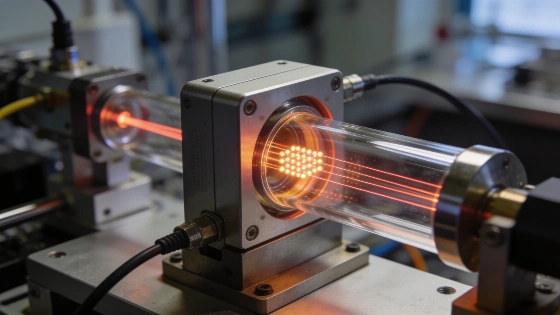
Neutral atoms are held and addressed with optical tweezers. Sqale also uses dynamic atom shuttling to move qubits through the processor and provide broad logical connectivity. This arrangement matters because connectivity determines how many additional operations are needed to entangle distant qubits. The demonstration therefore tested more than a qubit count: it combined encoded information with a control architecture intended to reduce routing overhead.
The reported circuit was an Instantaneous Quantum Polynomial-time benchmark containing about 1,000 physical operations, or 1 KiloQuOp. It included four transversal logical CCZ gates, which are non-Clifford operations and therefore probe a more demanding part of the logical gate set than a circuit made only from simpler Clifford operations. The workload was designed as a compact systems benchmark rather than as evidence that the processor had solved a practically useful optimization, simulation or biomedical problem.
A key part of the result came from an AI-assisted circuit-discovery process using the GPT 5.6 Sol model. Infleqtion says the process identified a more efficient logical double-CZ construction and reduced the stated physical two-qubit overhead for that operation from eight gates to four. Across the demonstrated circuit, the company reported 136 physical two-qubit gates. Reducing two-qubit depth can limit opportunities for control error, atom loss and calibration drift, although the benefit must be measured across repeated runs and a broader logical gate set.
The AI contribution is specific rather than a replacement for the physical processor. It identified a lower-overhead gate construction for the demonstrated workload; it did not remove the need for laser control, atom preparation, calibration, measurement or error decoding. Similar automated circuit-search approaches are being explored across the field, including by groups associated with MIT and other laboratories, but the usefulness of such methods depends on whether the discovered circuits remain robust under hardware noise and changing device conditions.
The supplied announcement does not provide gate fidelities, coherence times, logical error rates, readout fidelities, confidence intervals or a statistical uncertainty for the reported sampling result. Those missing quantities prevent a direct comparison with other quantum processors on algorithmic reliability. A lower gate count is an important engineering metric, but it is not by itself a measurement of fault-tolerant performance.
Atom loss creates a practical problem for neutral-atom processors because a missing atom can remove a measurement outcome from an otherwise valid circuit execution. Infleqtion says its Superstaq compilation and software stack reconstructed missing X-basis outcomes through parity-based post-processing. The company reports that this increased the yield of valid circuit shots by a factor of four.
The benchmark returned target-state samples at roughly 1,000 times the uniform-random background-noise baseline. The reported sampling baseline was a 25% hit fraction across more than 1 billion Hilbert-space outcomes. These figures describe the selected benchmark and its validation procedure; they do not establish a general computational advantage over classical machines. The supplied material also does not identify a classical runtime, an independently optimized classical algorithm or a peer-reviewed statistical comparison.
Infleqtion separately described the experimental signal as approximately 1,000 times stronger than the underlying noise. That statement concerns the reported signal-to-noise behavior of this experiment and should not be confused with a universal error-suppression factor for the processor. Independent replication, complete sampling data and a transparent comparison protocol would be needed to determine how the result compares with other platforms.
The distinction between correction and mitigation is important. The encoded blocks and logical gates are part of an error-correction architecture, while reconstructing missing measurement results after the run is software-based loss correction. Neither fact alone demonstrates fault-tolerant computation, in which logical errors must remain controllable as circuits and encoded systems grow. The threshold concept familiar from the quantum-error-correction literature, including work published in Nature, requires a demonstrated relationship between physical noise, decoder performance and logical error rates rather than only a successful benchmark sample.
Infleqtion says the 30-logical-qubit capability is already being used in commercial and health-tech applications including the Wellcome Leap Quantum for Bio, or Q4Bio, program for GPU-trained biomarker discovery. The supplied material does not report a biomarker result from the processor, a measured improvement over a classical workflow or a completed application outcome. It is therefore more accurate to describe the system as deployed for those application efforts than to call the demonstration a validated biomedical advance.
The result also belongs to a rapidly diversifying hardware field. A related hardware report examined an on-premises superconducting system, whereas Sqale uses individually controlled neutral atoms and atom movement for connectivity. Comparing the two by raw qubit count would obscure the more consequential differences in encoding, control, readout, error sources and operating infrastructure. Systems developed by organizations ranging from CERN-linked research programs to university laboratories such as Stanford and MIT likewise require comparisons based on logical error rates and circuit performance, not only headline qubit totals.
Infleqtion's roadmap targets 100 logical qubits by 2028 and 1,000 by 2030. Those are company targets rather than demonstrated capabilities. Reaching them would require preserving control quality while increasing the number of atoms and logical operations, handling loss and calibration across a larger array and showing that logical performance remains useful rather than merely increasing the nominal encoded-qubit count. The engineering challenge is distinct from the large-scale cryogenic and microwave-control requirements used by superconducting platforms studied in laboratories including NASA-associated technology programs.
A logical qubit is an encoded degree of freedom distributed across several physical qubits so that error information can be detected or corrected. Entangling logical qubits means creating nonclassical correlations between those encoded states, not sending information faster than light. In Sqale's case, the achievement is a substantial hardware benchmark with a clear architectural mechanism for reducing gate overhead, but the evidence supplied does not establish fault tolerance or quantum advantage. Its strongest significance is narrower and more credible: Infleqtion has shown that neutral-atom hardware can combine encoded qubits, non-Clifford operations, atom movement and post-processed loss recovery in one commercial demonstration, while the harder test remains sustained logical performance at larger scale.