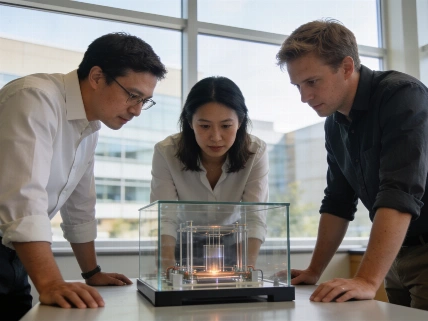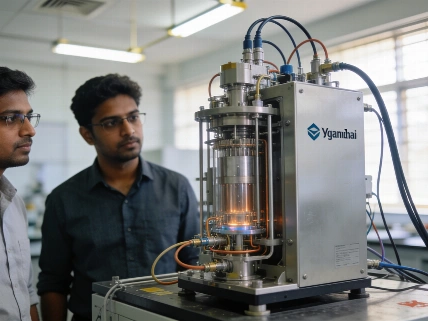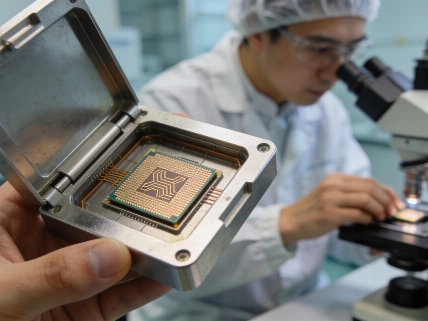
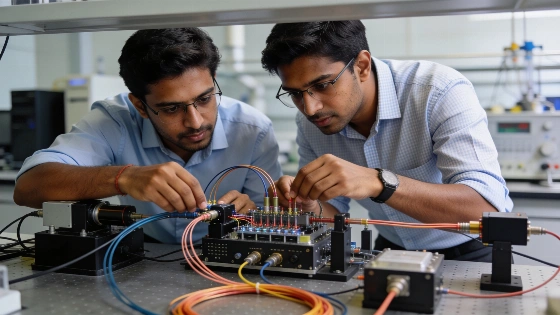
QNu Labs and SRMIST have launched a quantum communications laboratory equipped with industry-grade quantum key distribution hardware, aiming to train faculty and expand practical quantum education in India
QNu Labs, an Indian developer of quantum cybersecurity systems, has partnered with the SRM Institute of Science and Technology (SRMIST) to establish a dedicated quantum communications laboratory at the university's Kattankulathur campus. The initiative, supported by India's National Quantum Mission and the Department of Science and Technology, is designed to address a critical gap in quantum workforce development by providing hands-on training for educators using operational quantum key distribution (QKD) hardware rather than simulated environments.
Physical Quantum Hardware
The new laboratory is equipped with industry-grade QKD devices and quantum-safe infrastructure, similar to those deployed in national defense and banking sectors. Unlike many university programs that rely on software simulations, the SRMIST facility enables students and researchers to interact directly with physical quantum communication systems. This approach allows for the practical construction, testing, and benchmarking of cryptographic protocols under real-world conditions, exposing learners to the technical challenges of photon loss, detector efficiency, and channel noise that affect secure key distribution in operational networks.
Educator Training and Certification
Through the QNu Academy framework, the first cohort of SRMIST faculty completed a structured training and certification program in quantum communications. The curriculum focused on the principles and implementation of QKD, the operation of quantum-safe hardware, and the integration of quantum protocols into existing network infrastructure. By certifying educators to deliver standardized coursework, the program aims to scale quantum education across SRMIST's academic offerings and create a pipeline of graduates with practical skills in quantum engineering and security.
National Quantum Mission and Workforce Pipeline
The laboratory's deployment is part of a broader national effort to build quantum research and education capacity in India. The National Quantum Mission, launched by the Indian government, prioritizes the development of quantum technologies and the training of a technically skilled workforce. The SRMIST lab complements existing hardware initiatives and is intended to serve as a model for similar facilities at other institutions. The inaugural event was attended by representatives from the National Quantum Mission, SRMIST leadership, QNu Labs, and T-Hub, reflecting the multi-institutional support for the project.
Comparison With Other Quantum Education Initiatives
India's approach to quantum workforce development emphasizes direct access to operational hardware, contrasting with programs that focus primarily on theoretical or simulated instruction. This strategy is echoed in other regions, such as the United States, where projects like the EPB Quantum Network are integrating quantum computers and photonic nodes to support research and workforce training in applied settings. For example, a recent deployment in Tennessee connects a trapped-ion quantum computer to a photonic network, enabling hands-on experimentation for students and researchers (regional quantum network integration).
According to information provided by QNu Labs and SRMIST, the laboratory features industry-standard QKD hardware, but specific technical specifications such as secret-key rates, channel distances, or error rates have not been publicly disclosed. The facility is intended for both teaching and research, with the expectation that students will gain experience in device calibration, error analysis, and the practical limitations of quantum-secure communication. The program's effectiveness in producing industry-ready graduates will depend on continued access to up-to-date hardware and the integration of evolving quantum protocols.
Quantum key distribution (QKD) is a cryptographic technique that uses quantum states-typically single photons-to generate and share secret keys between parties. The security of QKD relies on the fundamental properties of quantum measurement: any attempt to intercept or measure the quantum states disturbs them, revealing the presence of an eavesdropper. However, practical QKD systems face engineering challenges such as photon loss in optical fibers, detector noise, and finite key rates. Real-world deployment requires careful calibration, error correction, and integration with classical authentication protocols. Hands-on experience with operational QKD hardware is essential for understanding both the promise and the limitations of quantum-secure communication.