
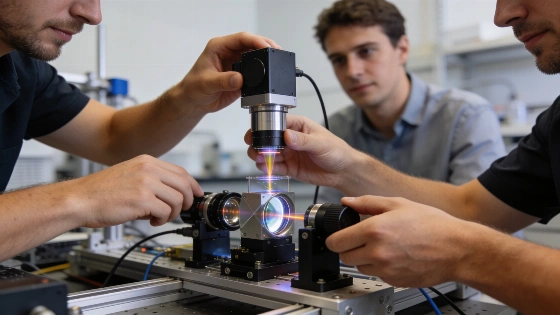
Diffraqtion has raised over $10 million in pre-seed funding to advance quantum-enabled optical sensing platforms that claim to resolve features far below the classical diffraction limit, targeting applications in space domain awareness and defense
Diffraqtion, a startup developing quantum-enabled optical sensing platforms, has closed a pre-seed funding round exceeding $10 million. The round includes strategic investments from Lockheed Martin Ventures and Presidio Ventures, the venture capital arm of Sumitomo Corporation, alongside participation from existing investors. The company aims to deliver quantum camera systems capable of resolving spatial features significantly smaller than those accessible to conventional optics, with a focus on applications in space domain awareness and defense reconnaissance.
Quantum Sensing Without Qubits
Unlike many quantum technology efforts that rely on qubits or cryogenic infrastructure, Diffraqtion's approach is based on passive photonic hardware and quantum estimation theory. The company's camera platform does not use quantum computing algorithms or require low-temperature operation. Instead, it sorts incoming photons by their spatial mode and shape before detection, extracting more information from the optical field than traditional pixel-based sensors, which only measure intensity. This method leverages quantum estimation principles to surpass the classical diffraction limit, a fundamental constraint that typically forces optical systems to use larger apertures to improve resolution.
Performance Claims and Technical Evidence
According to company-reported simulations, Diffraqtion's platform can resolve features up to 20 times smaller than those accessible to standard optical systems. The system is designed to perform target classification at speeds orders of magnitude faster than conventional approaches, using low-power onboard photonic inference. These claims are based on simulation and laboratory validation, not yet on large-scale field deployment. Over a seven-month technical validation period, Diffraqtion demonstrated its technology at a terrestrial observatory, distinguishing closely spaced objects under real-world conditions. The company also advanced a DARPA Direct-to-Phase-II SBIR project and secured a NASA Phase I SBIR for orbital debris tracking. In addition, Diffraqtion won NASA's $100,000 Space to Soil Challenge for adaptive onboard processing.
Engineering and Deployment Roadmap
Diffraqtion is led by CEO and Co-Founder Johannes Galatsanos, with Peter Kazlas, formerly of E Ink and QD Vision, joining as Head of Engineering to oversee the transition to volume hardware manufacturing. The newly raised capital will support the construction of the company's first field-deployable quantum camera, which is scheduled to achieve orbital flight heritage as a hosted payload on a partner spacecraft. The intended use cases include space domain awareness and defense reconnaissance, where the ability to resolve and classify objects at high speed and low power is critical. While the company's approach is distinct from quantum computing, it shares the broader quantum sensing ambition of extracting more information from physical systems than classical measurement allows. For context on the broader field, recent developments in quantum sensing for biomedicine have also attracted significant funding, as seen in the National Science Foundation's support for quantum sensor research.
Limitations and Open Questions
Diffraqtion's technology remains at the prototype and demonstration stage. The company's performance claims are based on simulation and limited field tests, and independent replication or peer-reviewed benchmarking has not yet been reported. The transition from laboratory demonstration to reliable, manufacturable hardware suitable for deployment in space or defense environments presents substantial engineering challenges. Key questions include the robustness of the photonic hardware under variable environmental conditions, the scalability of the manufacturing process, and the system's performance in the presence of real-world noise and interference. As with many quantum sensing proposals, the practical advantage over advanced classical systems will depend on reproducible field results and fair benchmarking against the best available alternatives.
Quantum sensing refers to measurement techniques that exploit quantum properties-such as superposition, entanglement, or quantum estimation-to achieve sensitivity or resolution beyond classical limits. In optical systems, the diffraction limit sets a fundamental bound on the smallest resolvable feature size for a given aperture. Quantum estimation strategies can, in principle, extract more information from the same number of photons by measuring additional properties of the light field, such as spatial mode structure. However, realizing these advantages in practical devices requires careful engineering to manage noise, loss, and environmental variability. The distinction between quantum-inspired and fully quantum-enhanced sensing is important: not all approaches that use quantum theory require qubits or entanglement, and the degree of quantum advantage must be established through rigorous comparison with classical methods.