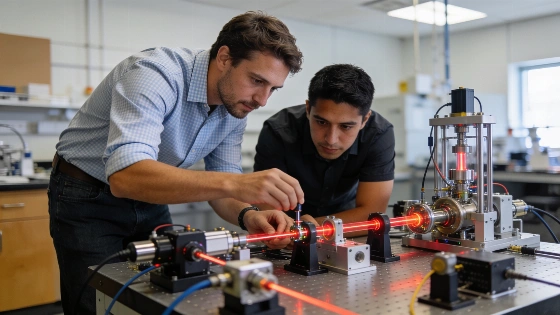
Quantinuum will expand its Albuquerque facility with $1.5 million in city and state funding, focusing on integrated photonics for trapped-ion quantum processors and strengthening ties with national laboratories
Quantinuum, a developer of trapped-ion quantum computing hardware, has announced plans to expand its research and development operations in Albuquerque, New Mexico. The company will establish a new facility dedicated to integrated photonics for trapped-ion quantum processors, supported by a combined $1.5 million incentive package from the State of New Mexico and the City of Albuquerque. The funding, split evenly between state and municipal Local Economic Development Act (LEDA) sources, is intended to accelerate the development of chip-scale photonic components essential for next-generation quantum architectures.
Integrated Photonics for Trapped-Ion Systems
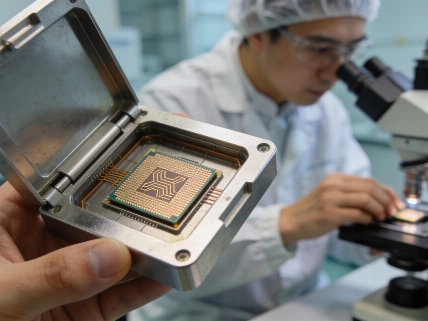
The expanded site at 5501 Wilshire will be converted from a vacant property into laboratory and office space focused on photonic integration. In trapped-ion quantum computing, precise laser control is required to manipulate and entangle qubits-ions confined in electromagnetic traps. Quantinuum's roadmap emphasizes miniaturized photonic devices capable of guiding, modulating, and delivering laser light with high spatial and temporal precision. These integrated photonic systems are critical for scaling up multi-zone quantum processing units (QPUs), enabling more complex quantum circuits and improved qubit addressability.
Collaboration with National Laboratories
The Albuquerque hub is positioned to strengthen Quantinuum's collaborative research with nearby federal institutions, including Sandia National Laboratories, Los Alamos National Laboratory, and the University of New Mexico. These partnerships are expected to support both fundamental research and the engineering of photonic components compatible with advanced trapped-ion platforms. The region's established quantum research ecosystem, which has attracted over $450 million in public investment, provides infrastructure and expertise for device fabrication, testing, and integration.
Regional Quantum Infrastructure
New Mexico's broader quantum initiative has prioritized investment in research infrastructure, start-up support, and defense partnerships, including collaborations with agencies such as DARPA. The Quantinuum expansion complements the company's headquarters in Broomfield, Colorado, and its international technology centers. The focus on integrated photonics reflects a wider industry trend toward miniaturization and scalable control in quantum hardware. For context, other companies are also pursuing modular approaches to trapped-ion systems, as seen in recent efforts to standardize manufacturing processes for scalable quantum devices-a topic previously covered in Science Report.
According to the company, the new Albuquerque facility will serve as a platform for both internal R&D and external collaboration. While the funding supports infrastructure and equipment, the technical challenge remains to demonstrate reliable, low-loss photonic integration at the scale required for practical quantum computation. Quantinuum has not disclosed specific device performance targets or timelines for the expanded site, and independent benchmarking of integrated photonic modules in operational trapped-ion processors has not yet been reported.
Integrated photonics in trapped-ion quantum computing refers to the use of on-chip optical components-such as waveguides, modulators, and beam splitters-to deliver and control laser light for qubit operations. Unlike bulk optics, integrated photonic devices can be fabricated using semiconductor processes, enabling more compact, stable, and scalable architectures. However, achieving low optical loss, high-fidelity modulation, and precise alignment with ion traps remains a significant engineering challenge. Progress in this area is essential for increasing the number of controllable qubits and reducing the complexity of optical setups in large-scale quantum processors.