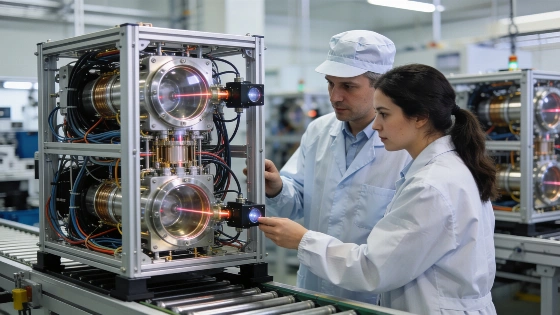
Quantinuum and Quanta Computer have agreed to co-develop manufacturing processes for modular trapped-ion quantum computing hardware, aiming to move beyond laboratory prototypes toward standardized, enterprise-ready systems
Quantinuum and Quanta Computer have announced a collaborative development agreement intended to address one of the central engineering challenges in quantum computing: the transition from custom-built, laboratory-scale trapped-ion devices to standardized, mass-manufacturable hardware suitable for enterprise and cloud deployment. The partnership brings together Quantinuum's experience with trapped-ion Quantum Charge-Coupled Device (QCCD) architectures and Quanta's established expertise in global electronics manufacturing and cloud infrastructure.
Trapped-Ion System Engineering
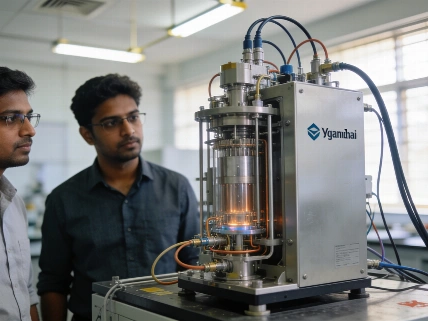
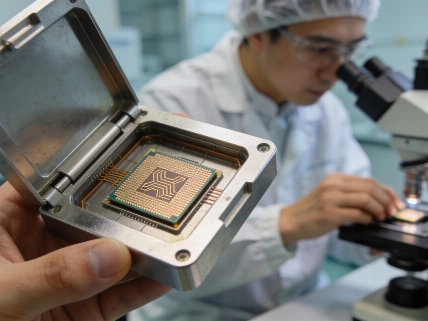
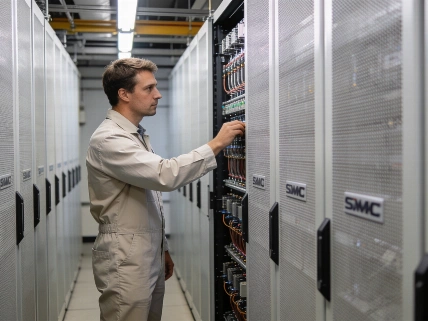
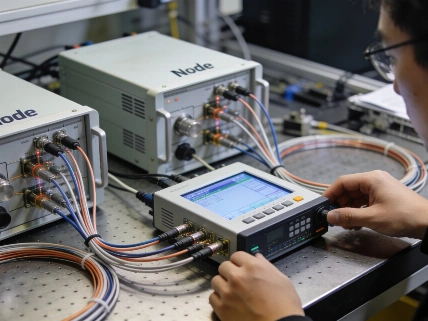
Trapped-ion quantum computers use individual ions, typically held in electromagnetic fields within ultra-high vacuum chambers, as physical qubits. These systems are valued for their long coherence times and high-fidelity gate operations, but their complexity and sensitivity have historically limited production to bespoke laboratory setups. Quantinuum's QCCD approach involves shuttling ions between zones for gate operations and measurement, requiring precise control electronics, stable laser systems, and robust environmental isolation. The new agreement focuses on modularizing these subsystems-such as rack-mountable enclosures, environmental packaging, and high-density interconnects-to enable repeatable assembly and integration into standard data center environments.
Manufacturing and Supply Chain Challenges
Scaling up trapped-ion hardware for commercial use demands more than technical performance at the device level. The collaboration aims to establish high-volume procurement pipelines for critical components, including sub-system electronics, laser and optical assemblies, and radio-frequency (RF) control hardware. Automated manufacturing lines are being designed to replace low-volume, manual assembly, with the goal of delivering standardized quantum processing units (QPUs) to commercial data centers and hyperscale cloud providers. This approach is intended to address variability, yield, and reproducibility-persistent obstacles in moving from laboratory demonstration to industrial-scale deployment.
Roadmap and Integration Efforts
The agreement is led by Quantinuum President and CEO Dr. Rajeeb Hazra and Quanta Computer's executive team. It follows Quantinuum's recent partnership with Oracle, which saw the company's 98-qubit Helios trapped-ion processor deployed within Oracle Cloud Infrastructure data centers. That integration, described in Science Report's coverage of the Helios-Oracle deployment, marked a step toward hybrid quantum-classical workloads for enterprise users. The current collaboration with Quanta Computer is positioned as a next phase, focusing on the physical and logistical infrastructure required to support future generations of larger, fault-tolerant quantum systems.
Technical and Engineering Limitations
While the partnership targets the industrialization of trapped-ion quantum hardware, significant technical hurdles remain. Trapped-ion systems require ultra-high vacuum, precise temperature control, and stable electromagnetic environments, all of which complicate mass production and field deployment. The transition from laboratory prototypes to standardized hardware will depend on maintaining high qubit coherence and gate fidelity across larger device arrays, as well as ensuring that automated assembly does not introduce new sources of noise or error. The companies have not yet released detailed performance metrics for the new manufacturing processes, and independent verification of system-level reliability and reproducibility will be essential before large-scale commercial deployment can be claimed.
In quantum computing, the distinction between physical and logical qubits is central to evaluating progress toward fault-tolerant systems. Physical qubits are the actual quantum systems-such as trapped ions-used to encode information, but they are susceptible to errors from environmental noise, control imperfections, and decoherence. Logical qubits are constructed by encoding information redundantly across multiple physical qubits using quantum error-correcting codes, allowing errors to be detected and corrected. Achieving practical fault tolerance requires not only high-fidelity physical qubits but also scalable architectures, reliable error correction, and robust manufacturing processes that can deliver consistent device performance at scale.