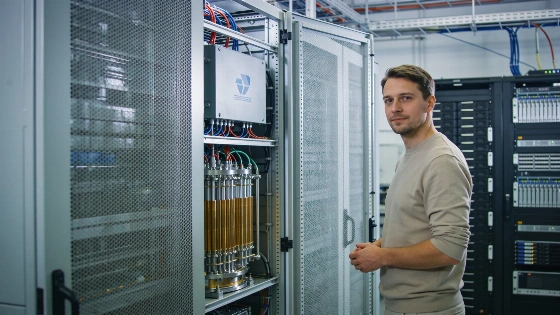
The European Union is backing a 36-month, €5 million effort to build an open and interoperable software layer across quantum processors, annealers and high-performance computing systems while addressing noise, testing and fragmented compilers.
Europe is putting €5 million behind an attempt to solve one of quantum computing's least glamorous but most consequential problems: software that can move between incompatible machines. The 36-month consortium referred to as Q-VERSE in project coverage is supported through Horizon Europe and aims to develop an open, interoperable stack that reduces dependence on any single hardware platform. Its objective is to separate application development from the physical details of gate-based processors, quantum annealers and high-performance computing clusters.
The initiative reflects a broader engineering lesson in scientific computing. Layered software and common interfaces allow complex systems to evolve without forcing every application to be rewritten when the underlying hardware changes. Similar abstraction challenges exist in large research infrastructures associated with CERN and NASA, although quantum systems add distinctive constraints because measurement changes the state, qubits are highly noise-sensitive and different processors expose substantially different control models.
Q-VERSE stands for Quantum Virtual Ecosystem for a unified Runtime for agnostic Software Engineering. The project is presented as a European quantum-software consortium operating for 36 months with Horizon Europe support. Its stated goal is an open and interoperable software stack rather than a new quantum processor. A Fraunhofer IKS announcement identifies Fraunhofer IKS as coordinator and describes a 13-partner consortium involving organizations from Germany, France, Austria, Spain, Sweden, the Czech Republic and Finland.
The European effort places the open-source Eclipse Qrisp framework at the center of its proposed high-level programming environment. The objective is not to erase hardware differences, but to expose them through a common software route. Today's quantum platforms vary in gate sets, connectivity constraints, calibration procedures, noise behavior and programming interfaces. A portable stack can reduce duplicated engineering work, while still allowing compilers and runtime systems to account for those physical differences.
That distinction is important because portability does not mean identical performance. A circuit that is efficient on a processor with a dense connectivity graph may require many additional operations on a device with restricted couplings. Extra operations can increase exposure to decoherence and control errors. Likewise, quantum annealers solve optimization problems through a different physical and computational model from universal gate-based machines, so a shared interface must preserve meaningful information about what each backend can actually execute.
The planned stack will combine OpenQASM with the LLVM-based Quantum Intermediate Representation known as QIR. Intermediate representations act as a translation layer between application code and hardware-specific compilation. They can preserve program structure and execution metadata while allowing different compiler passes to target different processors or quantum-classical systems.
A central proposed feature is dynamic capability discovery. At runtime, the platform is expected to query a processor's available gates, connectivity graph and noise profile rather than relying only on static assumptions. That approach could allow compilation and execution decisions to respond to changing hardware conditions, although the available project descriptions present this as a development goal rather than a demonstrated capability.
Q-VERSE also plans interaction layers based on gRPC and RESTful API bindings. Those interfaces would connect application frameworks with physical quantum processing units and quantum-annealing solvers, while also linking quantum workloads to classical computing resources. The architecture therefore treats quantum processing as part of a hybrid workflow: classical machines may prepare data, optimize parameters, manage control logic and analyze measurements before and after a quantum subroutine runs.
The hybrid model is consistent with how quantum algorithms are generally implemented on present-day noisy devices. A quantum processor rarely receives an entire application in isolation; it executes selected subroutines while conventional processors handle orchestration, compilation, optimization and statistical post-processing. The practical value of an abstraction layer will therefore depend not only on circuit portability, but also on whether it measures communication overhead, queueing time, compilation cost and classical processing requirements.
The consortium's software ambitions will be judged against the practical limitations of noisy intermediate-scale quantum hardware. Simula Research Laboratory leads the work package concerned with testing and integration. According to project coverage, its responsibilities include hybrid quantum-classical workflows, automated software testing, machine-learning-based noise mitigation and performance benchmarking.
Those tasks address different problems and should not be conflated. Noise mitigation uses classical processing or circuit-level techniques to reduce the effect of errors in measured results; it is not the same as quantum error correction, which encodes information across multiple physical qubits and detects or corrects faults through a dedicated code and decoding process. The project information does not report logical qubits, error-correction cycles, gate fidelities or a hardware demonstration, so Q-VERSE does not establish fault-tolerant operation or quantum advantage.
Peer-reviewed work reported in journals such as Nature has shown why this distinction matters: improvements in raw hardware performance, error suppression and logical error correction are separate milestones, each requiring different measurements. A software framework may help benchmark those layers consistently, but it cannot by itself create the redundancy, control accuracy or decoding performance required for fault-tolerant quantum computation.
Automated testing is especially important because quantum programs are probabilistic. A single execution produces samples rather than a deterministic output, and useful comparisons may require repeated shots, confidence estimates and carefully defined baselines. Benchmarking should also distinguish compilation overhead from circuit execution, compare like-for-like classical solvers and report how mitigation changes both accuracy and computational cost. These methodological requirements echo practices in conventional high-performance computing and in experimental research communities such as MIT and the broader quantum-information field.
The project is scheduled to test the ecosystem in five industrial pilot domains. They include railway dispatch scheduling, financial portfolio optimization, pharmaceutical molecular design and telecommunications data analytics, with the project descriptions also referring to a fifth industrial validation case. These pilots are validation targets for the software environment, not reported evidence that a quantum processor has already improved any of those workflows.
The measurable commitment is €5 million over 36 months for a 13-partner European research and innovation effort. The program spans gate-based quantum processors, quantum annealers and HPC clusters, with Qrisp as the high-level baseline, OpenQASM and QIR as intermediate representations, and gRPC and RESTful APIs as planned integration mechanisms. The work package structure identifies hybrid workflows, machine-learning-based noise mitigation, automated testing and runtime benchmarking as explicit development priorities.
The geographic breadth of the consortium is relevant to the software objective. Partners from seven European countries bring the project into contact with different research, industrial and computing environments, while coordination by Fraunhofer IKS gives the initiative a defined institutional center. The stated ambition is to simplify access to quantum resources and connect classical and quantum computing through a common stack, a direction that parallels wider efforts to standardize interfaces across fragmented technical ecosystems.
That scope makes Q-VERSE an infrastructure project rather than a claim about a single superior quantum architecture. A hardware-agnostic layer could reduce duplicated software effort and make backend comparisons easier, but portability is not automatic. Different processors may support different operations, topologies and noise models, while annealers do not execute the same gate-based circuits as universal gate-model machines. A common interface can expose those differences; it cannot remove their physical consequences.
The project is best understood as a funded plan to build and evaluate shared software infrastructure. Its significance will depend on whether the resulting tools can compile real applications reliably, detect backend limitations accurately, integrate classical processing without hiding total costs and produce benchmarks that remain meaningful across unlike machines. Until those tests are reported, Q-VERSE signals a serious attempt to address fragmentation, not a demonstrated solution to quantum computing's performance problem.
For readers assessing the claim, the key distinction is between physical hardware access and software abstraction. A physical qubit is an individual controllable quantum system, while a logical qubit is encoded across multiple physical qubits to manage errors; Q-VERSE's announcement concerns the layer that programs and orchestrates hardware, not the creation of logical qubits. In that context, the project's strongest contribution could be discipline: standardized interfaces and runtime measurements may make quantum systems easier to compare. The funding therefore matters because it targets the connective tissue of the field, but it should be judged by delivered interoperability and reproducible benchmarks rather than by the promise of hardware independence alone. The earlier software-layer challenge is also visible in an earlier control-layer report, though Q-VERSE addresses quantum execution rather than cryptographic migration.