A research team has built a hierarchical reinforcement learning system that enables a four-legged robot to leap through narrow gates at speed, coordinating vision and movement in real-world tests inspired by animal agility
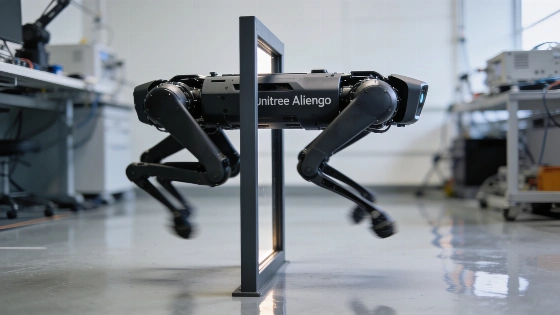
In a controlled laboratory setting, a 22-kilogram quadruped robot accelerated toward a narrow gate, calculated its trajectory in real time, and launched itself through the opening-without relying on a pre-scripted jump. The demonstration, led by researchers at the University of Hong Kong and the Oxford Robotics Institute, marks a concrete advance in machine agility: the robot selected when to leap, adjusted its gait, and coordinated its limbs to clear the obstacle, all using a learning-based control system rather than fixed motion sequences.
This result is not a generic claim of animal-like movement. The team's system, called ConsJump, was evaluated on a Unitree Aliengo robot, which autonomously traversed gates similar in size to its own body. The robot's onboard Intel D435i RGB-D camera provided both color and depth data, allowing the perception module to estimate the gate's position and geometry. The high-level controller then determined the optimal moment to transition from running to jumping, while the low-level controller executed the chosen movement pattern. During testing, the robot reached speeds up to 2.5 meters per second before decelerating for landing, with the airborne phase lasting approximately 0.44 seconds.
ConsJump's architecture divides control into two layers. The low-level controller was trained in simulation using imitation learning, drawing on animal-inspired gaits such as pacing, cantering, and jumping. This controller manages joint coordination and adapts movement to the robot's physical structure, with particular emphasis on mastering aerial maneuvers. The high-level controller, trained via reinforcement learning, acts as a decision-maker: it receives environmental input and selects which movement to deploy, issuing velocity and turning commands rather than direct joint instructions. This separation allows the robot to blend learned skills fluidly, rather than switching abruptly between pre-defined actions.
To bridge the gap between simulation and physical deployment, the researchers trained 5,480 simulated agents in parallel, varying parameters such as motor strength, latency, and added mass to improve robustness. The resulting policy was transferred to the physical robot, which processed perception and control onboard. The system was tested on uneven terrain and with gates in different positions, and it adapted to slips and minor disturbances without retraining the entire locomotion module. This modularity is a notable strength: the same architecture could, in principle, be extended to other complex tasks by updating only the high-level decision logic.
While the demonstration is technically impressive, it remains a research prototype. The robot's performance was evaluated in a controlled environment, and the success rate, failure cases, and safety margins were not disclosed in detail. Human intervention was not required during the tested runs, but the system's reliability in unstructured or crowded real-world settings is unproven. The approach is reminiscent of other recent advances in animal-inspired robotics, such as the six-legged robot that learned adaptive walking from stick insect data, as reported earlier.
For robotics researchers, the key technical contribution is the hierarchical reinforcement learning framework that separates skill acquisition from high-level decision-making. By training the low-level controller to master a repertoire of agile movements and delegating environmental adaptation to the high-level controller, the system achieves a degree of flexibility not seen in conventional rule-based control. However, the leap from laboratory demonstration to robust field deployment remains substantial. The evidence supports the claim that learning-based controllers can enable more dynamic and adaptive robot locomotion, but it does not establish that such systems are ready for unsupervised operation in unpredictable environments. The field's next challenge is to quantify reliability, safety, and failure recovery under real-world conditions-without sacrificing the agility that makes these systems promising in the first place.
Reinforcement learning in robotics refers to training a control policy through trial and error, where the robot receives feedback (rewards or penalties) based on its actions in a simulated or physical environment. Hierarchical reinforcement learning further divides the problem: a high-level policy selects among lower-level skills, each of which is itself learned or programmed. This structure allows robots to combine complex behaviors and adapt to new situations without retraining every component. However, transferring policies from simulation to real hardware-known as sim-to-real transfer-remains a major engineering challenge, as physical systems introduce noise, delays, and unmodeled dynamics that can undermine learned strategies.