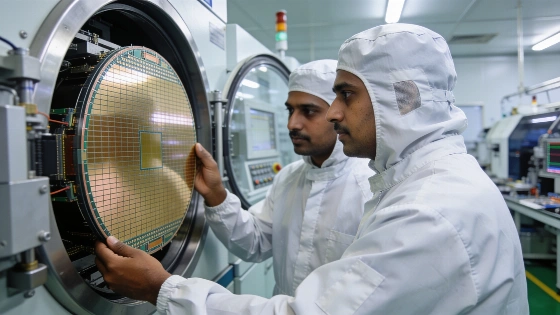
QpiAI has launched an 8-inch quantum chip fabrication facility in Bengaluru, aiming to manufacture superconducting quantum processors with up to 128 physical qubits and expand to 10,000-qubit devices by 2027. The site integrates full-stack device manufacturing and R&D.
QpiAI, a startup focused on quantum and artificial intelligence hardware, has inaugurated an 8-inch quantum processor fabrication facility in Jakkur, Bengaluru. The foundry, part of the company's 70,000-square-foot research and development center, is designed to produce superconducting quantum processing units (QPUs) and associated control electronics. The facility currently supports the fabrication of flip-chip superconducting processors with up to 128 physical qubits, with plans to expand to single-chip devices containing as many as 10,000 physical qubits by 2027.
Device Fabrication and Capabilities
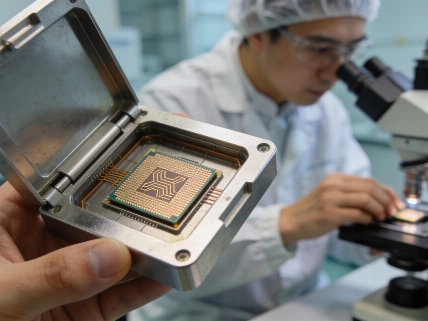
The foundry operates with Class 100 and Class 1,000 cleanroom environments, enabling the full device manufacturing lifecycle on-site. This includes electron-beam lithography, wet and dry etching, patterning, Josephson-junction fabrication, 3D flip-chip assembly, and cryogenic packaging. In addition to superconducting QPUs, the facility supports research into photonic and semiconductor spin qubits, as well as the development of peripheral control chips and sensors. The integration of these processes is intended to address the engineering challenges of scaling up quantum hardware while maintaining device yield and reproducibility.
Processor Prototypes and Roadmap
QpiAI has reported the fabrication of four primary quantum processors at the site: QVidya, an 8-qubit superconducting transmon chip; Indus, a 25-qubit transmon QPU integrated into hybrid classical high-performance computing centers; Kaveri, a 64-qubit superconducting transmon processor using proprietary low-loss flip-chip interconnects; and Yukti, a 9-qubit processor based on a fluxonium qubit variant for evaluating fault-tolerant surface codes. The company states that its next milestone is the delivery of a 128-qubit Ganges processor. However, the performance metrics-such as gate fidelity, coherence time, and error rates-have not been independently verified or published in peer-reviewed literature. The roadmap to a 10,000-qubit device by 2027 remains a projection contingent on advances in fabrication, control, and error correction.
Infrastructure, Investment, and Integration
To date, QpiAI has invested between $20 million and $25 million USD in the facility, with an additional $10 million to $15 million USD allocated for further equipment and testing expansion in the next phase. The foundry is positioned as the hardware backbone for the company's planned Quantum Supremacy Centres (QSCs)-hybrid data centers that aim to integrate fault-tolerant QPUs with artificial intelligence clusters for applications in pharmaceutical simulation, logistics, and materials science. The primary QSC is planned for a 10-acre campus in India, with 300,000 square feet of built-up space, and four additional international sites are under consideration. QpiAI's funding includes a $32 million USD Series A round co-led by Avataar Ventures and India's National Quantum Mission (NQM), and the company is among eight startups selected for direct equity and grant support under NQM's domestic hardware initiative.
Scaling Challenges and Industry Context
While QpiAI's foundry represents a significant infrastructure investment for India's quantum hardware ecosystem, the transition from prototype devices to large-scale, fault-tolerant quantum processors remains a major engineering challenge. Achieving high device yield, stable coherence, low error rates, and reliable control across thousands of qubits has not yet been demonstrated in any superconducting platform. The company's approach to integrating fabrication, assembly, and packaging under one roof is intended to address some of these bottlenecks, but the scalability of such systems is still an open question. For comparison, other industry efforts-such as the modular trapped-ion hardware development described in recent collaborative projects-highlight the diversity of approaches and the unresolved technical barriers to practical quantum computing at scale.
Superconducting quantum processors use physical qubits-typically based on transmon or fluxonium circuits cooled to millikelvin temperatures-to encode and manipulate quantum information. Each physical qubit is a controllable quantum system, but errors from decoherence, crosstalk, and imperfect gates accumulate rapidly as device size increases. To perform useful computations, quantum error correction is required, which encodes logical qubits across many physical qubits and detects or corrects errors in real time. The gap between the number of physical qubits and the number of reliable logical qubits is a central challenge for all quantum hardware platforms. Progress in fabrication, control electronics, and error correction codes will determine whether large-scale, fault-tolerant quantum processors can be realized in practice.