A 46×16 superconducting array produced a reproducible zero-flux anti-peak using uniform loop geometries, offering a route to absolute magnetic sensing without sacrificing the junctions' intrinsic sensitivity
A 46×16 test array produced a reproducible voltage dip at zero magnetic flux even though its physical loop areas were uniform. The result demonstrates a way to establish an absolute zero-field reference without varying loop sizes across a superconducting quantum interference filter (SQIF) array.
Engineering an effective spread
DC superconducting quantum interference devices, or SQUIDs, are highly sensitive magnetic-field detectors. Their voltage changes periodically with magnetic flux, though, so the response alone does not identify an absolute zero-field baseline. Conventional SQIF arrays address that problem with loops of incommensurate areas, whose interference produces a distinctive central anti-peak.
Changing loop areas also changes each cell's inductance. That variation can disturb the screening parameter βL and compromise the uniform operating conditions associated with high sensitivity. Adelaide University's Quantum and Nano Technology Group (QuaNTeG) developed a design that avoids physical area variation while reproducing the effect of a spread of loop areas.
What the array showed
Led by Associate Professor Giuseppe Tettamanzi of Adelaide University's School of Chemical Engineering and QuaNTeG, the team reformulated the resistively shunted junction (RSJ) equations to include bare superconducting loops: closed loops with no Josephson junctions. PhD researchers Ross Monaghan and Jonathan Marenkovic are also identified as members of the research team. In the model, bare loops add an anomalous inductive-flux term. Current-conservation constraints across the network translate that term into an effective, or synthetic, distribution of loop areas acting on the active junctions.
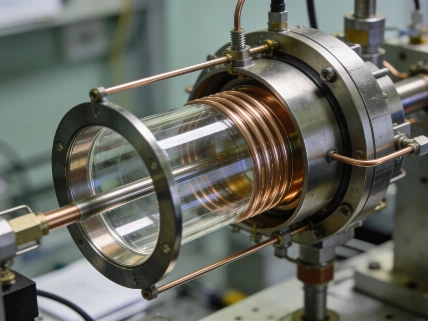
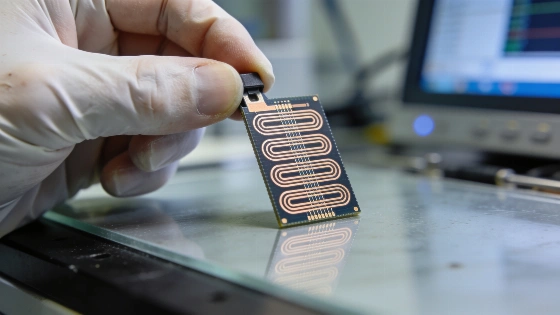
The effect was tested in fabricated devices operated at very low temperatures, with fabrication involving commercial superconducting foundry SEEQC. A standard 16×16 uniform array showed periodic voltage-magnetic-flux oscillations. In contrast, the 46×16 device contained sixteen rows of active Josephson-junction loops separated by pairs of bare-loop rows. It displayed a pronounced, reproducible anti-peak at zero flux, matching the theoretical prediction despite the uniform physical loop geometries.
Scope and next steps
The result is a device demonstration of the zero-field signature. The researchers identify potential uses in magnetoencephalography (MEG) brain imaging and low-noise RF receivers; quantum hardware readout is another proposed application. A separate spin-chain study examined how information can persist across several sites despite vanishing local responses, a different measurement problem from magnetometry.
The study, titled Synthetic areas spread in two-dimensional Superconducting Quantum Interference Filter Arrays, was published in Physical Review Applied in November 2026. The research paper describes the theoretical treatment and device demonstration. Its synthetic-area-spread concept is covered by international patent application PCT/AU2025/050991.