A Wisconsin consortium affiliation links Dirac Labs' diamond-based magnetic sensing concept with Lake Michigan test infrastructure. The announcement provides no sensitivity figures or field-performance data
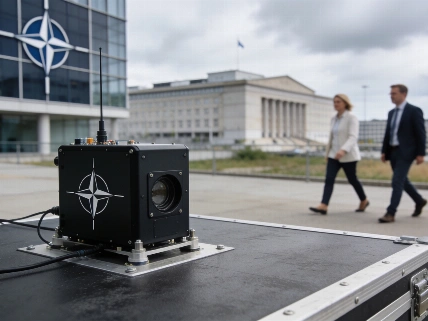
A navigation system that reads local magnetic variations could estimate position without relying on satellite signals. University of Wisconsin-Madison spinout Dirac Labs, based in Madison, is developing that approach for environments where GPS is unavailable, jammed or spoofed. On October 15, 2026, the company announced that it had joined the Wisconsin Security Research Consortium (WSRC) as an industry affiliate.
A magnetic route
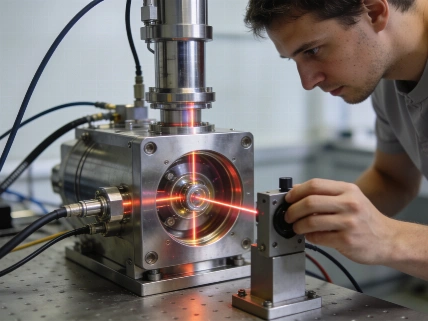
The proposed positioning, navigation and timing (PNT) system uses diamond-based quantum sensors to measure Earth's magnetic field. Dirac Labs says artificial-intelligence models will process those readings in real time, using local variations in the field to estimate position. Unlike satellite navigation, the approach relies on a passive natural signal rather than a transmission from space. The company describes the intended output as drift-free, but the announcement provides no measurements showing how accurately or consistently the system can locate a platform.
Dirac Labs co-founder and CEO Sanket Deshpande said the system is aimed at platforms such as submarines, subsurface systems and uncrewed vehicles operating under jamming-users for whom GPS may be unavailable. The company also points to civilian applications including mining, subsurface exploration, ocean science, agriculture and autonomous infrastructure monitoring. A sensor reading is not a position by itself: converting magnetic measurements into coordinates requires interpreting local field patterns. The announcement describes real-time signal processing but does not report a position-error figure, sensor sensitivity, measurement rate or field-test results.
Lake Michigan setting
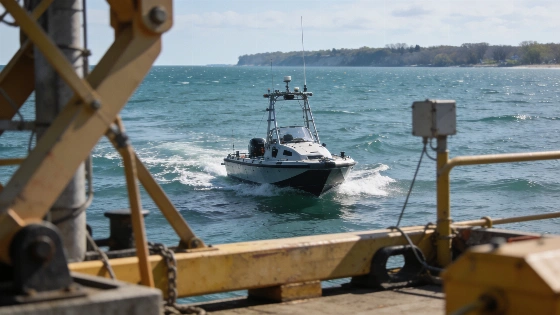
The WSRC affiliation connects Dirac Labs with the regional Area 52 defense testing initiative. Area 52 uses Lake Michigan's deepwater geography and FAA-restricted airspace for testing uncrewed maritime platforms, including surface and subsurface operations. The initiative's testing environment is intended for autonomous systems with potential defense applications.
The announcement describes a regional testing ecosystem, not a completed deployment of Dirac Labs' navigation system. It does not say that the sensors have been integrated with a vessel or demonstrated in Lake Michigan. Deshpande said the platforms that most need precise navigation-submarines, subsurface systems and uncrewed vehicles operating under jamming-are precisely those GPS cannot serve. The company's affiliation with WSRC was described in The Quantum Insider.
Manufacturing and integration
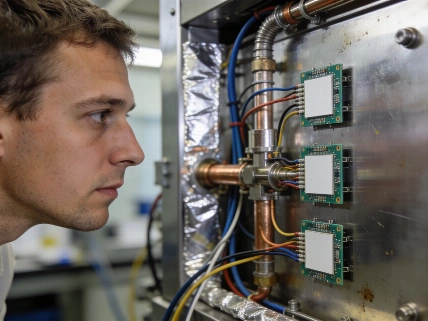
Dirac Labs says it is designing its sensors for production using existing semiconductor foundry infrastructure, with the aim of addressing the size, cost and scaling barriers associated with quantum sensing. The company also says the system is designed to connect through existing GPS ports on aircraft, submarines and other vehicles, reducing the need for platform redesign. These are development goals; the announcement gives no manufacturing cost or yield figures and describes no integration with a specific operational platform.
The manufacturing goal has a different focus from the planned chipmaking investment described in New York's facility. Both concern infrastructure for quantum technology, while Dirac Labs' stated plan is to use existing semiconductor foundry capacity to manufacture its sensors.
The company's system remains in development. Its announcement characterizes the intended position as reliable and unaffected by drift, but provides no numerical data on magnetic-field sensitivity, position error, drift over time or performance under interference. The proposed magnetic-navigation approach uses natural field variations as location cues; the system's ability to turn those readings into useful coordinates will depend on how it interprets and maps the local field.
Because Earth's magnetic field is present where satellite signals cannot reach, magnetic sensing offers a potential navigation input for underwater and subsurface environments as well as areas affected by GNSS jamming. Dirac Labs is developing the technology for autonomous maritime, underwater and land-based systems, while its WSRC affiliation links the company to a regional environment for research and testing.