

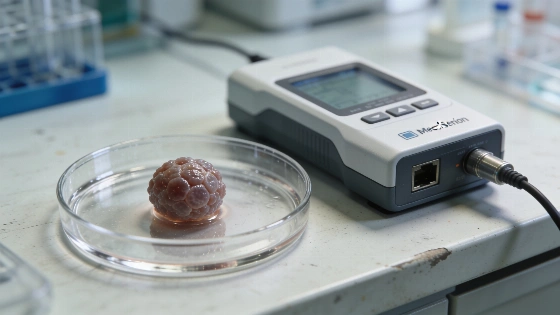
Destructive measurements can make it hard to track changes in organoids and microphysiological systems. The NIH-NASA challenge seeks quantum-enabled sensing approaches, with submissions opening Dec. 15, 2026.
Destructive measurements can make it difficult to track biological changes in organoids and microphysiological systems over time. These in vitro models can generate human-relevant data for drug development and safety evaluation, yet conventional assays and imaging may be noisy, invasive or insufficiently sensitive to detect weak, early-stage or low-abundance signals.
Limits of Current Tests
When measurements are noisy or invasive, subtle biological activity may go undetected. A destructive measurement can also make it difficult to monitor a model's changing processes over time. The NIH and NASA's Quantum-Enabled Predictive Preclinical NAMs for Toxicity and Safety (QuSAFE) Challenge focuses on quantum-enabled sensing for these new approach methodologies, including organoids and microphysiological systems.
Quantum Sensing Potential
NASA says quantum-enabled sensing approaches could offer ultra-high sensitivity, improved signal-to-noise performance and nanoscale resolution. The challenge seeks to apply those capabilities to biological models, where more sensitive measurements could help researchers observe signals that conventional detection methods miss. NASA describes the goal as improving drug-safety evaluation while reducing animal use through in vitro testing approaches.
The effort directly supports NASA's Biological and Physical Sciences Division. NASA also frames the work as relevant to sensing needs beyond traditional laboratories, with potential benefits for research in space and on Earth. A separate NASA initiative selected 19 citizen-science proposals for 2026, as covered in coverage of those awards; QuSAFE focuses on sensing for preclinical models. NASA's QuSAFE challenge announcement describes the competition and its aims.
Prize and Dates
The challenge offers up to $7.1 million in prizes. Submissions are scheduled to open Dec. 15, 2026, and close July 27, 2027. The planned competition is intended to draw on advances in sensor development and apply them to preclinical models; the published schedule makes QuSAFE a forthcoming challenge, with submissions yet to begin.







