NASA's Pioneer 11 spacecraft became the first probe to traverse Saturn's rings in 1979, gathering data on the planet's moons, rings, and magnetic field while clearing the way for later missions to the outer solar system
When NASA directed Pioneer 11 through Saturn's outer rings in September 1979, the agency was not simply chasing a planetary first. The maneuver was a calculated risk: if the probe survived, it would prove that a spacecraft could safely cross the ring plane, a prerequisite for the more ambitious Voyager missions already en route. The stakes were immediate and concrete-no simulation could substitute for a real passage through Saturn's debris-laden environment.
Testing Saturn's Hazards
Pioneer 11's closest approach brought it within 21,000 kilometers of Saturn's cloud tops, a region never before visited by human technology. The probe's trajectory was deliberately plotted to intersect the ring plane, exposing its instruments to potential collisions with unseen debris. NASA's mission planners needed to know whether the Voyager spacecraft, carrying more advanced scientific payloads, could risk a similar path. Pioneer 11's successful transit-despite a near-miss with a small moon-provided the operational green light for Voyager's own Saturn encounter.
During the flyby, Pioneer 11's suite of 12 instruments recorded data on Saturn's rings, atmosphere, and magnetic environment. The probe detected a previously unknown ring and identified two new moons, expanding the known architecture of the Saturnian system. Its magnetometer registered the first direct evidence of Saturn's magnetic field, a result that would shape models of the planet's internal structure for decades.
Mission Design and Gravity Assists
Pioneer 11 was not originally built for Saturn. Launched in April 1973, it was the twin of Pioneer 10, which had already demonstrated that a spacecraft could survive the asteroid belt and Jupiter's intense radiation. After its own Jupiter flyby in December 1974, Pioneer 11 used the planet's gravity to alter its trajectory, setting course for Saturn. This gravity assist technique-now standard in planetary exploration-enabled the probe to reach the outer solar system with the limited propulsion available at the time.
The Saturn flyby was not an isolated event but part of a broader strategy to exploit a rare planetary alignment. NASA's goal was to send multiple spacecraft on a "Grand Tour" of the outer planets, a window that would not reopen for another 175 years. Pioneer 11's data directly informed the planning and risk assessment for Voyager 1 and Voyager 2, which would later extend humanity's reach to Uranus and Neptune.
Scientific Results and Legacy
At Saturn, Pioneer 11 captured 440 images, including the first close-up views of the planet's rings and its largest moon, Titan. The probe's instruments measured Saturn's atmospheric composition, confirming that hydrogen dominates and that temperatures near Titan's surface reach -192°C. The detection of a magnetic field, along with the discovery of new moons and a faint ring, provided a foundation for subsequent missions to refine models of Saturn's evolution and dynamics.
Pioneer 11's operational life far exceeded its original 21-month design. After departing Saturn at a velocity of 114,000 kilometers per hour, the spacecraft continued to transmit data until November 1995, when it was more than 6.4 billion kilometers from Earth. Its final signal marked the end of a mission that had redefined the boundaries of robotic exploration. The probe also carried a plaque designed by Carl Sagan, Frank Drake, and Linda Salzman Sagan, intended as a message to any extraterrestrial intelligence that might encounter it-a precursor to the Voyager Golden Record.
Comparisons and Broader Context
Pioneer 11's Saturn flyby stands as a technical and scientific milestone, but it was not the only mission to push the limits of planetary exploration in the 1970s. The Soviet Luna 24 mission, for example, returned lunar soil samples in 1976, closing a chapter in robotic Moon exploration, as reported earlier. Both missions demonstrated the value of direct measurement in environments where theory and remote sensing alone could not resolve critical uncertainties.
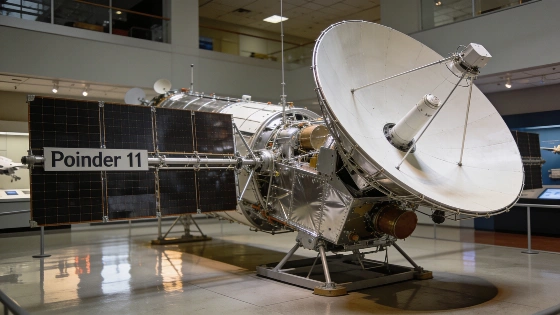
Today, mock-ups of Pioneer 10 and Pioneer 11 are displayed at the Smithsonian National Air and Space Museum, reminders of an era when mission risk was balanced against the need for empirical data. The lessons from Pioneer 11's Saturn crossing continue to inform spacecraft design and trajectory planning for missions venturing into uncharted regions of the solar system. The probe's legacy is not just in the discoveries it made, but in the operational precedent it set for navigating the hazards of deep space. NASA's willingness to test the unknown, rather than rely solely on models, remains a defining feature of successful planetary science.
Spacecraft flybys of giant planets require precise navigation and robust engineering to survive high-radiation environments, gravitational forces, and potential collisions with debris. Gravity assist maneuvers-using a planet's motion and gravity to alter a spacecraft's trajectory and speed-are essential for reaching distant targets with limited fuel. Instruments such as magnetometers, cameras, and spectrometers convert physical phenomena into data that can be transmitted across billions of kilometers. The reliability of these measurements depends on careful calibration and an understanding of the spacecraft's limitations, especially when operating far beyond the reach of real-time intervention from Earth.