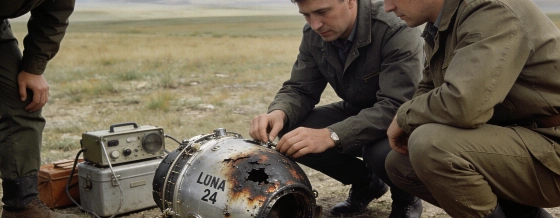
On August 9, 1976, the Soviet Luna 24 probe launched from Baikonur, aiming to collect and return lunar soil. The mission's samples revealed traces of water and closed a chapter in robotic Moon exploration.
On August 9, 1976, the Soviet Union launched Luna 24, its final robotic mission to the Moon. The spacecraft's objective was to collect lunar soil and return it to Earth, concluding a series of Soviet sample-return efforts that had begun nearly two decades earlier. Luna 24's success provided new material for laboratory analysis and marked the last time, for nearly half a century, that Russia attempted a lunar landing.
Mission Profile and Landing Site
Luna 24 lifted off atop a Proton-K rocket from the Baikonur Cosmodrome in Kazakhstan. After a nine-day journey, the probe executed a soft landing on Mare Crisium, a basaltic plain known as the Sea of Crises. The spacecraft's descent and ascent stages were designed to collect a core sample of lunar regolith and transfer it to a sealed return capsule. Less than 24 hours after landing, Luna 24's ascent stage launched from the Moon's surface, carrying the sample back to Earth.
The mission returned approximately 170 grams (6 ounces) of lunar soil, which arrived on Earth on August 22, 1976. Laboratory analysis of the material revealed the presence of water at a concentration of about 0.1% by mass, a finding that contributed to ongoing debates about the Moon's volatile inventory. The Luna 24 descent stage remains on Mare Crisium, and its location has been imaged by NASA's Lunar Reconnaissance Orbiter.
Scientific and Historical Context
The Luna program was central to the Soviet Union's lunar exploration strategy, especially after the United States achieved the first human landing in 1969. Earlier Luna missions had established several milestones: Luna 2 was the first spacecraft to impact the Moon in 1959, and Luna 9 achieved the first soft landing in 1966. By the time Luna 24 launched, twelve NASA astronauts had walked on the Moon, and the Soviet program had shifted focus to robotic exploration and sample return.
Luna 24 was the third successful Soviet sample-return mission, following Luna 16 and Luna 20. Each probe used a similar architecture: a lander with a drill, a sample transfer mechanism, and a return capsule. Not all attempts succeeded-Luna 23, for example, was damaged during landing and could not return a sample. The Luna 24 mission, however, completed its objectives as planned, providing the last direct lunar material to Earth until recent Chinese missions.
Legacy and Renewed Interest
After Luna 24, the Soviet Union did not attempt further lunar landings, and Russia's lunar ambitions remained dormant for decades. In August 2023, Roscosmos launched Luna 25, aiming for the lunar south pole, but the mission ended in failure after a navigation error led to a crash. The renewed interest in lunar exploration by multiple nations has revived attention to the technical and scientific challenges of sample-return missions.
Sample-return missions remain a critical method for understanding planetary surfaces, as laboratory analysis can reveal details about mineralogy, chemistry, and the presence of volatiles that remote sensing cannot resolve. The Luna 24 samples, for instance, provided early evidence for water in lunar regolith, a topic that continues to shape mission planning and scientific priorities. For readers interested in the complexities of lunar impacts and orbital dynamics, a recent Science Report article examines how NASA and SpaceX are tracking a spent Falcon 9 rocket stage expected to strike the Moon, using ground and space-based telescopes to refine impact predictions: how agencies monitor lunar-bound rocket debris.
Sample-return missions require careful engineering to avoid contamination, preserve volatile compounds, and ensure safe reentry. The Luna 24 mission's design-combining a drill, sealed capsule, and automated ascent-set a technical precedent for later lunar and planetary sample-return efforts.
Sample-return missions are among the most technically demanding in planetary science. They require a spacecraft to land, collect material, and launch back to Earth, all with minimal human intervention. The returned samples allow scientists to perform detailed laboratory analyses, including isotopic measurements and mineral identification, that are not possible with remote sensing alone. These missions provide ground truth for orbital observations and help calibrate models of planetary formation and evolution.