Perseverance has analyzed igneous rocks in Mars' Jezero Crater that record at least three separate interactions with water, including a later episode involving heated underground fluids.
Rocks exposed along the edge of Mars' Jezero Crater preserve evidence of at least three separate encounters with water, turning what was expected to be a quiet ancient lakeshore into a geological record of changing aqueous systems. NASA's Perseverance rover found the evidence in igneous rock rather than the sedimentary layers scientists initially expected.
Aqueous crossroads
The discovery comes from the Margin Unit, a geologic area that follows the shoreline of Jezero's former lake. Orbital observations had identified strong carbonate signals there, leading researchers to suspect that lake water had produced the minerals. On the ground, however, Perseverance encountered coarse-grained rock dominated by olivine, a magnesium- and iron-bearing mineral that formed as magma cooled slowly underground.
That result matters because igneous minerals can preserve the chemistry of the conditions in which they formed and the later fluids that altered them. In the higher parts of the unit, the olivine shows little evidence of water interaction. At lower elevations, the grains are fractured and silica occupies the spaces between them, while carbonate fills networks of cracks.
Carbonates are especially important because they can form when water reacts with dissolved carbon dioxide, making them one of the clearest mineral indicators of ancient liquid-water activity on Mars. The carbonate-bearing fractures therefore provide evidence not merely of a rock's exposure to moisture, but of chemically active groundwater moving through its interior. A concise carbonate analysis places this interpretation in the wider context of Martian water studies.
The pattern does not establish that life existed in Jezero. Carbonate and silica can preserve chemical traces of past environments, and water interacting with olivine can release hydrogen that some terrestrial microbes use as an energy source, but the rover has not reported a biological detection. NASA emphasizes that these minerals may preserve environmental signatures without constituting evidence of life itself.
Three water events
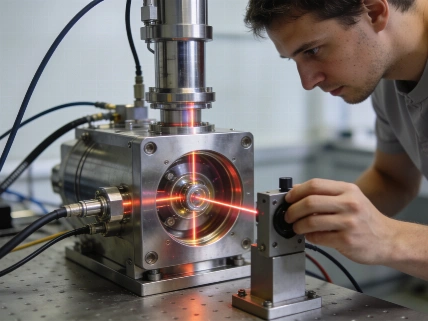
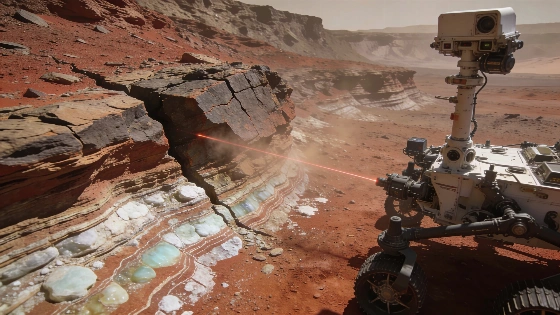
SuperCam supplied the central evidence. Mounted on Perseverance's mast, the instrument fires a laser at selected targets from as far as 6.5 meters away and analyzes the light emitted by the resulting plasma. This laser-induced breakdown spectroscopy reveals elements in the rock, while complementary observations help identify mineral phases. Across the Margin Unit, the rover used this method on more than 185 bedrock targets.
The first inferred water episode involved carbon-dioxide-rich groundwater reacting with olivine. The reaction produced carbonate ridges inside fractures at lower elevations. As surrounding rock eroded more easily, those mineralized fractures remained as raised features on the surface. This sequence is consistent with groundwater that circulated through the subsurface and chemically altered the original igneous material.
A second episode may have been connected to Jezero's ancient lake. Rocks below the former waterline contain more silica, consistent with the chemical transformation of olivine in water-rich conditions. The broader geological context supports a picture of water acting repeatedly and over an extended interval rather than appearing only during one brief surface event. Researchers can reconstruct this sequence of alteration, but the available evidence does not determine the absolute age of any individual water event.
The final identified episode was hotter. In the eastern part of the Margin Unit, mineral veins roughly 25 centimeters thick contain calcium sulfate and fluorite. Fluorite commonly forms when heated water circulates through volcanic rocks, so its presence points to a later underground hydrothermal event rather than simply another phase of shallow lake activity. The mineral sequence thus records a transition from carbon-dioxide-rich groundwater to probable lake-related alteration and, later, heated subsurface fluids carrying calcium sulfate- and fluorite-forming components.
What SuperCam measured
Perseverance reached the Margin Unit in September 2023 and examined it across about 265 meters of elevation. That vertical range allowed the team to compare relatively fresh olivine-bearing rock at higher levels with increasingly altered material closer to the ancient lakebed. The contrast links mineral changes to different fluid environments without requiring the rocks to have formed at the same time as the lake.
Igneous rock was an unexpected target for a location selected partly because sedimentary deposits can preserve ancient environmental and microbial evidence. Yet the rover's measurements show why the original expectation was too narrow: a single Martian outcrop can contain evidence of underground magma cooling, groundwater circulation, lake-related alteration and later heating.
The findings were published in Communications Earth & Environment. Their significance extends beyond Jezero because the crater lies within one of Mars' largest exposed carbonate regions. NASA's direct measurements show why orbital mineral signatures must be tested against rocks at the surface. For context on how spacecraft observations can reshape understanding of planetary surfaces, an earlier lunar finding shows the value of comparing orbital evidence with direct measurements on another world.
Limits of the record
The mineral sequence is stronger than the original orbital interpretation because it is based on measurements made directly across many bedrock targets. It still does not provide a calendar for Mars' wet periods, a complete history of the crater's climate or proof that any water remained on the surface for a particular length of time. The link between the second alteration phase and the lake is also presented as a possibility rather than a settled identification.
Those limits sharpen the result rather than weaken it. Jezero's water history was not a single event preserved in one simple deposit; it was a succession of chemical environments recorded in rock that formed deep underground and was later exposed by erosion. Perseverance has therefore delivered a more useful scientific picture than a straightforward ancient-lake narrative: early Mars supported interacting groundwater, surface-water and heated subsurface systems, and reconstructing that sequence is essential for judging where conditions may once have been favorable for microbial life.
Mineral spectroscopy is the key concept behind the result. A laser does not photograph the rock's composition; it vaporizes a tiny portion and creates plasma whose emitted wavelengths act as a chemical signature. Those signatures must then be interpreted against known mineral behavior, which is why the measurements support a sequence of water-driven alteration without independently proving the exact timing or biological meaning of each episode. As with planetary studies reported across journals such as Nature, the distinction between environmental habitability and evidence of life remains central to interpreting the data.