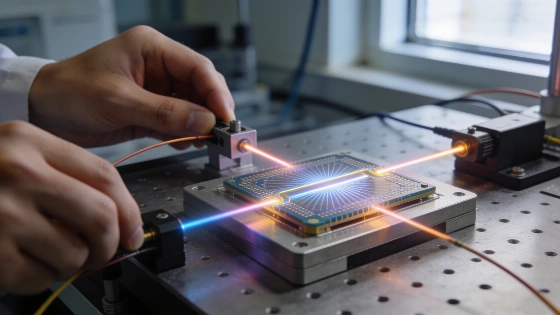
A foundry-fabricated photonic chip has produced a self-aligned octave-spanning microcomb by driving one resonator with two lasers separated by an octave, demonstrating a potential route to compact precision metrology.
A photonic chip has produced a self-aligned optical frequency comb spanning an octave without relying on the conventional single-pump architecture that can make absolute stabilization difficult. The result was reported in a Nature research paper published on September 30, 2026, by a collaboration involving the University of Auckland, the National Institute of Standards and Technology, the University of Maryland, and UC Santa Barbara.
Frequency combs act as rulers for light. Their evenly spaced spectral lines allow optical frequencies to be compared with exceptional precision, linking optical and microwave domains for applications in timekeeping, spectroscopy, communications, and sensing. As in other precision-measurement programs at institutions such as NIST and NASA, the central challenge is not simply producing light, but maintaining a traceable and stable frequency relationship.
Traditional comb designs begin with one laser and cascade light outward through nonlinear interactions. On a chip, that approach can struggle to maintain low-noise signals across a full octave. The missing span is not merely cosmetic: detecting and locking the carrier-envelope offset frequency, known as fCEO, is required when the comb is used as an absolute frequency reference.
The researchers reversed that arrangement. Instead of asking one pump to populate the spectrum in both directions, they placed two pump lasers at the boundaries of the desired range. The pumps are separated by one octave, meaning that the higher frequency is approximately twice the lower frequency, and they drive a nonlinear χ(3) microresonator. Their interaction creates a parametrically driven cavity soliton that fills the spectral region between them.
This architecture builds on the parametrically driven cavity-soliton, or PDCS, concept first predicted by Miro Erkintalo's group in 2023. In the new implementation, PDCS is combined with a synchronization method previously developed by Grégory Moille, Kartik Srinivasan, and colleagues. The resulting system, named SParCS for self-aligned parametrically driven cavity soliton, aligns the comb lines into a common frequency set rather than leaving their relationship to be established entirely by external control electronics.
That is the central engineering move. The chip does not simply broaden one optical input; it uses two separated optical boundaries to define the useful spectral interval from both sides. The researchers describe this choice as a way to select the comb edges for a particular task and ensure an octave span in advance, potentially simplifying setup compared with architectures in which the spectrum must be expanded from a single source.
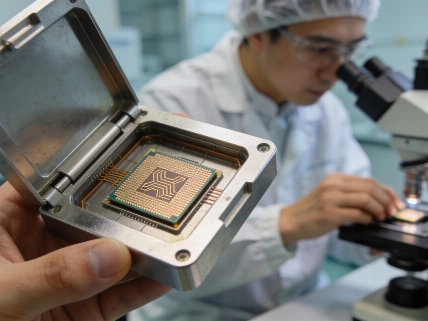
The device was fabricated on a foundry platform and integrated onto a single photonic chip. The same SParCS platform demonstrated three functions relevant to optical frequency metrology: linking microwave frequencies to optical frequencies, generating low-noise millimeter waves, and reading out a signal for integrated optical clocks. These demonstrations establish the breadth of the architecture, but the available materials do not provide a complete numerical table for noise, stability, optical power, uncertainty, or long-term drift.
The physical mechanism matters because the two pumps supply built-in spectral references at opposite ends of the octave. The nonlinear resonator then generates the intermediate comb structure. Because the synchronization scheme aligns the generated lines with the pump pair, the design aims to reduce dependence on complex external stabilization controls while retaining the frequency relationships needed for absolute measurements.
The result is still an optical-metrology experiment rather than a quantum-computing demonstration. The chip uses nonlinear photonics and cavity dynamics; its significance lies in controlling optical frequencies with integrated hardware. Portable optical atomic clocks, GPS-denied navigation, communications, and precision quantum sensing are potential downstream applications identified by the researchers, not products demonstrated by the experiment.
The collaboration includes Professor Miro Erkintalo, Dr. Grégory Moille, and Dr. Kartik Srinivasan. The researchers have filed a provisional patent application covering the architecture, with potential commercialization discussed for portable atomic timekeeping, defense navigation systems, and integrated quantum photonics. A patent filing records an effort to protect and develop an invention; it does not establish that a commercial product exists or that the system is ready for field operation.
The foundry fabrication is important but should not be confused with proof of mass manufacturability. A chip fabricated through a foundry process can demonstrate compatibility with an established manufacturing route, while deployment still depends on packaging, pump-laser control, thermal stability, optical coupling, long-term calibration, and performance across many devices. The published materials do not report device yield, environmental qualification, operating lifetime, or a complete system comparison with established frequency-comb technologies.
That chip-level emphasis sits alongside an earlier photonics report on a separate silicon-photonics program targeting communications and quantum circuits. The comparison is useful only at the level of direction: both stories point to photonic integration, but this Nature result concerns a microcomb architecture for frequency metrology rather than a communications or quantum-processing platform.
The strongest evidence here is architectural and experimental: two octave-separated pumps drove a χ(3) microresonator on a foundry-fabricated chip, producing a self-aligned octave-spanning microcomb and supporting microwave-to-optical conversion, low-noise millimeter-wave generation, and optical-clock signal readout. The evidence does not establish independent replication, field deployment, commercial readiness, or superior performance against every existing comb technology.
For quantum sensing and navigation, the practical question is not whether a spectrum can be generated once, but whether the reference remains stable under the temperature, vibration, packaging, control, and maintenance conditions of the intended instrument. The published account provides no operating lifetime, device yield, environmental test, or complete system comparison. Those omissions do not erase the result, but they define its present boundary.
A microcomb is a set of precisely spaced optical frequencies generated by a nonlinear resonator. Octave-spanning means that the highest frequency is twice the lowest, enabling the relationships needed for fCEO detection and absolute stabilization. The new architecture uses two pumps to constrain that range from both sides instead of depending entirely on spectral expansion from one pump. That makes the demonstration a credible step toward integrated frequency references, while the gap between a chip experiment and a deployable clock or sensor remains an engineering problem rather than a solved one.
The broader promise is reduced size, mass, power consumption, and cost for optical-comb systems. The developers present those benefits as a path toward portable atomic clocks, GPS-free navigation, communications, and precision sensors, not as already achieved commercialization. Further testing will determine whether the self-aligned design can preserve its advantages when the resonator, lasers, control electronics, and packaging are integrated into a complete field instrument.