Event cameras emit sparse light-change signals instead of ordinary frames. Penn researchers say their Fast Feature Field model handles high-definition data 120 times per second and VGA data at 440 in tests using robotic datasets
Roughly 95% of the possible positions in event-camera data contain no events, even though the sensors can produce tens of millions of signals each second. Unlike conventional cameras, which record complete images at fixed intervals, event cameras register changes in light intensity at individual pixels. Penn engineers developed Fast Feature Field (F³) to process these sparse, asynchronous signals and turn them into information robots can use.
F³ learns patterns by predicting future events from earlier ones, an approach designed to capture both the structure of a scene and motion within it. Richeek Das, the paper's first author, said: "To accurately anticipate future events based on past ones, the network must learn to represent both the structure of a scene and the motion taking place within it." The representation is intended to provide a common computational language for tasks such as object recognition, distance estimation and motion tracking, rather than requiring a separate processing method for each task.
The system processed high-definition event-camera data 120 times per second and VGA-resolution data 440 times per second. Algorithms using F³ ran roughly two to five times faster than earlier approaches, information from the researchers. These figures describe data-processing throughput, rather than a robot's complete response time.
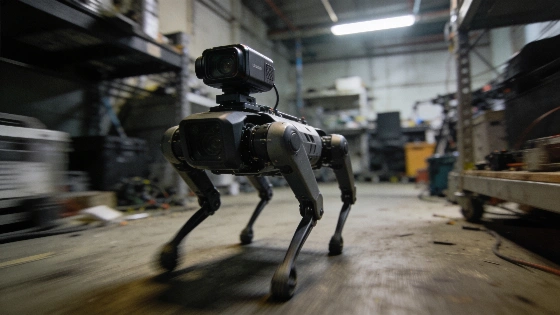
The team evaluated F³ using data from cars, flying drones and four-legged robots, including recordings from nighttime urban streets and crowded indoor spaces. Tests covered object recognition, distance estimation and motion tracking, and Penn Engineering reported advanced results across multiple perception tasks.
F³ is a software representation, not a new camera sensor. By converting event signals into features that can work with software developed for conventional cameras, it aims to make event-camera data usable across a broader range of robotic-vision applications. Penn co-author Kostas Daniilidis compared the role to that of JPEG and MPEG formats in helping different devices work with pictures and video.
The research, led by Das, Daniilidis and senior author Pratik Chaudhari, was published in Science Robotics as "The Missing Link Between Event Cameras and Robot Vision" (DOI: 10.1126/scirobotics.aec8218) and was supported by the U.S. National Science Foundation. Chaudhari, an associate professor of Electrical and Systems Engineering at the University of Pennsylvania, said the team expected the work to be "a watershed moment in the history of event cameras, showing how to make event-camera processing reliable, fast and broadly useful," as Penn Engineering reported.
The researchers said they were incorporating the system into autonomous drones intended for cluttered and poorly lit environments. A separate physical-AI toolchain report covered simulation and deployment; F³ focuses on converting event-camera signals into visual features.