Cambridge's new IonQ centre is set to combine a planned 256-qubit Superion computer with campus entanglement links, while Innovate UK will arrange three years of computing access for the National Quantum Computing Centre
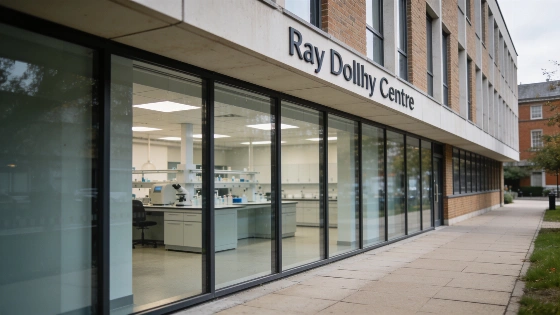
IonQ and the University of Cambridge opened the IonQ Quantum Innovation Centre at the Ray Dolby Centre, the new home of the university's Cavendish Laboratory, on 15 October 2026. The first university research centre established by IonQ is the physical base for the partners' collaboration in trapped-ion quantum computing, quantum networking and device engineering. The centre builds on an agreement between IonQ and Cambridge reached in March 2026, and is described by the university as the base of its largest corporate partnership. The announcement from IonQ sets out the centre's initial research programme and planned infrastructure.
Planned hardware
IonQ plans to deploy a 256-qubit Superion quantum computer at the centre. The company identifies Superion as its sixth-generation quantum processing unit architecture. The announcement describes the deployment as a future step; the centre's opening marks the launch of the research hub rather than the start of operation of the planned computer.
The nine inaugural research projects will span quantum hardware, networking and applications. Hardware topics include microscopic mirrors designed to collect more light from trapped ions, optical links between quantum processors and components for quantum memory. Other projects will explore quantum algorithms in chemistry, materials science, finance, engineering and medicine, including cancer research. The projects were selected by a joint steering committee of business and scientific leaders from IonQ and Cambridge.
Network and access
The planned campus network will distribute entanglement and comprise two Quantum Networking Data Centres and three Quantum Networking Nodes. IonQ says the infrastructure is intended to support research across the campus. Its regional ambitions have also been linked to the Cambridge-Bristol quantum communications network.
Separately, Innovate UK, the UK's innovation agency, will provide the National Quantum Computing Centre (NQCC) with access and computing time on the equipment over three years. The programme adds a route for the national centre to use the Cambridge facility as part of the broader research collaboration.
The partnership also plans academic posts, postdoctoral fellowships and PhD positions to support the regional quantum workforce, in line with the UK National Quantum Strategy. A separate security partnership involving Space Force systems illustrates another public-sector technology effort, though the announcement provides no link between the two programs.
The centre brings Cambridge researchers together with IonQ specialists in trapped-ion computing, quantum networks and device engineering. IonQ has described the collaboration as a long-term investment in the UK's quantum future and as a platform for work across science and industry.
Entanglement is a relationship between quantum systems that cannot be described as ordinary independent states. A network can distribute entangled states between locations, but entanglement itself does not allow information to be sent faster than light.