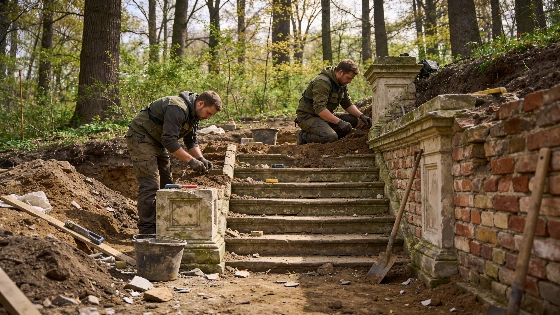
Archaeologists have revealed the remains of 19th-century buildings, including walls, floors, and a stone staircase, during excavations in Warsaw's Morysin Park, offering new evidence for the park's architectural history and preservation challenges
Recent archaeological investigations in Morysin Park, a protected landscape in Warsaw, Poland, have exposed the remains of several 19th-century buildings previously concealed beneath soil and vegetation. The work, commissioned by the Museum of King Jan III's Palace at Wilanów, has brought to light architectural features such as masonry walls, tiled and wooden flooring, a well-preserved stone staircase, and fragments of decorative stucco associated with the former Hunting Palace and Caretaker's House.
Excavation Context and Findings
Morysin Park was established in the early 1800s as a Romantic landscape by Stanisław Kostka Potocki, incorporating a series of distinctive buildings designed to complement the natural setting. Among these, the Hunting Palace, completed in 1811, and later additions such as the Oraculum, Neo-Gothic Gate, Caretaker's House, and Gamekeeper's Lodge, formed a complex architectural ensemble. Over time, many of these structures deteriorated or became buried, with limited documentation surviving regarding their original appearance and development.
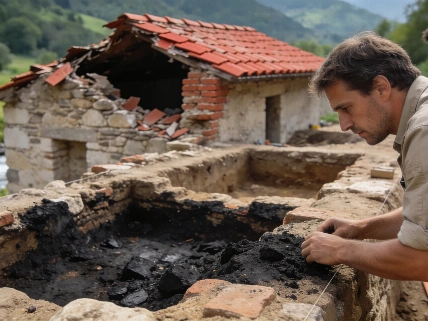
During the 2026 field season, archaeologists focused on the Caretaker's House and the Hunting Palace. At the Caretaker's House, the team uncovered walls up to 0.5 meters high, belonging to a previously undocumented section west of the surviving turret. Notably, the floor combined ceramic tiles and wooden elements in alternating strips, an arrangement rarely documented in the region. The corridor surrounding the building, once forming a pergola, was surfaced with asphalt-a material increasingly used in the late 19th century. Foundations extended to a depth of approximately 1.6 meters below the historic ground level, indicating substantial construction.
Material Evidence and Preservation
Excavations yielded both architectural and smaller material finds. Among the artifacts was a porcelain plate marked by Krister Porzellan-Manufaktur (KPM) of Wałbrzych, likely produced in the 1930s and belonging to the Prinzess service. This object, found in a later context, suggests continued use or visitation of the site after its initial development. Around the Hunting Palace, archaeologists identified a passage connecting the porch to a probable boiler room and, more significantly, the largely intact stone flooring of a staircase leading to the upper story. Decorative stucco fragments recovered from the rubble may help reconstruct aspects of the palace's interior.
Measurements from the 2026 season document the extent of preservation: walls up to 0.5 meters high, foundations reaching 1.6 meters below ground, and a staircase with stone flooring surviving in situ. The corridor's asphalt surface reflects changing construction practices in the late 19th century. These findings provide a rare opportunity to study the architectural evolution of a Romantic-era estate in Warsaw.
Conservation and Research Challenges
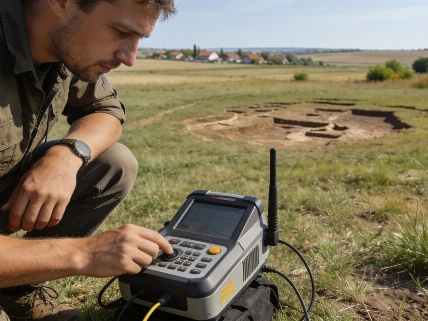
Despite its historical significance, Morysin Park received limited conservation attention after World War II, resulting in gradual deterioration and loss of architectural features. The current archaeological program aims to inform conservation strategies to stabilize and, where feasible, restore surviving elements. Information from the excavations will support plans to secure the ruins and integrate them into the park's cultural offerings. Restoration of the Gamekeeper's Lodge is scheduled for 2027, with further investigations planned at the Hunting Palace, including an outbuilding identified through ground-penetrating radar.
Conducting archaeological work within a protected natural reserve required careful coordination between archaeologists, museum specialists, landscape architects, and environmental scientists. The 2026 investigations were led by Dr Rafał Solecki, with participation from students at Cardinal Stefan Wyszyński University. Measures were implemented to minimize ecological impact, overseen by environmental specialists, ensuring that research proceeded without compromising the park's biodiversity.
Comparative Context and Future Directions
The discoveries at Morysin Park add to a growing body of research on buried architectural remains in European landscapes. Similar approaches, such as the use of ground-penetrating radar to map medieval monastic sites beneath modern infrastructure, have been reported elsewhere, including the identification of a 13th-century monastery beneath a Danish football field (see related research). In Warsaw, the combination of excavation and non-invasive survey has begun to clarify the extent of surviving structures and inform conservation priorities.
The evidence from Morysin Park demonstrates that substantial portions of the 19th-century architectural landscape remain preserved below ground, despite decades of neglect. Ongoing research and conservation efforts are expected to further document, protect, and interpret these remains for future generations.
Ground-penetrating radar (GPR) is a non-destructive geophysical technique used to detect and map subsurface features by transmitting electromagnetic pulses into the ground and recording reflected signals. In archaeological contexts, GPR can identify buried walls, voids, and other structures without excavation, allowing researchers to target areas of interest and minimize disturbance. However, interpretation of GPR data requires careful calibration and ground-truthing through excavation, as reflected anomalies may result from natural or modern disturbances as well as archaeological features. The integration of GPR with traditional excavation methods has become increasingly important in the study and conservation of complex historical sites like Morysin Park.