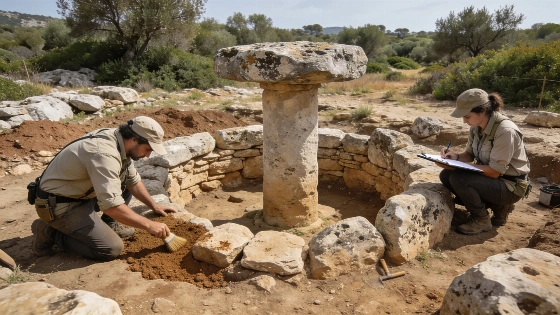
Archaeologists at Son Fornés in Mallorca have uncovered a fourth talayot hidden beneath dense vegetation, revealing a previously unknown monumental structure and raising new questions about the diversity and chronology of Talayotic architecture at the site
When vegetation was cleared near the future entrance of the Son Fornés Archaeological Park in Montuïri, Mallorca, archaeologists did not expect to find a substantial prehistoric monument concealed beneath the undergrowth. The emergence of a fourth talayot-distinct from the three previously excavated structures-has forced a reassessment of the site's architectural complexity and the organization of its ancient community.
Unexpected Monument Revealed
The newly identified talayot stands apart from its counterparts, both in location and in form. Unlike the three previously known monuments, which cluster near the core of the settlement, this structure occupies an elevated and highly visible position on the site's periphery. Only the upper sections of its central column, a segment of its perimeter, and several large collapsed stones are currently exposed. The monument's scale appears comparable to the other talayots, but its atypical placement and partial preservation complicate immediate interpretation.
Initial clearing was intended to improve access for the planned museum, not to expand the known inventory of monumental architecture. The discovery was made under archaeological supervision, and the structure's central column-a hallmark of Talayotic construction-suggests that undisturbed archaeological layers may survive beneath, potentially preserving artifacts and sediments that could clarify the building's function and chronology.
Chronology and Function Under Investigation
A team from the Autonomous University of Barcelona, supported by volunteers, has launched a three-week excavation campaign to investigate the monument's origins. Key questions include whether the structure was built contemporaneously with the other talayots or represents a later or earlier phase of construction. The building's shape remains uncertain; excavation will determine whether it is circular or square, and laboratory analysis of recovered material may provide evidence for its original use.
Previous research at Son Fornés has established that the three earlier talayots served different roles. Talayot I, identified in 1975, appears to have functioned as a center for food distribution, reflecting economic and social organization. Talayot II, excavated in 1981, shows evidence of restricted access and possible cultic activity. Talayot III was remodeled and reused in later periods, obscuring its initial purpose. The fourth monument's distinct location and ambiguous form suggest it may have fulfilled yet another role within the settlement, highlighting the diversity of monumental architecture in Talayotic Mallorca.
Regional Connections and Preservation Challenges
The monument's proximity to the sites of Campanar dels Moros and Sabor has prompted researchers to consider broader regional relationships. Together, these sites form a geographical triangle, raising the possibility of coordinated activity or interaction among neighboring settlements. The Sabor site, which remains privately owned despite its protected status, has been cited as a priority for acquisition or transfer to ensure long-term preservation and research access.
At Son Fornés, the accidental discovery has shifted the focus of the current excavation campaign. Researchers are now tasked with documenting the monument's construction, assessing the preservation of archaeological layers, and integrating the new evidence into the broader narrative of Talayotic society. The find echoes the pattern seen in other Mediterranean contexts, where the unanticipated recovery of monumental structures-such as those described in recent fieldwork-has challenged assumptions about settlement organization and architectural diversity.
Evidence and Uncertainty
With the addition of this fourth talayot, Son Fornés now features four megalithic monuments attributed to the Talayotic period. The site's previously excavated talayots have yielded evidence for economic, social, and ritual functions, but the new structure's purpose remains undetermined. Only partial remains are currently visible, and the extent of undisturbed deposits beneath the collapsed stones is unknown. The ongoing excavation will provide the first opportunity to recover stratified material and establish a secure chronological framework for the monument.
Researchers emphasize that the monument's atypical location and incomplete exposure limit immediate interpretation. The possibility that the structure was constructed in a different phase or for a unique function cannot be excluded. Conservation and public access are long-term goals, but the priority remains careful excavation and analysis to avoid disturbing potentially intact archaeological layers.
Talayots are a defining feature of the prehistoric Balearic Islands, but their functions and meanings varied across sites and periods. The Son Fornés discovery underscores the importance of context-specific investigation and the risks of assuming uniformity in monumental architecture. As with other recent finds in the region, the evidence at Son Fornés demonstrates that even well-studied sites can yield surprises that complicate established narratives. The challenge now is to integrate this new monument into a coherent understanding of Talayotic society without overstating what the current evidence can support.
Understanding the significance of the new talayot at Son Fornés requires attention to archaeological context and the limitations of the available evidence. Monumental structures like talayots are often identified by their massive stone construction and central columns, but their functions must be inferred from associated artifacts, stratigraphy, and spatial relationships. Excavation strategy, preservation conditions, and the integrity of archaeological layers all affect what can be learned from a site. Incomplete exposure and uncertain dating mean that interpretations remain provisional until further analysis is complete.