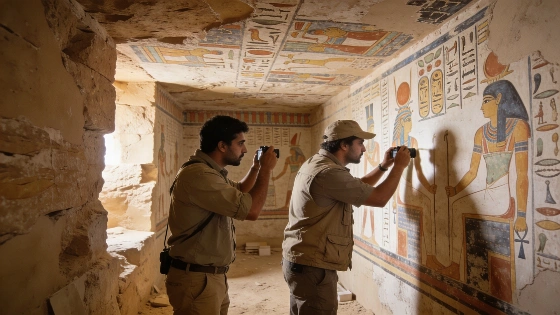
Archaeologists excavating at Sheikh Abd el-Qurna on Luxor's west bank have identified a previously undocumented New Kingdom tomb, featuring painted wall scenes and inscriptions naming the owner as Paser. The find adds to the understanding of elite burial practices in Thebes.
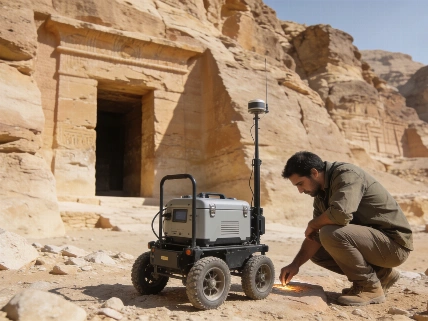
A previously unknown tomb has been identified in the Sheikh Abd el-Qurna necropolis on Luxor's west bank, according to a report from Egypt's Ministry of Tourism and Antiquities. The discovery was made by a Dutch archaeological team from Leiden University, working in partnership with the Supreme Council of Antiquities. The tomb, located east of the well-documented Tomb No. 45, was uncovered during the current excavation season as part of a long-term project focused on the Lower Sheikh Abd el-Qurna area and its New Kingdom cemetery.
Architecture and Decoration of Paser's Tomb
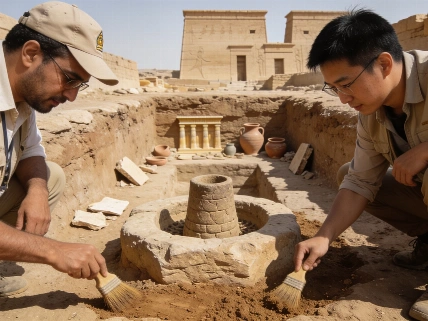
The tomb's architecture follows the established pattern for elite private burials in Thebes during the New Kingdom, circa 1550-1070 BCE. The structure consists of an open courtyard leading to a rock-cut chapel with a T-shaped plan, beneath which lie subterranean burial chambers. Within the courtyard, archaeologists recorded preserved mudbrick walls, a niche intended for a funerary stela, and a staircase flanked by ramps providing access to the tomb entrance. These features are consistent with other high-status tombs from the period, supporting the interpretation of the tomb as belonging to an individual of significant social standing.
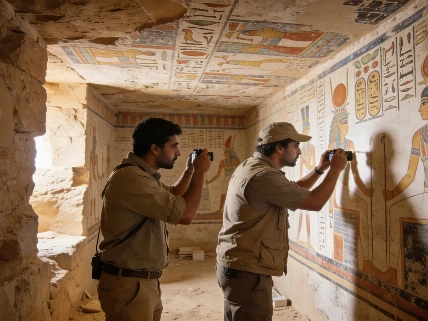
Inscriptions and painted decoration inside the tomb repeatedly name the owner as Paser. Although some wall paintings remain obscured by sediment, visible scenes depict Paser worshipping before deities in shrine settings, as well as seated with his wife before an offering table—a motif common in New Kingdom funerary art, symbolizing the provision of sustenance in the afterlife. The artistic style of the inscriptions and paintings is consistent with New Kingdom conventions, but further study is required to refine the tomb's chronological placement within the period.
Human Remains and Future Excavation
Archaeologists have not yet completed the documentation or analysis of the human remains and associated material within the burial chambers. The team plans to continue recording the tomb's architecture, inscriptions, and paintings, as well as to undertake conservation and stabilization work to preserve the surviving decoration. Future research will focus on identifying the individuals interred in the tomb and reconstructing their identities and social roles within the context of Theban society.
According to the Ministry, the ongoing project at Lower Sheikh Abd el-Qurna combines excavation with conservation and risk management, aiming to protect the archaeological landscape while producing a comprehensive study of the area's funerary development. Since 2018, the Leiden University mission has worked in collaboration with Egyptian authorities to investigate the spatial organization, chronology, and social dynamics of the necropolis. The discovery of Paser's tomb contributes to a growing dataset of elite burials, offering new evidence for the diversity of mortuary practices and artistic expression in New Kingdom Thebes.
Preservation and Archaeological Significance
Preliminary reports indicate that the tomb's preservation is relatively good, with several architectural elements and painted scenes surviving in situ. However, sediment coverage and potential past disturbance may limit the recovery of some details. The mission's future work will include conservation of the painted surfaces and further excavation to clarify the tomb's use and post-depositional history. The Ministry of Tourism and Antiquities has emphasized the importance of such discoveries for understanding ancient Egyptian society and for the ongoing management of Egypt's archaeological heritage.
Sheikh Abd el-Qurna is one of the principal necropolises of ancient Thebes, containing hundreds of tombs dating primarily to the New Kingdom. The area is notable for its concentration of elite burials, many of which are decorated with biographical inscriptions and scenes reflecting the social, religious, and economic life of their owners. The identification of new tombs in this context provides opportunities to refine the chronology of the necropolis, examine patterns of tomb reuse and modification, and assess the relationship between burial architecture and social status.
How Archaeologists Study Theban Tombs
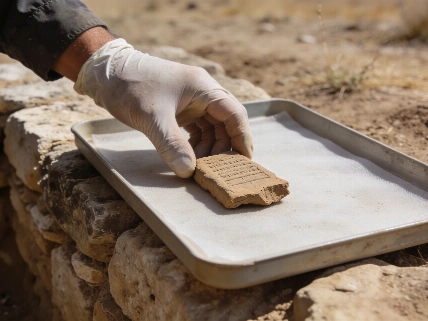
In archaeological research, the interpretation of tombs relies on a combination of architectural analysis, epigraphy—the study of inscriptions—and the examination of associated material culture. The dating of tombs in Thebes often depends on stylistic comparison of decoration and inscriptions, as well as stratigraphic relationships with neighboring structures.
While inscriptions can provide names and titles, the identification of individuals and their roles within society requires careful contextual analysis, especially when human remains are fragmentary or disturbed. Conservation of painted decoration is a critical aspect of tomb research, as pigment and plaster are vulnerable to environmental and human-induced damage. Ongoing documentation and preservation efforts are essential for ensuring that new discoveries contribute to the broader understanding of ancient Egyptian mortuary practices.