
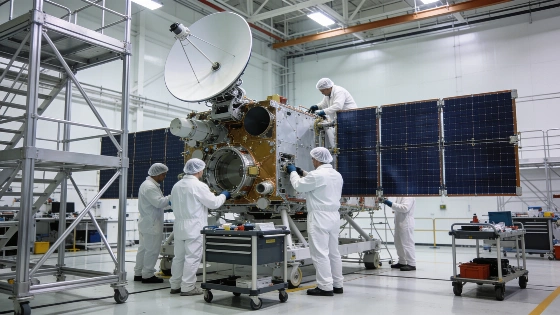
NASA has awarded Blue Origin a $700 million contract to develop the Mars Telecommunications Network, a dedicated relay orbiter intended to support future Mars missions as current infrastructure ages
NASA has committed $700 million to Blue Origin for the construction of a new Mars telecommunications orbiter, signaling a decisive shift in how the agency plans to maintain and expand its communications infrastructure at the Red Planet. The contract, announced in September 2026, tasks Jeff Bezos' company with delivering a dedicated relay spacecraft by the end of 2028-a move that will directly address the looming obsolescence of NASA's current Mars data-relay assets.
Why NASA Needs a New Relay
For more than two decades, NASA has relied on a small fleet of orbiters-Mars Odyssey, launched in 2001, and Mars Reconnaissance Orbiter, launched in 2005-to transmit data between surface missions and Earth. These spacecraft, along with the European Space Agency's Mars Express and Trace Gas Orbiter, have supported high-profile missions such as Curiosity and Perseverance. However, all four orbiters are aging, and each carries its own scientific instruments, dividing operational focus between relay duties and primary science.
The Mars Telecommunications Network (MTN) will be the first NASA orbiter designed solely for communications and navigation, without a science payload. This dedicated approach is intended to provide higher bandwidth, more reliable links, and operational flexibility for both robotic and future crewed missions. As NASA targets human landings on Mars in the late 2030s or early 2040s, uninterrupted data relay will be essential for mission safety and scientific return.
Blue Origin's Blue Ring Platform
Blue Origin secured the contract after a competitive process that included Rocket Lab as a leading contender. The MTN spacecraft will be based on Blue Origin's Blue Ring platform, a modular bus featuring hybrid solar-electric and chemical propulsion. Blue Ring is designed for high maneuverability and can accommodate multiple payloads, though for MTN, its primary function will be to serve as a robust communications node in Mars orbit.
While Blue Ring has not yet flown a full operational mission, a prototype was launched aboard Blue Origin's New Glenn rocket in January 2025. The MTN mission will require Blue Origin to design, integrate, launch, and operate the orbiter, with delivery to NASA required by December 31, 2028. The contract stipulates that Blue Origin will handle all mission phases, from spacecraft development to operational support in Mars orbit.
Funding, Timeline, and Technical Stakes
Congress allocated $700 million for the Mars telecom orbiter in July 2025, following a budget reconciliation bill that prioritized infrastructure for future Mars exploration. NASA issued its requirements in February 2026 and opened the competition to commercial providers in May. The selection of Blue Origin reflects both the agency's willingness to entrust critical infrastructure to commercial partners and the technical promise of the Blue Ring platform, despite its limited flight heritage.
The MTN is expected to be operational at Mars by 2030, providing high-bandwidth relay and navigation services for a new generation of surface missions. Unlike its predecessors, MTN will not collect science data, focusing exclusively on communications. This specialization is a departure from the dual-purpose orbiters of the past, and it raises questions about how NASA will balance scientific and operational needs as Mars exploration intensifies. For context, the last major shift in planetary mission architecture-such as the end of the Soviet Luna program-marked a similar inflection point in how agencies approached long-term exploration, as seen in this earlier breakdown.
Implications for Mars Exploration
The decision to fund a dedicated relay orbiter underscores NASA's recognition that reliable communications are now as mission-critical as propulsion or life support. As the agency prepares for more complex surface operations and eventual human presence, the risk of relying on aging, multi-purpose orbiters has become untenable. The MTN contract also signals a growing reliance on commercial providers for infrastructure once considered the exclusive domain of government agencies.
Yet, the choice of Blue Origin-whose Blue Ring platform remains unproven in deep space-introduces technical risk. NASA's willingness to accept this risk reflects both the urgency of the communications gap and the limited options available as legacy orbiters approach the end of their operational lives. The agency's bet is that a purpose-built, commercially developed relay will deliver the reliability and capacity needed for the next era of Mars science and exploration. If Blue Origin delivers, the MTN could become the backbone of Mars operations for decades. If not, NASA may find itself scrambling for alternatives as the clock runs out on its current fleet.
Establishing a dedicated relay orbiter for Mars is not simply a matter of adding bandwidth. Spacecraft at Mars must contend with vast distances-ranging from 56 million to over 400 million kilometers from Earth-resulting in significant signal delay and attenuation. A relay orbiter like MTN will use high-gain antennas and advanced radio systems to maintain continuous links with both surface assets and Earth-based stations. The orbiter's navigation capabilities will also support precise positioning for landers and rovers, reducing operational risk and enabling more ambitious mission profiles. As Mars exploration becomes more crowded and complex, the reliability and capacity of the communications backbone will increasingly define what is scientifically and operationally possible.