

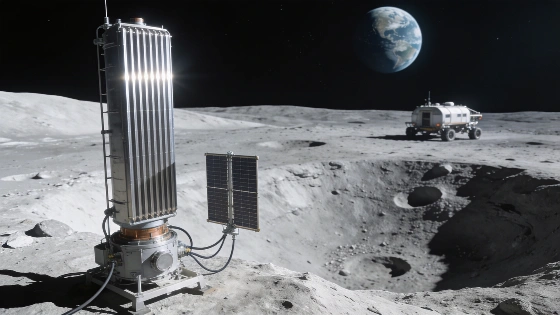
Lunar nights last about 14 Earth days, creating a long gap for solar power. NASA's proposed LR-1 would generate 20 kilowatts, while the agency seeks industry proposals for development and testing
For about 14 Earth days at a time, the lunar surface receives no sunlight. That is the gap NASA's proposed fission system is designed to cover.
Power Through Lunar Night
Lunar Reactor-1 (LR-1) is planned to generate 20 kilowatts of electricity, equivalent to the annual power use of approximately 16 average U.S. households on Earth. On the Moon, that supply could serve future habitats, communications systems, rovers, scientific instruments and other essential infrastructure.
Unlike solar power, a fission system can generate electricity continuously. NASA says the capability could support operations in places where sunlight is limited or unavailable, including areas affected by long lunar nights and permanently shadowed terrain.
Design and Procurement
NASA is seeking industry partners to develop and test LR-1, with a launch-ready system targeted for 2030. The agency plans to operate it on the Moon for at least five years after deployment.
The Space Power and Reactor Capabilities Request for Proposals reflects feedback on a draft released in August and an industry day held in September at the Ohio Aerospace Institute in Cleveland. The solicitation requires the reactor to meet Department of Energy (DOE) safety standards for nuclear operations. NASA and DOE have worked together on lunar fission-surface power since at least 2020, with DOE's Nuclear Energy office providing technical support.
The procurement follows an earlier design-study phase. In June 2022, NASA and Idaho National Laboratory selected three industrial teams for 12-month studies of a lunar system targeting about 40 kilowatts of electric power and at least 10 years of operation. The teams were Lockheed Martin with BWXT and Creare; Westinghouse Electric Company with Aerojet Rocketdyne; and Intuitive Machines with X-energy, Maxar and Boeing. DOE awarded the design contracts in September 2022, and the studies were completed, as summarized in NASA's fiscal-year 2025 report.
Those earlier studies targeted a different system from LR-1: 40 kilowatts and a 10-year operating life, compared with LR-1's planned 20 kilowatts and five years. The concept work also examined closed Brayton-cycle power conversion, which uses a gas-turbine cycle to convert reactor heat into electricity.
NASA may also issue additional task orders for other space nuclear power systems. Brian Giblin, NASA's Lunar Reactor-1 program manager, said reliable energy would be important for exploration on the Moon and Mars, where systems cannot depend on sunlight.
Two Reactor Programs
LR-1 is managed by NASA's Space Reactors Division in partnership with the Department of Energy. The division is also developing Space Reactor-1 (SR-1) Freedom, a separate project scheduled to launch in 2028. NASA's space-nuclear roadmap identifies SR-1 as a planned December 2028 mission and says it is intended to inform and enable LR-1. It is intended to deliver three SkyFall helicopters to Mars and demonstrate nuclear electric propulsion, which uses reactor-generated electricity to power spacecraft propulsion systems.
Nuclear electric propulsion and lunar surface power are distinct applications: SR-1 is designed to generate electricity for an electric propulsion system, while LR-1 would provide power to equipment on the lunar surface. NASA describes both within its broader space-nuclear development effort in its nuclear-power overview.
NASA says nuclear power could help address environments where solar energy is less effective: lunar nights last about 14 Earth days, dust storms on Mars can block sunlight for months, and solar power weakens farther from the Sun. The agency's South Pole outpost plan describes robotic scouting before longer astronaut stays. Proposals for LR-1 are due Dec. 21.







