NASA's Super Guppy cargo aircraft completed its first test flight in 1965, enabling the agency to move oversized rocket stages and spacecraft components across the United States for missions including Apollo and Artemis
On August 31, 1965, NASA's Super Guppy cargo aircraft completed its inaugural test flight, marking a turning point in the agency's ability to transport large and delicate space hardware. Developed by Aero Spacelines and based on the Boeing B-377 Stratocruiser, the Super Guppy was engineered to carry oversized payloads that could not be accommodated by conventional cargo planes or overland routes. Its distinctive, bulbous fuselage-resembling a flying whale-was designed to house rocket stages, spacecraft modules, and other critical components required for the United States' expanding space program.
Engineering for Oversized Payloads
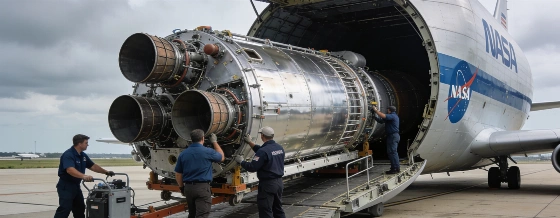
The Super Guppy's cargo bay measures approximately 7.6 meters in both height and width, with a length of 33.8 meters. This cavernous space allows the aircraft to transport payloads exceeding 26 metric tons. The entire nose section hinges open, enabling direct loading of large structures without disassembly. During the Apollo era, the Super Guppy was essential for moving Saturn rocket stages from manufacturing sites in California to launch facilities in Florida, reducing transit times and minimizing the risk of damage compared to sea or rail transport.
NASA's reliance on the Super Guppy continued well beyond Apollo. The aircraft has carried a diverse range of hardware, including T-38 supersonic jets, prototype X-38 crew return vehicles, and major elements of the Artemis program such as Orion spacecraft modules and Space Launch System components. The original Super Guppy was retired in 1991 and is now displayed at the Pima Air and Space Museum in Arizona, while a modernized version remains in active service, based at El Paso International Airport in Texas.
Operational Impact and Limitations
The Super Guppy's unique design addressed a persistent logistical challenge: how to move extremely large, fragile, or irregularly shaped spaceflight hardware across long distances. While barges and railways were sometimes used, these methods were slower and exposed sensitive equipment to additional handling risks. The aircraft's ability to fly directly between manufacturing and assembly sites streamlined mission preparation and reduced schedule uncertainty.
However, the Super Guppy's specialized airframe also introduced operational constraints. Its flight range and speed are limited compared to modern cargo jets, and its maintenance requires expertise with legacy systems. In 2026, the aircraft was scheduled to appear at the EAA AirVenture Oshkosh air show but sustained storm damage, leading to repairs and uncertainty about its participation in upcoming events, according to the Herald Times Reporter. NASA's plans for a major aerospace expo, Max Power, in November 2026, may depend on the aircraft's repair timeline.
Legacy in Space Logistics
The Super Guppy's role in space logistics is part of a broader history of adapting transportation technology to the needs of space exploration. Its continued use for Artemis program deliveries demonstrates that, despite advances in launch vehicle design and modular spacecraft, the challenge of moving large hardware remains. The aircraft's operational history also highlights the importance of reliable logistics in supporting ambitious mission timelines and safeguarding critical components.
NASA's experience with the Super Guppy echoes earlier milestones in spaceflight infrastructure, such as the Gemini 5 mission's demonstration of extended crew endurance, which provided essential evidence for future lunar missions. For more on the evolution of NASA's mission capabilities, see this overview of Gemini 5's record-setting flight.
The Super Guppy's continued relevance underscores the interplay between engineering innovation and practical constraints in space mission planning. As NASA and its partners prepare for new lunar and deep-space missions, the lessons learned from decades of hardware transport remain central to mission success.
Understanding the Super Guppy's significance requires some context on aerospace logistics. Moving large rocket stages or spacecraft modules involves more than just size; it demands careful control of vibration, temperature, and handling forces to prevent damage to sensitive systems. Aircraft like the Super Guppy are engineered with reinforced structures and specialized loading mechanisms to accommodate these requirements. The ability to transport hardware by air, rather than by sea or rail, reduces exposure to environmental hazards and allows for more flexible scheduling-factors that remain critical as mission architectures grow more complex.