NASA's Gemini 5 mission demonstrated that astronauts could survive eight days in orbit, providing crucial evidence for the feasibility of future lunar missions and marking a turning point in human spaceflight duration
In August 1965, NASA's Gemini 5 mission returned two astronauts safely to Earth after an eight-day flight, establishing a new benchmark for human space endurance. The mission, led by Gordon Cooper and Pete Conrad, was designed to test whether astronauts could withstand the physical and technical demands of a journey long enough to reach the Moon and return-a critical requirement for the upcoming Apollo program.
Mission Objectives and Launch
Gemini 5 launched on August 21, 1965, atop a Titan II rocket from Cape Canaveral, Florida. The primary goal was to demonstrate that a crewed spacecraft could remain operational and habitable for at least eight days, matching the duration needed for a round-trip lunar mission. The spacecraft carried Cooper as commander and Conrad as pilot, with backup crew members including Neil Armstrong and Elliott See. The mission also marked the first time a U.S. crew designed and wore a mission patch, featuring a Conestoga wagon and the phrase "8 Days Or Bust."
While in orbit, the crew was scheduled to perform a series of rendezvous maneuvers using a deployed pod, as well as several scientific and medical experiments. However, an electrical issue with the fuel cell oxygen tank forced the cancellation of the planned rendezvous demonstration and some experiments. To conserve power, Cooper and Conrad powered down non-essential systems, adapting their procedures to ensure the mission could continue for the full planned duration.
Technical Challenges and Adaptations
The Gemini 5 crew encountered several technical difficulties during their flight. The most significant was a drop in fuel cell oxygen tank pressure, which threatened the spacecraft's ability to generate electrical power. Mission Control decided to abort the rendezvous test to prioritize the mission's endurance objective. The astronauts also experienced thruster malfunctions on the fifth day, but managed to maintain attitude control using a "drift-and-correct" technique, allowing them to continue their scientific observations and medical studies.
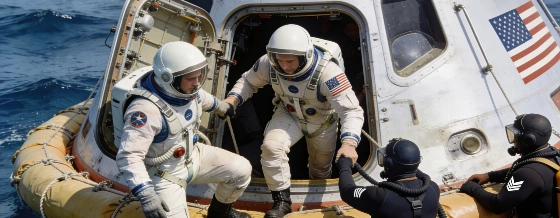
Despite the cramped conditions-later described by Conrad as "eight days in a garbage can"-the crew conducted Earth observation experiments, including visual acuity tests and photography of predetermined land areas. Both astronauts lost weight during the mission, but medical assessments after splashdown indicated they remained in good physical condition, supporting the feasibility of longer-duration flights.
Scientific Impact and Historical Context
Gemini 5's successful completion more than doubled the previous U.S. spaceflight duration record, which had stood at four days. The mission also surpassed the earlier endurance record set by Soviet cosmonaut Valery Bykovsky, who spent nearly five days in orbit aboard Vostok 5 in 1963. By demonstrating that astronauts could live and work in space for over a week, Gemini 5 provided essential physiological and operational data for planning future lunar missions.
At the time, human spaceflight was still in its early stages. The first crewed orbital flight, by Yuri Gagarin in 1961, lasted just 108 minutes. Gemini 5's endurance test was a pivotal step in validating life-support systems, power management, and crew health protocols for extended missions. The mission's lessons informed the design and operation of subsequent Gemini and Apollo flights, directly contributing to the success of lunar exploration.
Legacy and Ongoing Relevance
Although an eight-day mission may seem modest compared to later achievements-such as the 437-day single-flight record set by Valeri Polyakov on the Mir space station-Gemini 5's results were foundational for the Apollo program and the broader field of human spaceflight. The Gemini 5 capsule is now displayed at Space Center Houston, serving as a tangible reminder of the mission's role in advancing endurance and operational knowledge.
NASA's approach to technical assessment and mission adaptation continues to shape its work today. For example, the agency's recent evaluation of EarthDEM elevation data for scientific accuracy, as detailed in a technical review of geospatial models, reflects the same commitment to rigorous testing and operational reliability that defined the Gemini era.
Today, astronauts routinely spend months aboard the International Space Station, but the principles established by Gemini 5 remain central to mission planning, risk management, and the ongoing pursuit of longer and more complex crewed missions beyond low Earth orbit.
Understanding the significance of Gemini 5 requires some context on spacecraft life-support and mission duration. In the 1960s, the ability to sustain human life in orbit for more than a few days was unproven. Life-support systems had to provide oxygen, remove carbon dioxide, manage waste, and maintain temperature and humidity within safe limits. Power generation, primarily through fuel cells, was a limiting factor, as any failure could force an early return. The Gemini 5 mission demonstrated that with careful engineering and adaptive procedures, these challenges could be managed, paving the way for the Apollo lunar landings and the era of long-duration spaceflight.