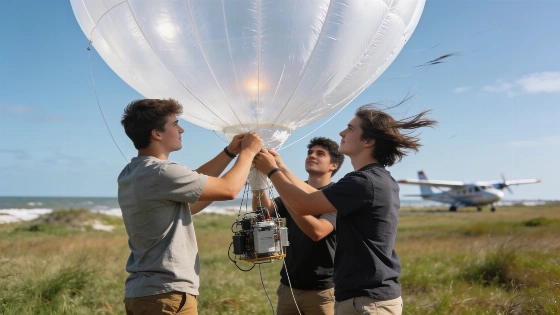
Undergraduates in NASA's Student Airborne Research Program deployed ozonesonde balloons and flew on science aircraft to collect atmospheric data over the Texas Gulf Coast, gaining hands-on experience with field instruments and satellite validation
NASA's Student Airborne Research Program (SARP) recently concluded its annual summer session with undergraduate participants conducting atmospheric fieldwork along the Texas Gulf Coast. The program, designed to immerse students in real-world Earth science, centered on the deployment of ozonesonde balloons and airborne instrument campaigns to measure ozone and related atmospheric properties.
Ozonesonde Balloon Launches
One of the core activities involved preparing and releasing ozonesonde-equipped weather balloons. These instruments, filled with helium and launched from the ground, ascend through the atmosphere while measuring ozone concentrations at various altitudes. Students were responsible for chemically preparing the sensor cells, managing balloon inflation, and monitoring the ascent and data transmission. The process required careful handling in challenging wind conditions and provided direct exposure to the technical demands of atmospheric measurement.
Each ozonesonde flight generated a vertical profile of ozone, contributing to a dataset that can be compared with satellite-based observations. The hands-on experience allowed students to understand the calibration, limitations, and real-time data challenges inherent in field-based atmospheric science. In total, a dozen of the 48 SARP undergraduates participated in these launches, working alongside instrument scientists and graduate mentors.
Airborne Science Operations
Beyond balloon launches, SARP students joined research flights aboard a fleet of science aircraft, including NASA's Gulfstream G-III, GV, and C-20A, as well as Dynamic Aviation's B200 and a NOAA P-III. These aircraft carried a suite of instruments, such as atmospheric lasers for particulate measurement, enabling students to observe the operation of advanced sensors in flight. The program's structure divided students into four disciplinary groups-atmospheric science, oceans, terrestrial ecology, and hydrology-each tasked with collecting field data and designing individual research projects.
After two weeks in Houston, the cohort split, with half traveling to California and half to Virginia for continued research. The airborne component provided a rare opportunity for undergraduates to participate in instrument deployment, data collection, and preliminary analysis, mirroring the workflow of professional field campaigns. Students also compared their in situ measurements with data from NASA satellite missions, reinforcing the importance of cross-validation in Earth observation.
Data, Methods, and Uncertainty
The ozonesonde balloons measured ozone concentrations as they ascended from the surface to the upper atmosphere, transmitting data in real time. Each instrument required chemical preparation and calibration before launch, and the resulting profiles were used to assess vertical ozone distribution. The science aircraft operated with a range of sensors, including lidar and in situ atmospheric samplers, collecting data on particulates, trace gases, and meteorological parameters. Students learned to interpret these measurements in the context of instrument sensitivity, calibration drift, and environmental variability.
While the SARP program emphasizes hands-on learning, the data collected also contribute to ongoing research on atmospheric composition and air quality. The experience highlighted the challenges of field measurement, including instrument handling, environmental interference, and the need for careful data validation. These lessons are consistent with the broader context of airborne and in situ research, as seen in other NASA campaigns and in efforts to validate satellite data, such as those described in recent studies of planetary atmospheres using in situ probes.
Training the Next Generation
The eight-week SARP program is structured to bridge classroom learning with practical field experience. Students participate in all aspects of a scientific campaign, from instrument preparation and data collection to analysis and presentation of findings. The program includes lectures, workshops, and direct mentorship from scientists and graduate students, aiming to prepare participants for future careers in field research and STEM disciplines. The collaborative environment fosters both technical skill development and an understanding of the interdisciplinary nature of Earth system science.
By engaging with real instruments and data, students gain insight into the complexities of atmospheric measurement and the importance of rigorous methodology. The program's emphasis on cross-validation with satellite missions underscores the need for multiple lines of evidence in environmental science. SARP's approach reflects a broader trend in training early-career researchers through immersive, instrument-driven fieldwork.
Ozonesonde balloons are specialized instruments used to measure ozone concentration as a function of altitude. Each balloon carries a sensor package that transmits data back to ground stations during its ascent, providing a vertical profile of ozone in the atmosphere. These profiles are essential for validating satellite-based ozone measurements and for understanding the distribution of ozone, which plays a critical role in atmospheric chemistry and climate. The calibration and handling of ozonesondes require careful attention to chemical preparation and environmental conditions, and the resulting data must be interpreted in the context of instrument limitations and atmospheric variability.