NASA's Juno spacecraft has measured temperatures beneath Io's surface, revealing intense internal heating and unexpectedly smooth, low-density terrain. The findings, published in a peer-reviewed journal, offer new insight into tidal heating on active moons
NASA's Juno spacecraft has delivered the first direct measurements of temperatures beneath the surface of Jupiter's moon Io, providing new evidence for intense internal heating on the most volcanically active world in the solar system. The results, published in the Journal of Geophysical Research: Planets, are based on data collected during two close flybys in late 2023 and early 2024, and offer a rare look at how tidal forces drive geological activity on distant moons.
Microwave Radiometry Reveals Subsurface Heat
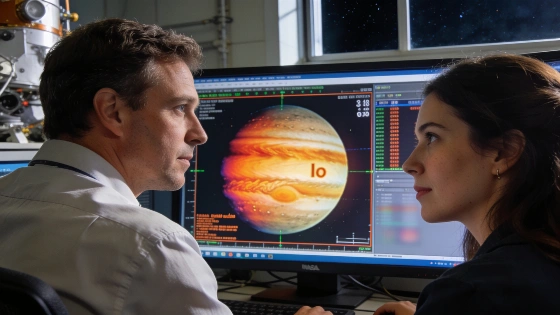
Io's extreme volcanism is powered by tidal heating, as Jupiter's gravity flexes the moon's interior during its orbit. Until now, most temperature measurements on Io have been limited to the surface, primarily through infrared observations. Juno's Microwave Radiometer (MWR) instrument, originally designed to study Jupiter's deep atmosphere, was repurposed during the mission's extended phase to probe the subsurface of Io. By detecting microwaves at six different wavelengths, the MWR can sense temperatures from just below the surface down to several meters in depth.
During flybys on December 30, 2023, and February 3, 2024, Juno passed within approximately 1,500 kilometers of Io's surface. The MWR detected a temperature increase of more than 22°C (40°F) within the first few meters below the surface-far steeper than can be explained by sunlight alone. This gradient suggests that heat is rising from Io's interior, consistent with models of tidal heating, but the precise mechanism remains under investigation.
Possible Sources of Io's Heat Flow
The observed subsurface temperature gradient could be explained by two main scenarios. One possibility is that heat is conducted steadily through Io's crust, resulting in a background heat flow of 1 to 3 watts per square meter-locally modest, but globally amounting to up to 30 times Earth's average geothermal output. Alternatively, the signal may originate from cooling lava flows, capped by 9 to 11 meters of solidified crust, which are estimated to cover about 10% of Io's surface at any given time.
These findings help clarify how energy generated by tidal forces is transported from Io's interior to its surface. The ability to measure heat flow beneath a rocky moon's surface with a microwave radiometer also has implications for studying volcanic processes on Earth and other planetary bodies. For comparison, NASA's ongoing efforts to investigate extreme environments on Earth, such as those described in recent airborne missions targeting wildfires and glacier retreat, demonstrate the value of remote sensing for understanding planetary processes.
Surface Structure and Terrain
In addition to thermal measurements, Juno's overlapping flybys allowed researchers to map how Io's surface reflects microwaves at different angles. The data indicate that, away from its prominent mountains, much of Io's surface is remarkably smooth, with broad plains extending for over 100 kilometers. The surface material appears to have a low density, more similar to volcanic ash or pumice than to solid rock, suggesting ongoing resurfacing by volcanic activity.
This smoothness contrasts with the moon's well-known high-relief features and supports the idea that Io's surface is continually renewed by eruptions and lava flows. The combination of low-density material and active volcanism makes Io a unique laboratory for studying planetary resurfacing and heat transport.
Mission Context and Scientific Implications
The Juno mission, managed by NASA's Jet Propulsion Laboratory and operating since 2016, is currently in its extended phase, with a focus on Jupiter's moons as well as the planet itself. The MWR instrument's ability to probe beneath the surfaces of Ganymede, Europa, and now Io, has expanded its scientific reach beyond its original atmospheric objectives. The new Io results provide a direct test of tidal heating models and offer a template for future missions targeting active or icy moons elsewhere in the solar system.
While the findings confirm that Io's interior is a powerful source of heat, the exact distribution and transport mechanisms remain uncertain. Further flybys and data analysis will be needed to distinguish between steady conductive heat flow and episodic volcanic resurfacing as the dominant process. The results also highlight the importance of multi-wavelength remote sensing for revealing planetary interiors.
Microwave radiometry is a remote sensing technique that measures natural microwave emissions from planetary surfaces and subsurfaces. Unlike infrared instruments, which are limited to the uppermost surface, microwave radiometers can penetrate several centimeters to meters below, depending on wavelength and material properties. By comparing signals at different wavelengths, scientists can reconstruct temperature gradients and infer physical characteristics such as density, composition, and layering. This approach is especially valuable for studying bodies where direct sampling is not possible, and it provides a complementary perspective to traditional imaging and spectroscopy.