NASA's Juno spacecraft, launched in 2011 on an Atlas V rocket, reached Jupiter in 2016 and has since delivered unprecedented data and images, reshaping our understanding of the giant planet's atmosphere, magnetic field, and moons
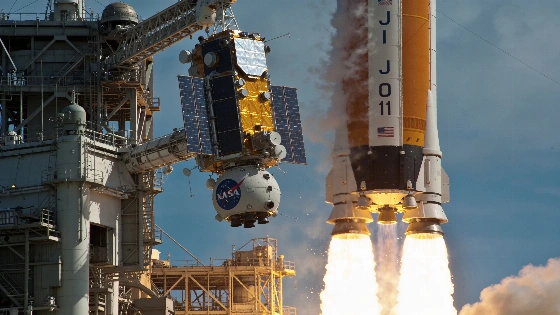
On August 5, 2011, NASA launched the Juno spacecraft aboard an Atlas V rocket from Cape Canaveral, Florida, beginning a mission that would fundamentally change how scientists study Jupiter. Juno's journey to the solar system's largest planet took nearly five years, culminating in orbital insertion in July 2016. Since then, the spacecraft has provided a wealth of data on Jupiter's structure, composition, and dynamic atmosphere, as well as new insights into its powerful magnetic field and complex system of moons.
Mission Design and Scientific Goals
Juno was the first dedicated Jupiter orbiter since the Galileo mission, which ended in 2003. Unlike its predecessors, Juno relies on three large solar arrays-each about 9 meters long-to generate power, making it the first solar-powered spacecraft to operate at Jupiter's distance from the Sun. The mission's primary scientific objectives include mapping Jupiter's gravitational and magnetic fields, probing its deep atmospheric structure, and investigating the planet's polar auroras using a suite of instruments sensitive to microwave, infrared, ultraviolet, and charged particle emissions.
Juno's polar orbit allows it to avoid the most intense regions of Jupiter's radiation belts, enabling repeated close passes over the planet's cloud tops. These flybys have produced high-resolution images and spectra, revealing atmospheric features and weather systems in unprecedented detail. The spacecraft's JunoCam, while technically an outreach instrument, has also contributed to scientific analysis by capturing visible-light images of Jupiter's poles and equatorial regions.
Key Measurements and Extended Mission
During its primary mission, Juno completed 37 orbits around Jupiter, collecting data on the planet's gravity, magnetic field, and atmospheric composition. The mission revealed that Jupiter's atmospheric bands extend much deeper than previously thought, and that its magnetic field is both stronger and more irregular than models had predicted. Juno's microwave radiometer detected ammonia and water at varying depths, challenging earlier assumptions about the planet's internal structure.
After the initial 20-month primary mission, NASA approved multiple extensions, allowing Juno to conduct targeted flybys of Jupiter's largest moons-Ganymede, Europa, and Io. These close encounters have provided new constraints on the moons' surface properties and internal activity, supporting planning for future missions such as the European Space Agency's Jupiter Icy Moons Explorer (JUICE) and NASA's Europa Clipper. The extended mission has also enabled Juno to observe changes in Jupiter's atmosphere over time, including evolving storms and auroral activity.
Technical Challenges and Historical Context
Juno's design addressed several technical challenges unique to Jupiter exploration. The spacecraft's solar panels had to be large enough to generate sufficient power in the weak sunlight at Jupiter's orbit, while its electronics were shielded to withstand the planet's intense radiation environment. Communication with Earth is limited by the vast distance-over 700 million kilometers at closest approach-requiring careful planning for data transmission and spacecraft operations.
Juno's arrival marked the first time since Galileo that a spacecraft entered orbit around Jupiter. Galileo's high-gain antenna failed to deploy fully, restricting the volume of data returned and limiting the mission's ability to image Jupiter's atmosphere in detail. In contrast, Juno's instruments have delivered both detailed measurements and striking images, including the first time-lapse video sequences of Jupiter's cloud dynamics. For context on how launch vehicles and mission design affect deep space exploration, see this analysis of how a Falcon 9 upper stage ended up on a lunar trajectory: the story of a Falcon 9 upper stage's unexpected journey.
Scientific Impact and Future Missions
Juno's findings have reshaped models of Jupiter's interior, atmospheric circulation, and magnetic environment. The mission's data have informed the selection of science targets for upcoming missions, including JUICE and Europa Clipper, which will build on Juno's discoveries to investigate the habitability of Jupiter's moons. Juno's ongoing observations continue to refine our understanding of giant planet formation and evolution, with implications for exoplanet studies and comparative planetology across the solar system.
While Juno's instruments have revealed much about Jupiter, significant questions remain about the planet's core, the origin of its magnetic field, and the processes driving its atmospheric dynamics. The mission's extended operations are expected to provide further data, but the ultimate resolution of these questions will depend on future missions and continued analysis of Juno's rich dataset.
Orbital insertion is a critical milestone for planetary missions, marking the transition from cruise to science operations. For Juno, this involved a precisely timed engine burn to slow the spacecraft and allow Jupiter's gravity to capture it into a polar orbit. Achieving and maintaining this orbit required careful navigation and robust engineering to withstand Jupiter's radiation and gravitational forces. The success of orbital insertion determines whether a spacecraft can fulfill its scientific objectives, making it one of the most technically demanding phases of any planetary mission.