

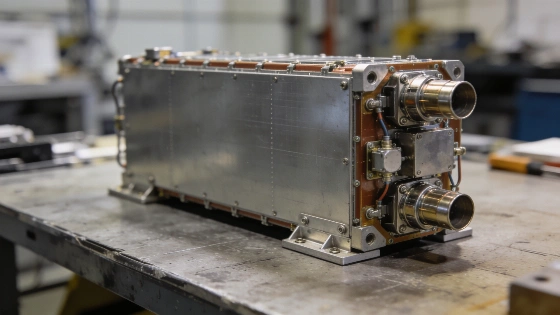
NASA and its partners have agreed to contract actions for the fission power module planned for SR-1 Freedom, aiming to reduce technical risk as the Mars mission targets a 2028 launch
SkyFall is the science payload planned for a spacecraft that would test fission power beyond Earth's orbit. NASA says contract actions agreed with its partners will advance the power module for Space Reactor-1 (SR-1) Freedom, a mission designed to travel to Mars using nuclear electric propulsion. The planned payload is a capsule carrying three autonomous helicopters for aerial exploration of the Martian surface.
Power for the mission
SR-1 Freedom is planned as the first spacecraft to demonstrate fission power beyond Earth's orbit. NASA announced the mission during its "Ignition" event. The current update concerns development of a central mission element: the nuclear power module. The spacecraft has not yet made that demonstration; it remains a planned mission, with launch targeted for 2028.
Fission releases energy when atomic nuclei split. In nuclear electric propulsion, electricity from a nuclear power source would support an electric propulsion system. Unlike a nuclear thermal engine, which heats and expels propellant directly, this approach uses the reactor to generate electricity for the spacecraft's engines. Nuclear Engineering International has reported a planned system output of about 20 kilowatts electric (20 kWe) for SR-1; that figure is a projected design parameter.
The mission is part of broader NASA and U.S. Department of Energy work on space nuclear power and propulsion, including reactor and fuel development. On October 14, 2026, the agencies announced a partnership under the name "Accelerating American Leadership in Space Nuclear Power and Propulsion." The partnership also includes Lunar Reactor-1, a planned lunar surface power system targeted for 2030.
Contract actions agreed
NASA and its partners have mutually agreed to contract actions intended to advance the module and reduce technical risk. NASA program director Steve Sinacore said the actions are meant to maintain momentum toward launch and strengthen collaboration among the partners. The update focuses on continued development of the power module.
SkyFall is planned as a trio of helicopters that SR-1 would deliver to Mars. The aircraft are intended to extend exploration beyond the reach of surface rovers; reported mission concepts include onboard science instruments and ground-penetrating radar to investigate subsurface layers and buried ice. These are planned capabilities for the payload, not results from a Mars mission.
The schedule remains a target, not a confirmed launch date. The mission is intended to launch in 2028 and travel to Mars with SkyFall. NASA has also described a solar-array upgrade for the International Space Station in its station power coverage; SR-1 Freedom is a separate Mars mission centered on fission power.
The agreed actions are intended to move module development forward and reduce technical risk as NASA works toward the planned launch. The effort sits within a wider program to develop space reactors, fuels, manufacturing capabilities and propulsion systems for future missions.
A planned demonstration
The mission's central test is still ahead. If SR-1 Freedom flies as planned, it is intended to demonstrate fission power beyond Earth's orbit on a Mars-bound spacecraft. Nuclear electric propulsion uses electricity to operate electric engines rather than relying on a reactor to heat and expel propellant directly.
Nuclear Engineering International has described SR-1 as a planned nuclear-electric-propulsion mission with an approximately 20 kWe system. NASA's announced contract actions concern advancing the power module; the 2028 launch target remains a plan as the mission continues in development.
NASA's October 2026 partnership with the Department of Energy also identifies a 2030 target for Lunar Reactor-1. Together, the lunar and Mars projects form part of the agencies' work on space nuclear power and propulsion, while SR-1 is designed to carry the technology demonstration toward Mars.







