

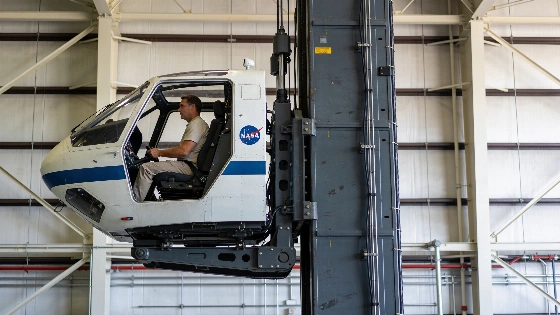
NASA's Ames Research Center will host media on Oct. 29 and 30 for a look at its lunar landing simulation, including a Vertical Motion Simulator ride-along. RSVP by Oct. 27 at 5 p.m. PT
NASA's Johnson Space Center developed the lunar-landing simulation now integrated into the recently upgraded flight deck at Ames Research Center in California's Silicon Valley. It will be used to give astronauts and engineering support teams simulated experience as they prepare for future crewed lunar missions.
Training before landing
NASA is combining agency-operated and partner motion-based simulators to prepare crews and support teams for future missions using commercial human landing systems. At Ames, the simulation runs in the Vertical Motion Simulator (VMS), a large facility designed to reproduce aircraft and spacecraft flight dynamics. The lunar-landing simulation was developed at Johnson Space Center in Houston and transferred to Ames for training.
The simulator is a place to rehearse mission operations and human-machine procedures, not a flight test of a commercial lander. NASA's broader plan involves SpaceX's Starship Human Landing System and Blue Origin's Blue Moon Mark 2, which have different mission designs and operating concepts.
NASA's revised Artemis architecture targets the first planned crewed lunar landing for Artemis IV in 2028. Artemis III is planned as a 2027, 14-day low-Earth-orbit demonstration mission, where crews and flight controllers are expected to practice rendezvous, docking, habitation and operational procedures with test versions of the commercial landers. NASA has named astronauts Randy Bresnik, Frank Rubio and Andre Douglas, along with European Space Agency astronaut Luca Parmitano, for the planned mission.
The revised sequence calls for SpaceX and Blue Origin each to conduct an uncrewed lunar demonstration before their landers carry astronauts on near-term Artemis missions. NASA has also set partner-specific rendezvous orbits to reflect the different lander designs. Blue Origin's accelerated Blue Moon Mark 2 Alpha concept is planned to use three transfer stages to send the lander toward the Moon, deferring propellant transfer; SpaceX's Starship architecture includes in-space propellant transfer.
NASA's wider mission planning has also covered destinations across the solar system in an earlier mission outlook. The Ames exercise addresses another part of exploration: preparing for crew operations associated with lunar landings.
Media visits at Ames
Media can visit on Thursday, Oct. 29, or Friday, Oct. 30. The tour includes an chance to ride the Vertical Motion Simulator and interview subject matter experts. Space is limited, and advance registration is required for consideration.
Journalists interested in attending must RSVP to the NASA Ames newsroom by Tuesday, Oct. 27, at 5:00 pm PT, specifying a preference for Oct. 29 or Oct. 30. The advisory also directs media to NASA's online accreditation policy.
What the simulation shows
The motion-based simulator lets astronauts and engineering support teams experience selected mission conditions in a controlled training setting. Its role is to support rehearsal, crew coordination and procedure development before astronauts pilot commercial human landing systems from lunar orbit to the surface. It does not establish the flight performance or readiness of either lander.
NASA's Aerospace Safety Advisory Panel has raised concerns about the compressed schedule and the landers' landing and return capabilities, including Starship's unproven in-space refueling requirements, as reported by the Space Foundation. NASA's staged plan includes the Artemis III low-Earth-orbit demonstrations and uncrewed lunar tests before crewed landings.
The Ames tour offers media a chance to see the simulator and speak with experts as NASA prepares for its planned lunar-landing campaign. The 2028 Artemis IV landing remains a program target, with the Artemis III demonstrations intended to help inform NASA's assessment of the commercial landers.







