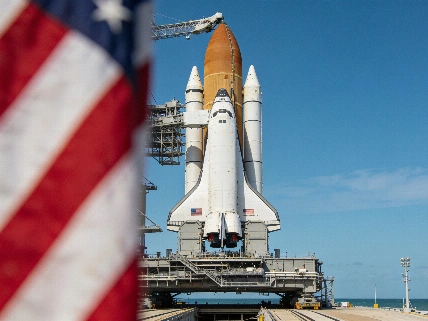
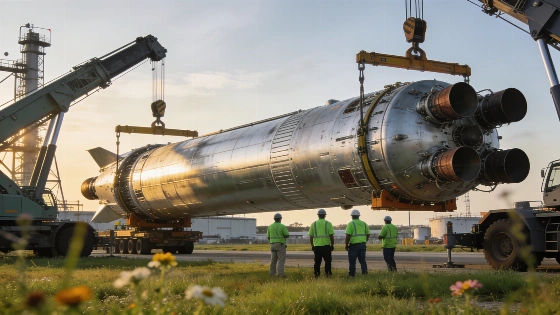
A 130-foot liquid hydrogen tank for Artemis IV was transported at NASA's Michoud Assembly Facility, marking a key step toward core stage testing for the Space Launch System rocket
NASA engineers have transported the Artemis IV liquid hydrogen tank from its production cell to a dedicated test building at the Michoud Assembly Facility in New Orleans. This move marks a significant milestone in the assembly and verification process for the core stage of the Space Launch System (SLS), the heavy-lift rocket designed to support future crewed missions to the Moon under the Artemis Program.
Tank Transfer and Mission Context
The liquid hydrogen tank, standing approximately 40 meters (130 feet) tall, is a central component of the SLS core stage. On May 15, 2026, teams at Michoud carefully moved the completed tank from the main factory building to a separate test facility on the 829-acre site. This transfer is a standard part of the SLS manufacturing workflow, enabling engineers to conduct structural and functional tests before integration with other core stage elements.
The Artemis IV mission is planned as a major step in NASA's ongoing lunar exploration efforts. The SLS core stage, powered by four RS-25 engines, relies on the liquid hydrogen tank to store and deliver thousands of gallons of super-cooled propellant. The tank's performance is critical for the rocket's ability to generate the thrust required to escape Earth's gravity and deliver crew and cargo to lunar orbit.
Testing Procedures and Engineering Challenges
Once inside the test building, the tank will undergo a series of rigorous assessments. These include pressure tests, structural integrity checks, and evaluations of weld quality and insulation performance. Engineers will simulate launch conditions to verify that the tank can withstand the mechanical and thermal stresses expected during flight. Any anomalies detected during testing can be addressed before the tank is integrated into the full core stage assembly.
The scale and complexity of the SLS hydrogen tank present unique engineering challenges. The tank must maintain the integrity of its cryogenic environment, keeping liquid hydrogen at temperatures below 20 kelvins (-253°C), while also withstanding dynamic loads during launch. Manufacturing tolerances are tight, and even minor defects can compromise mission safety or performance.
Role in Artemis IV and Broader Program
The Artemis IV mission is scheduled to build on the achievements of earlier Artemis flights, aiming to deliver additional crew and hardware to the lunar surface and support the construction of the Lunar Gateway. The SLS core stage, with its hydrogen tank, is central to these objectives. Each successful test and integration milestone reduces risk for the mission and contributes to the overall reliability of NASA's lunar exploration architecture.
While the tank's transfer and upcoming tests are routine steps in the SLS production cycle, they are essential for validating the hardware that will power future deep space missions. The Artemis Program's reliance on proven, thoroughly tested components reflects the high safety and performance standards required for human spaceflight beyond low Earth orbit.
Large rocket stages such as the SLS core rely on cryogenic propellant tanks to store and deliver fuel at extremely low temperatures. Liquid hydrogen tanks are particularly challenging to design and manufacture due to hydrogen's low density, high diffusivity, and the need for robust insulation. Testing these tanks involves pressurizing them with inert gases or cryogenic fluids, monitoring for leaks, and assessing structural behavior under simulated launch loads. These procedures are critical for ensuring that the tanks can safely contain propellant and function as intended during the intense conditions of launch and ascent.