NASA has formally invited India to participate in developing a permanent lunar base near the Moon's south pole, marking a significant step in US-India deep-space cooperation and expanding the Artemis program's international partnerships
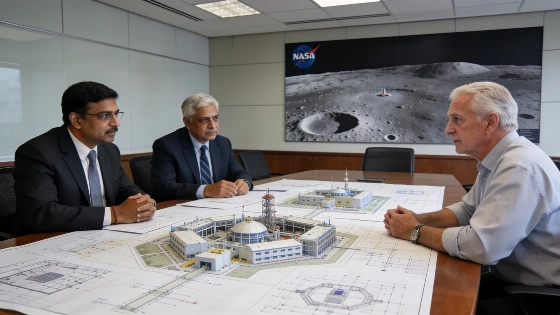
NASA has extended a formal invitation to the Indian Space Research Organisation (ISRO) to participate in the development of a permanent base near the Moon's south pole. The proposal, delivered during the ninth meeting of the U.S.-India Civil Space Joint Working Group in Bengaluru, signals a deepening of technical collaboration between the two countries as both pursue ambitious lunar exploration goals. The meeting brought together senior officials from NASA, the U.S. Department of State, and ISRO, but specific details of India's potential role in the lunar base architecture remain under discussion.
Expanding Artemis Partnerships
The invitation builds on India's 2023 decision to sign the Artemis Accords, a U.S.-led framework outlining principles for responsible lunar and deep-space exploration. With India now among 70 signatory nations, the Artemis program aims to establish a sustained human presence on the Moon, focusing on the south polar region where permanently shadowed craters may contain significant water ice. The U.S. Embassy in India confirmed that both sides agreed to advance discussions on open scientific data sharing under the Accords, but did not specify timelines or mission assignments for ISRO's involvement.
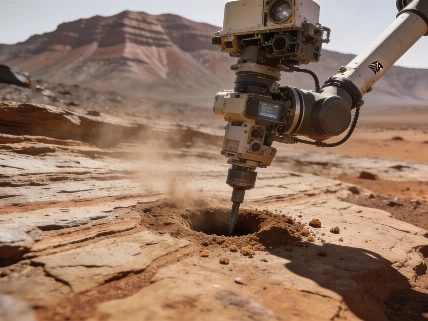
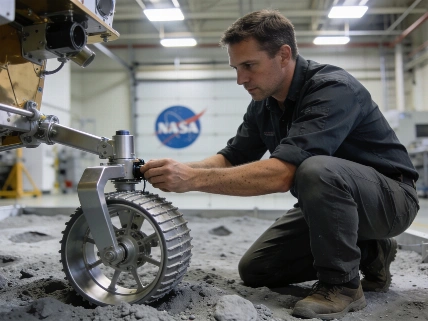
NASA's current lunar strategy centers on a phased approach. The first phase, beginning in 2028, will deploy small robotic scouts to map and characterize the south polar terrain and resources. Subsequent phases, projected for 2029-2032 and beyond, aim to establish initial operating capability and then a semi-permanent crewed outpost. The planned base will likely feature hilltop habitats to maximize sunlight exposure, with nuclear power systems positioned at a distance to reduce radiation risk. These plans are designed to support sustained operations and to keep pace with China's parallel lunar ambitions.
Technical and Policy Considerations
While the invitation marks a diplomatic milestone, the technical and operational details of India's participation remain undefined. ISRO's current lunar roadmap includes plans for its own Moon base, a lunar orbital station, and eventual crewed landings in the 2040s. The agency's experience with the Chandrayaan Program and its growing human spaceflight capabilities could contribute to surface operations, robotics, or infrastructure, but no formal agreements on division of labor or technology transfer have been announced.
NASA, for its part, has recently paused development of the Gateway lunar space station to prioritize surface infrastructure and increase launch cadence. This shift reflects a strategic emphasis on direct lunar surface capability, resource utilization, and international collaboration. The U.S.-India working group, established in 2005, has previously focused on satellite missions and Earth observation, but the current invitation represents a significant expansion into human and robotic lunar exploration.
Scientific Stakes and International Context
The Moon's south pole is of particular scientific interest due to its unique illumination conditions and the presence of permanently shadowed regions that may harbor water ice. Access to these resources could be critical for supporting long-term human activity and for producing fuel for deeper space missions. The planned lunar base architecture, as outlined by NASA in May, envisions a modular approach with phased construction and international contributions. However, the complexity of integrating multiple national space programs, technologies, and operational standards presents significant engineering and policy challenges.
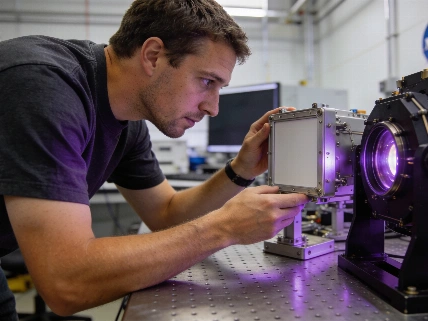
International collaboration on lunar science and infrastructure is not new, but the scale and ambition of the Artemis program set it apart. Recent developments, such as the deployment of new seismic instruments for lunar surface monitoring, highlight the growing sophistication of lunar science. For example, NASA's preparation of the Lunar Environment Monitoring Station (LEMS) for Artemis astronauts, as described in a recent Science Report article, illustrates the type of specialized instrumentation that may become standard for future multinational lunar bases.
As the U.S. and India negotiate the terms of their lunar partnership, the outcome will likely influence the broader landscape of international space cooperation, technology sharing, and scientific access to the Moon's most promising regions.
Establishing a permanent base on the Moon's south pole involves a complex interplay of engineering, science, and policy. The region's permanently shadowed craters are believed to contain water ice, which could be extracted for life support and fuel. However, accessing and processing these resources requires advanced robotics, reliable power systems, and robust environmental monitoring. The Artemis Accords provide a diplomatic framework for cooperation, but translating these principles into operational agreements and shared infrastructure will require detailed technical planning and sustained political commitment from all partners.