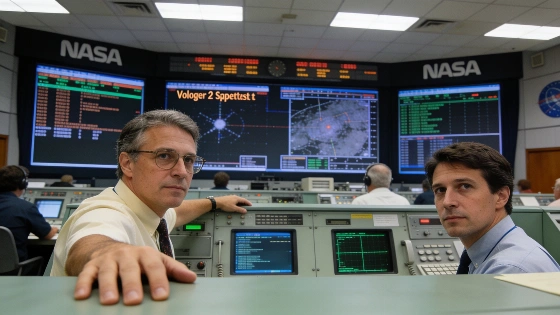
NASA engineers have implemented a new power management strategy on Voyager 2, allowing the spacecraft to continue collecting scientific data for at least another year as its nuclear power source declines
NASA has confirmed that Voyager 2, one of the two longest-operating spacecraft in history, will continue its scientific mission for at least another year thanks to a newly tested power-saving procedure. The maneuver, developed to address the declining output of the probe's nuclear power source, has allowed engineers to keep all three of Voyager 2's remaining science instruments active without sacrificing essential spacecraft functions.
Managing Power at the Edge of the Solar System
Both Voyager 2 and its twin, Voyager 1, rely on radioisotope thermoelectric generators (RTGs) fueled by plutonium-238, which naturally decays and produces less power each year. After nearly five decades in space, each spacecraft now loses about 4 watts of power annually. Without intervention, Voyager 2 would have been forced to shut down one of its three remaining science instruments later this year, reducing its ability to collect data from the interstellar environment.
The new approach, informally called the "Big Bang" maneuver, involves shutting off a group of higher-power systems simultaneously and activating lower-power alternatives. This strategy is designed to maintain the spacecraft's internal temperature above critical thresholds while freeing up enough energy to keep scientific instruments running. NASA engineers tested the procedure on Voyager 2 between May and June 2026, carefully monitoring the spacecraft's health and data return.
Results and Risks of the Big Bang Maneuver
According to NASA's Jet Propulsion Laboratory, the power reallocation was successful, and Voyager 2's three science instruments are expected to remain operational for at least another year. The maneuver carries some risk, as reducing internal heat could expose sensitive electronics to the extreme cold of interstellar space. However, initial results indicate that the spacecraft remains stable and continues to transmit valuable data on cosmic rays, magnetic fields, and plasma conditions beyond the heliopause-the boundary marking the Sun's influence.
Voyager 1, which is farther from Earth and in slightly worse condition, is scheduled to undergo a similar power-saving maneuver within the next few months. Earlier this year, mission controllers were forced to shut down one of Voyager 1's last two science instruments after an unexpected power drop. The team hopes that the Big Bang approach will allow Voyager 1 to continue returning scientific data for as long as possible, despite its more limited power reserves.
Distance, Communication, and Mission Milestones
Voyager 2 is currently about 143 astronomical units (AU) from Earth, while Voyager 1 is nearly 171 AU away-where 1 AU is the average distance between Earth and the Sun. In November 2026, Voyager 1 will reach a milestone "light day" from Earth, meaning it will take 24 hours for a radio signal to travel one way between the spacecraft and mission control. Both probes are the only operational spacecraft in interstellar space, providing unique measurements of the environment beyond the heliopause.
Launched in 1977, Voyager 2 completed flybys of Jupiter, Saturn, Uranus, and Neptune, taking advantage of a rare planetary alignment that occurs only once every 176 years. Voyager 1, after its Saturn encounter, was directed above the plane of the solar system. Over time, as power supplies dwindled, engineers have had to shut down non-essential systems and instruments to extend the missions. The latest maneuver represents a further step in prioritizing science as the probes approach their 50th anniversary in 2027.
Scientific Legacy and Ongoing Challenges
The Voyager missions have fundamentally changed our understanding of the outer solar system and the interstellar medium. Their instruments have measured the properties of charged particles, magnetic fields, and plasma waves in regions never before explored. As the probes age, the challenge of managing limited power and maintaining communication grows. Each year, the RTGs produce less energy, and the risk of instrument failure increases.
Despite these constraints, the mission teams continue to find ways to maximize scientific return. The recent power-saving maneuver on Voyager 2 demonstrates the value of careful engineering and adaptive mission management. Similar ingenuity has been seen in other NASA missions, such as Juno's extended operations at Jupiter, which have also required creative solutions to power and data limitations. For more on how NASA has adapted spacecraft operations to extend science returns, see this overview of Juno's impact on Jupiter research.
As Voyager 1 prepares for its own Big Bang maneuver, the scientific community awaits further updates on whether both spacecraft can continue to operate in the harsh environment of interstellar space. The outcome will determine how much longer humanity's most distant emissaries can send back data from beyond the solar system's edge.
Spacecraft operating far from the Sun face unique engineering challenges, especially in power management. Radioisotope thermoelectric generators (RTGs) convert heat from the decay of plutonium-238 into electricity, but their output declines steadily over time. As power drops, mission teams must decide which systems to prioritize, often shutting down heaters, backup electronics, or even science instruments to keep the most critical functions alive. These decisions require careful modeling of spacecraft thermal balance and risk assessment, as turning off heaters can expose electronics to damaging cold. The Voyager missions exemplify how adaptive engineering can extend the life of scientific spacecraft well beyond their original design limits.